

Marina fish: local richness and regional diversity
An environmental DNA survey along the French Mediterranean coast found species-rich marinas whose fish communities were more similar to one another. A species count from a single basin can therefore miss a wider reorganization of biodiversity.


- Content type
- Scientific news
- Sector
- Environment
- Animal group
- Fish
- Keywords
- Environmental DNAPCRSalinity
A species list can grow while biological communities become more alike. Research published in June 2026 describes this contrast among fish along the French Mediterranean coast. For environmental managers, the question extends beyond the number detected beside one quay: which communities are being maintained across the coastline, and how can they be compared without confusing presence, abundance and health?
A coastal survey from summer 2023
Macé and colleagues used environmental DNA as part of the BioDivMed project. Their analysis covered 111 shallow coastal sites on the mainland and Corsica, including 20 recreational marinas. Each site was sampled twice, giving 222 water samples collected during summer 2023. This was a spatial survey, rather than a new sampling campaign undertaken in October 2026.
Genetic fragments were amplified by PCR and compared with a reference database. Sequences were grouped into molecular operational taxonomic units, or MOTUs, used as proxies for species. That distinction matters because an individual unit is not always an unambiguously identified species. The institutional press release’s description of 160 species simplifies the scientific paper’s MOTU-based result.
The researchers compared local richness with differences in community composition between sites. Marinas had higher local richness but hosted assemblages more similar to one another at taxonomic and phylogenetic levels. The finding cannot therefore be reduced to a ranking of marinas by species count.
Local richness and differences between sites answer different questions
Biodiversity can be described at several scales. Local richness counts the taxa at one site, whereas diversity between sites describes how much their assemblages differ. A series of basins containing many taxa, but almost always the same ones, can contribute less to regional variety than a mosaic of distinct communities.
That distinction is useful when assessing a development project. More detections within one marina do not establish that the coastline as a whole has gained diversity. Species identities, distributions and comparison sites need to remain part of the assessment. Otherwise, a favourable local indicator can conceal a loss of ecological distinctiveness.
Phylogeny provides another perspective by considering evolutionary relationships. It should not be treated as equivalent to the range of ecological functions. In this study, evidence of taxonomic and phylogenetic homogenization was clearer than evidence of functional homogenization. Reporting all three dimensions as interchangeable would remove an important qualification.
For monitoring reports, these distinctions can be made explicit in the questions asked. Are more taxa detected at the intervention site? Do sites retain different assemblages? Are particular groups absent from the comparison? Each question requires information that a single total cannot provide.
Native species can drive community convergence
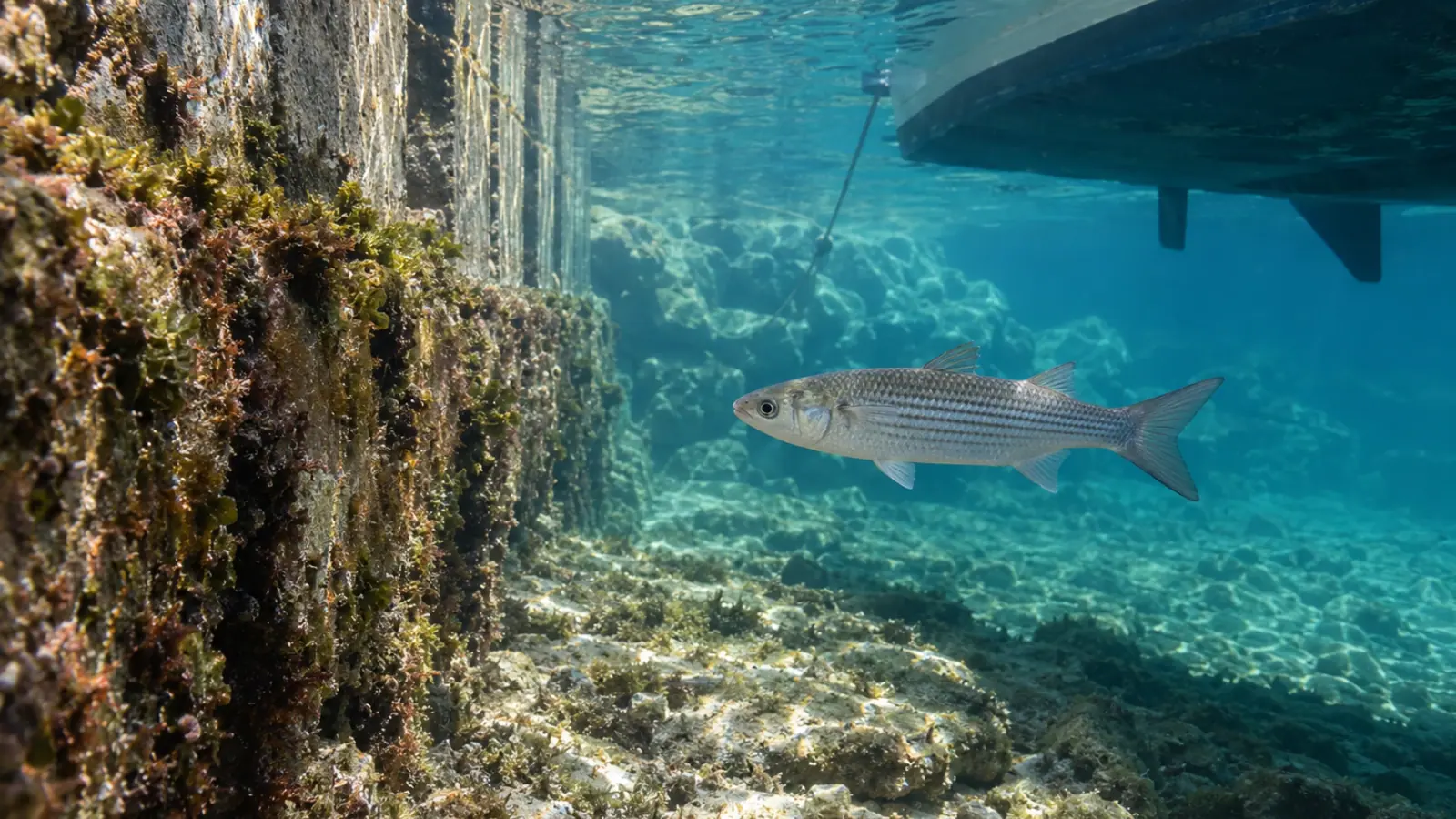
The EPHE, University of Montpellier and CNRS communication highlights native fish associated with port environments, including seabreams, gobies and mullets. Communities can become more alike through changes in species already present in the region. A biological invasion is not necessary for this pattern to emerge.
No non-indigenous fish species was identified in the analysis, although some molecular units remained unassigned. That result establishes neither absolute absence nor lasting resistance to future introductions. Monitoring records should retain uncertain taxa and the limits of their identification rather than removing them from the interpretation.
The label marina also cannot replace a description of habitat. Depth, substrate, circulation and connections with lagoons or freshwater can help organise comparisons. Salinity is particularly useful to record where brackish water influences a basin. These descriptors provide context without automatically attributing any detection to a single factor.
Keep community composition in the monitoring brief
An assessment programme can specify reference sites, seasons, sampling effort and identification methods before an intervention begins. Detailed detections need to be retained alongside the total count. This allows the team to examine whether the same taxa recur everywhere or distinct assemblages persist.
A local design might pair stations inside the marina with suitable coastal comparison sites, then repeat observations. This is a proposal for monitoring design, not a guarantee that every intervention effect will be detected. Repetition cannot correct an unsuitable reference, an undocumented method change or inadequate seasonal coverage.
Reporting should distinguish confident identifications, uncertain assignments and non-detections. Weather and technical events that could affect collection can also be retained. Comparisons are easier to evaluate when filtering decisions and protocol changes remain traceable, particularly if different contractors or laboratories contribute over time.
Managers should agree which outcomes would support a decision before examining the final results. An attractive increase in one indicator should not lead to abandoning the other planned comparisons. Equally, an uncertain result should remain uncertain rather than being turned into a claim that an intervention succeeded or failed.
Environmental DNA does not establish fish health
Presence–absence data cannot count fish or directly estimate their biomass. They do not describe body condition, lesions, age or reproductive success. Detecting a taxon in water therefore does not demonstrate that a healthy, self-sustaining population uses a marina as a nursery.
The study compared sites at one period; it did not directly measure a historical decline within every marina. Urban pressure was associated with community composition, but an observational design cannot experimentally isolate all possible causes. An announced restoration still requires evaluation: completing works does not itself demonstrate a biological benefit.
Questions about fish health or recruitment require appropriate complementary observations. Those observations should be designed around the specific question, rather than inferred from sequence counts. A health alert needs its own clinical and environmental evidence; this publication does not document a local fish mortality event.
Assess distinctiveness alongside the species total
The practical lesson is to retain several scales of interpretation: local richness, assemblage composition and differences between sites. A marina with many detections is not sufficient evidence that the surrounding coastline is in better condition. This broader view helps managers decide what a project must monitor before assessing its benefit.
Vetofish can contribute to indicator selection, interpretation of observations and coordination between ecological and health monitoring through its consultancy and assessment service, supporting aquatic environmental management.


