

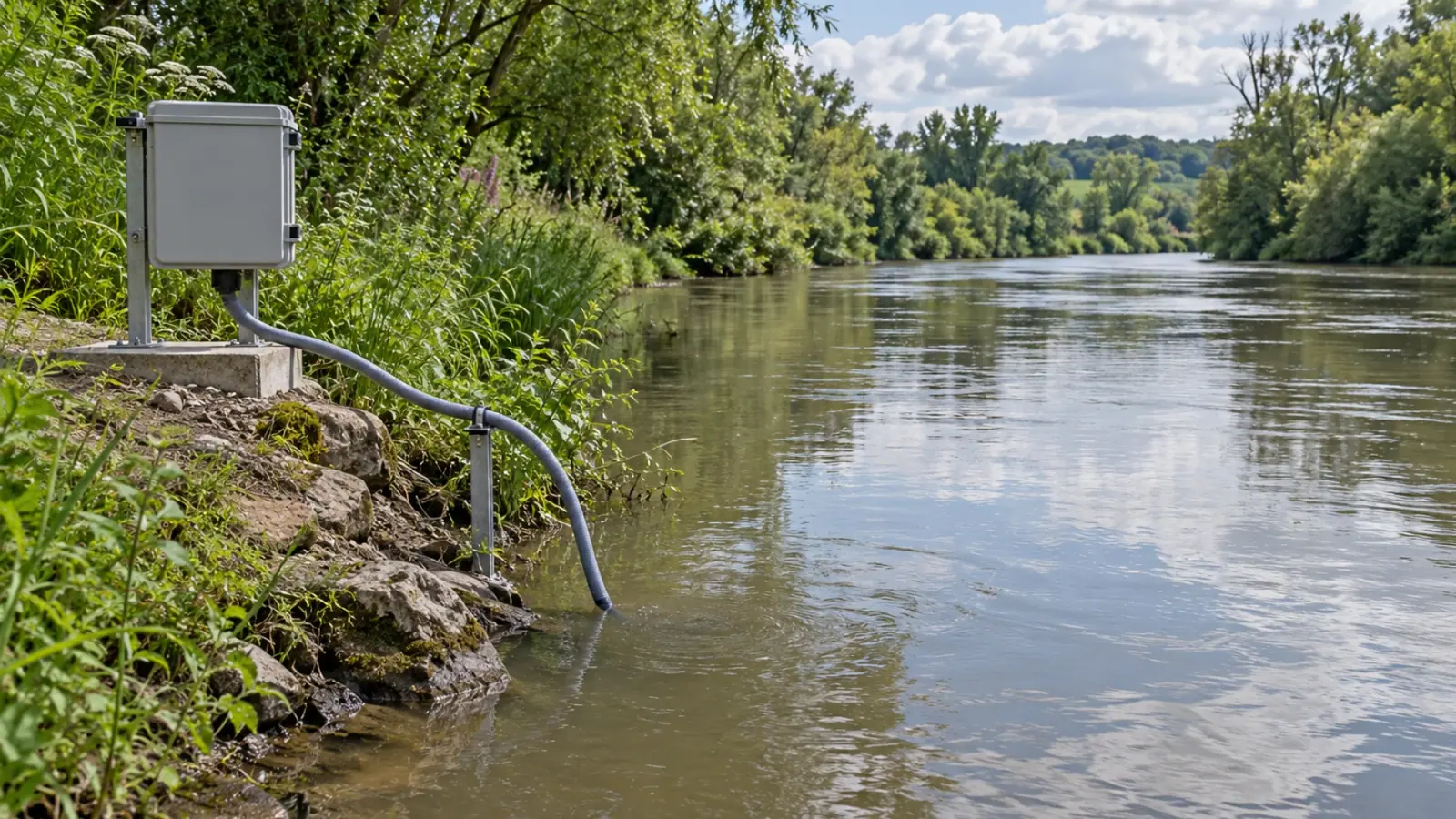
Autonomous eDNA: sampling is not real-time analysis
Autonomous samplers can cover periods difficult to reach during field visits. Yamahara’s 2025 review highlights the collection, preservation and quality-control decisions separating a programmed series from interpretable biological information.


- Content type
- Practical guide
- Sector
- Environment
- Animal group
- Fish
- Keywords
- Environmental DNAPCRTemperature
An instrument can collect water at programmed intervals without identifying fish at the same rate. Automating environmental DNA sampling can improve temporal coverage, but collection, preservation and analysis remain separate functions. For river monitoring, the useful decision begins with the information required, its timing and the checks needed to interpret it.
Yamahara and colleagues’ 2025 review in Environmental DNA describes autonomous aquatic sampling and preservation technologies. It combines published literature with an international workshop and expert consultations. It is not a single experiment comparing every instrument under identical river conditions, and its catalogue of capabilities should not be treated as one.
Automated collection is not necessarily real-time detection
Environmental DNA is recovered directly from a sample of the environment without first isolating each source organism. Water can contain cells, fragments and extracellular genetic material. The signal depends on release, transport and degradation, among other processes. Detecting it does not automatically locate a living fish at the exact sampling point.
The review distinguishes instruments that collect and preserve samples from developments incorporating on-site analysis. Many devices primarily automate the earlier stages of the chain. Collection timing may be well controlled while biological identification remains delayed until laboratory processing. A report should preserve this distinction rather than describe all autonomous sampling as real-time surveillance.
An immediate alert and a seasonal biodiversity inventory therefore have different requirements. The former needs a chain capable of producing and interpreting a result within the useful response period. The latter may prioritise a well-preserved sample series. The number of collections completed cannot, by itself, measure whether either information need has been met. A targeted PCR assay and a metabarcoding inventory also address different biological questions.
Design coverage around the biological question
Sampling specifies the units and periods being observed. An autonomous instrument may cover times difficult for occasional field visits, such as night-time windows or particular hydrological events. That potential advantage should be connected to the biological question rather than the manufacturer’s maximum collection frequency alone.
A denser series may better represent rapid change while retaining spatial limitations. A fixed point does not necessarily describe all river habitats or depths. Location, intake height, observation periods and configuration changes should remain in the record if results are to be compared appropriately between deployments or sites.
Collection duration also matters. A time-integrated sample and a brief discrete sample represent different windows. Comparing them requires the actual operating arrangement, achieved volumes and interruptions. A single timestamp can otherwise suggest a temporal precision that the sample itself does not possess. More timestamps are useful only when their relationship to the sampled water is understood.
Assess filtration and preservation on site
Filtration retains part of the material carried by water. Actual processed volume and filter characteristics influence the material available for analysis. Turbidity, particles and clogging can alter performance in the field. Programmed volume should consequently remain separate from verified filtered volume when the dataset is interpreted.
The technologies described use different preservation strategies. Suitability depends on the collected material, the interval before analysis and deployment conditions. Long electrical autonomy is not proof that samples remain usable for an equivalent period. Instrument endurance and the performance of the preservation chain should be documented separately rather than merged into one autonomy claim.
A local comparison with a reference approach can assess agreement and operating limits. This local validation does not establish universal equivalence between manual and automated sampling. Performance observed for one instrument, target or environment does not automatically transfer to another configuration. The relevant comparison needs to reflect the intended monitoring use.
Retain controls and missing observations
Cross-contamination can move genetic material between samples and create misleading detections. Reused fluid paths, handling and preparation belong in the assessment. Automation may reduce some human interventions without eliminating every transfer route. Quality controls remain necessary even when an instrument successfully completes its programmed sequence.
Controls and their interpretation should be defined with the laboratory for the complete chain being used. Maintenance and incidents also need records. A failed filter or interrupted power supply creates missing information, not evidence that fish were absent. The series should make such gaps visible instead of presenting an apparently uninterrupted biological record.
Environmental observations help interpret molecular variation. Water level, temperature and sampling conditions provide context, but they do not turn correlation into a demonstrated causal mechanism. Signal changes may reflect organisms, DNA transport or a change in the instrument’s ability to collect the relevant material. Interpretation needs to keep those alternatives available.
Read capability claims with their provenance
The review draws partly on a 2023 workshop involving 55 experts, followed by additional exchanges and literature work. Some instrument specifications come from developers. Several authors are employed by companies manufacturing instrumentation, affiliations declared in the publication. Those features are relevant when considering how independently particular capability claims were assessed.
The authors emphasise further validation and standardisation. A feature list or promising prototype is not independent evidence of effectiveness in every river. For procurement or deployment, evidence matched to the environment, targets and intended use is more useful than a general ranking of devices. Practical support, maintenance and data interpretation remain part of that choice.
Conclusion and Vetofish support
Autonomous eDNA sampling is useful when it answers a monitoring question through verifiable collection, preservation and interpretation. Our advisory service can help teams working in the aquatic environment define that question, plan controls and connect findings to site conditions. Automating collection does not remove the need to establish what each sample represents.


