

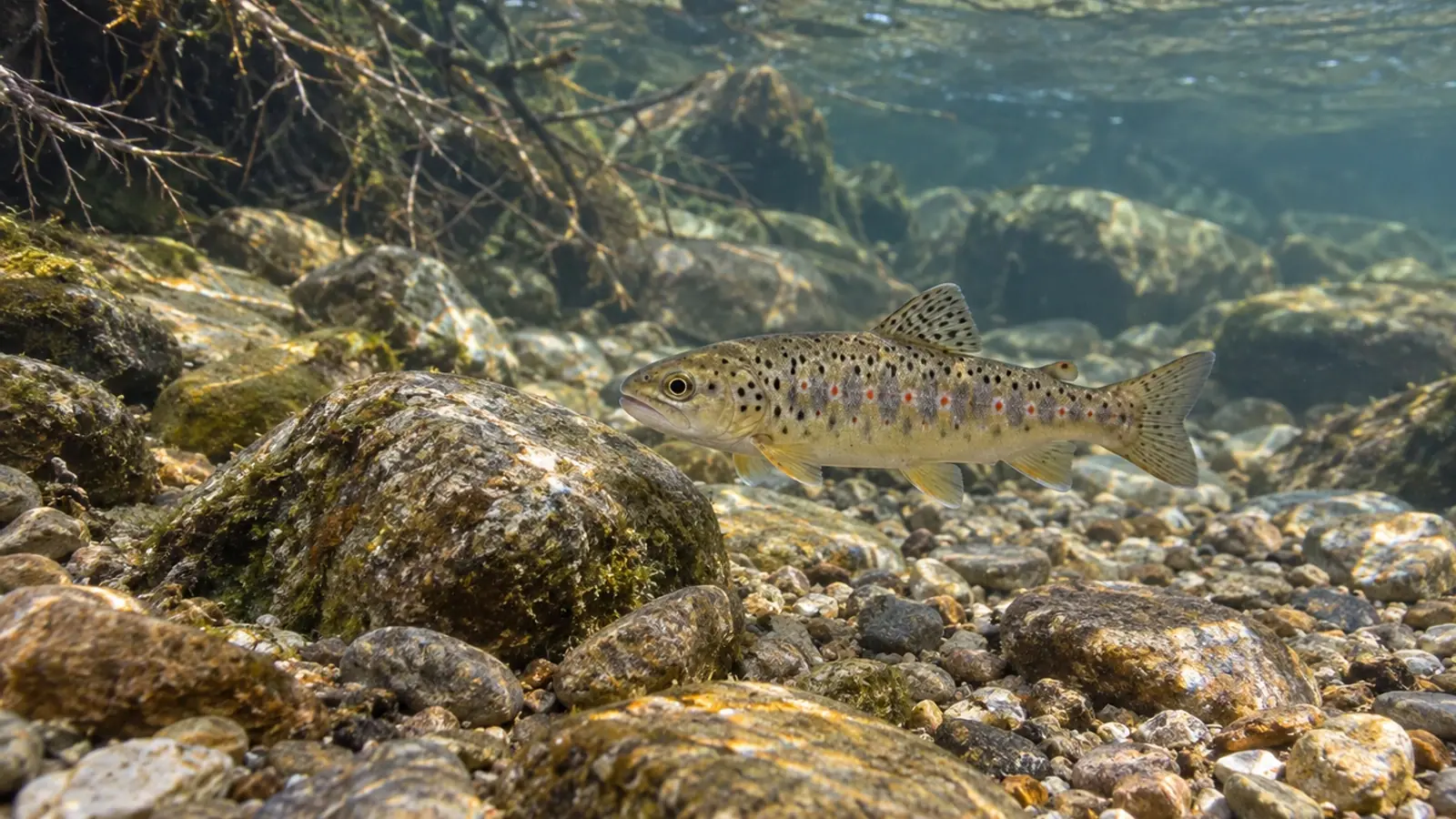
PIT tags: relate tag length to the fish being marked
A small PIT transponder does not guarantee that marking is without effects. A 2020 meta-analysis in juvenile salmonids helps assess tag-to-fish length, growth and mortality, while leaving important uncertainties for field programmes.


- Content type
- Practical guide
- Sector
- Environment
- Animal group
- Salmonids
- Keywords
- Capture–recaptureStressTelemetry
A discreet tag can still affect the fish
A passive integrated transponder, or PIT tag, identifies a fish when it enters the field of a compatible reader. It does not operate like an acoustic transmitter emitting a signal. That distinction shapes detection-system design, but it does not remove the need to assess marking effects on the animal.
A tag looks very small on a workbench. Its biological significance depends on the fish carrying it, the procedure and recovery conditions. Before selecting equipment, managers need to define the target population, expected sizes and monitoring question. Choosing only the device with the most convenient detection performance may create an unfavourable compromise for the smallest fish.
Vollset and colleagues’ 2020 paper provides a quantitative synthesis for juvenile salmonids. It is used here to inform project preparation, rather than presented as a new field study or permission to conduct a tagging procedure. The distinction matters when a published recommendation is transferred into a local protocol.
Understand the measurement behind the recommendation
The review assembled laboratory studies involving juveniles from Oncorhynchus, Salmo and Salvelinus. Its PIT synthesis drew on 18 publications. The analysis examined mortality and growth in relation to tag length divided by fish total length.
Mortality increased non-linearly as that ratio rose, with variation between studies. The authors proposed a guideline of 17.5% of fish total length. This is a recommendation derived from their synthesis, not a boundary guaranteeing that every fish below it experiences no effect or that every fish above it will die.
The ratio concerns length. It should not be replaced by a percentage of body mass. Total length and fork length also require distinction rather than unrecorded substitution. Field forms should name the measure actually taken; a column labelled simply “size” creates avoidable ambiguity when records are later compared.
Review the size distribution before fieldwork
Mean size does not describe the smallest animals or the full range of burdens within a group. Campaign preparation should examine the expected distribution and inclusion criteria. Excluding small fish also changes the population represented by the final dataset, even if the decision reduces a particular welfare concern.
A planning comparison can examine different tag sizes and their detection capabilities, then specify implications for fish size classes. Technical convenience, scientific relevance and welfare need separate consideration. A smaller device with poorer detection is not automatically preferable if the project then requires many more marked animals to answer the same question.
Define postponement and exclusion criteria before capture. Decisions made under time pressure may be applied differently across teams. Retaining records of untagged fish and the reason for exclusion makes that selection process visible in the eventual analysis. The aim is consistency with the question, rather than a single minimum size chosen without explanation.
Separate the procedure from the retained device
Capture, handling, implantation and recovery form one intervention, but their contributions differ. Comparisons with untreated controls and with animals undergoing a sham procedure answer different questions. Where such groups are included, their definition needs to remain available to anyone interpreting the results.
Animal condition and water conditions also enter the decision to proceed. The care protocol, operator competence and recovery arrangements should fit the actual site. This article provides neither an implantation method to copy nor an anaesthetic concentration. Those elements require preparation specific to the animals and the intervention.
Immediate observations after marking do not replace subsequent follow-up. A fish that resumes normal posture may still show altered growth or lose its tag. Define outcomes and observation times before starting, rather than reducing evaluation to the moment of release. Where a later outcome cannot be measured, that limitation should be stated explicitly.
Keep non-detection separate from death
Failure to obtain another reading does not establish mortality. It may also reflect movement outside the array, tag loss or imperfect detection. The analysis plan needs to retain those possibilities, even when the antenna map appears to cover the whole study reach.
Checking readers, operating periods and conditions affecting detection is a different task from assessing biological tagging effects. Both records should nevertheless be linked. If an antenna stops working, fewer recorded passages cannot be interpreted as an animal response without additional evidence.
Physical recapture may provide information on condition, growth and tag retention that remote readings alone do not supply. Its availability depends on the project. A programme without recapture should acknowledge the gap rather than presenting detections as direct measurement of every marking effect. Definitions of apparent survival and detection assumptions should remain accessible alongside the results.
Laboratory findings have limits in the wild
The 2020 synthesis concerns laboratory studies and a defined taxonomic group. Predation, movement and other pressures in natural habitats may alter the consequences of marking. Its results do not establish a general size rule for cyprinids, percids or elasmobranchs.
Growth and mortality are also partial outcomes. A behavioural change may matter for the ecological question without being captured by either measure. Observation duration needs to remain visible: findings over one interval do not demonstrate absence of longer-term effects. Conversely, an early effect does not establish that its magnitude remains unchanged indefinitely.
Project documentation should distinguish the recommendation obtained from the literature, the local decision and the uncertainties retained. If a species or system falls outside the evidence, seek relevant data rather than assigning universal scope to the 17.5% guideline. A clearly stated evidence gap is more useful than a confident threshold whose basis does not match the fish.
Conclusion: document the compromise before marking
A credible PIT programme starts with an explicit relationship between tag size, fish size and detection capability. The juvenile-salmonid synthesis helps frame that decision; it removes neither procedural effects nor network limitations. Monitoring data are easier to assess when those choices, exclusions and detection assumptions remain in the record.
Vetofish support
Our animal welfare service can help review inclusion criteria, recovery arrangements and observations after intervention. For field and environmental monitoring projects, the aim is to make choices proportionate to the question, without promising that marking will have no effect.


