

Pond effluents: linking concentration and discharge volume
A high concentration in a small volume and a moderate concentration in a large volume represent different discharged masses. A Southern Regional Aquaculture Center report helps separate these measurements during catfish pond drainage, without establishing a universal discharge limit.


- Content type
- Practical guide
- Sector
- Aquaculture
- Animal group
- Fish
- Keywords
- TemperatureOxygenpH
Concentration and load answer different questions
A concentration tells us how much of a substance or suspended material is present in a given volume of water. A discharged load describes the mass leaving a site over a defined period. Reading a pond effluent result requires both quantities. Water with a lower concentration can carry more material if the discharged volume is sufficiently large; a brief concentration peak may account for only part of the event.
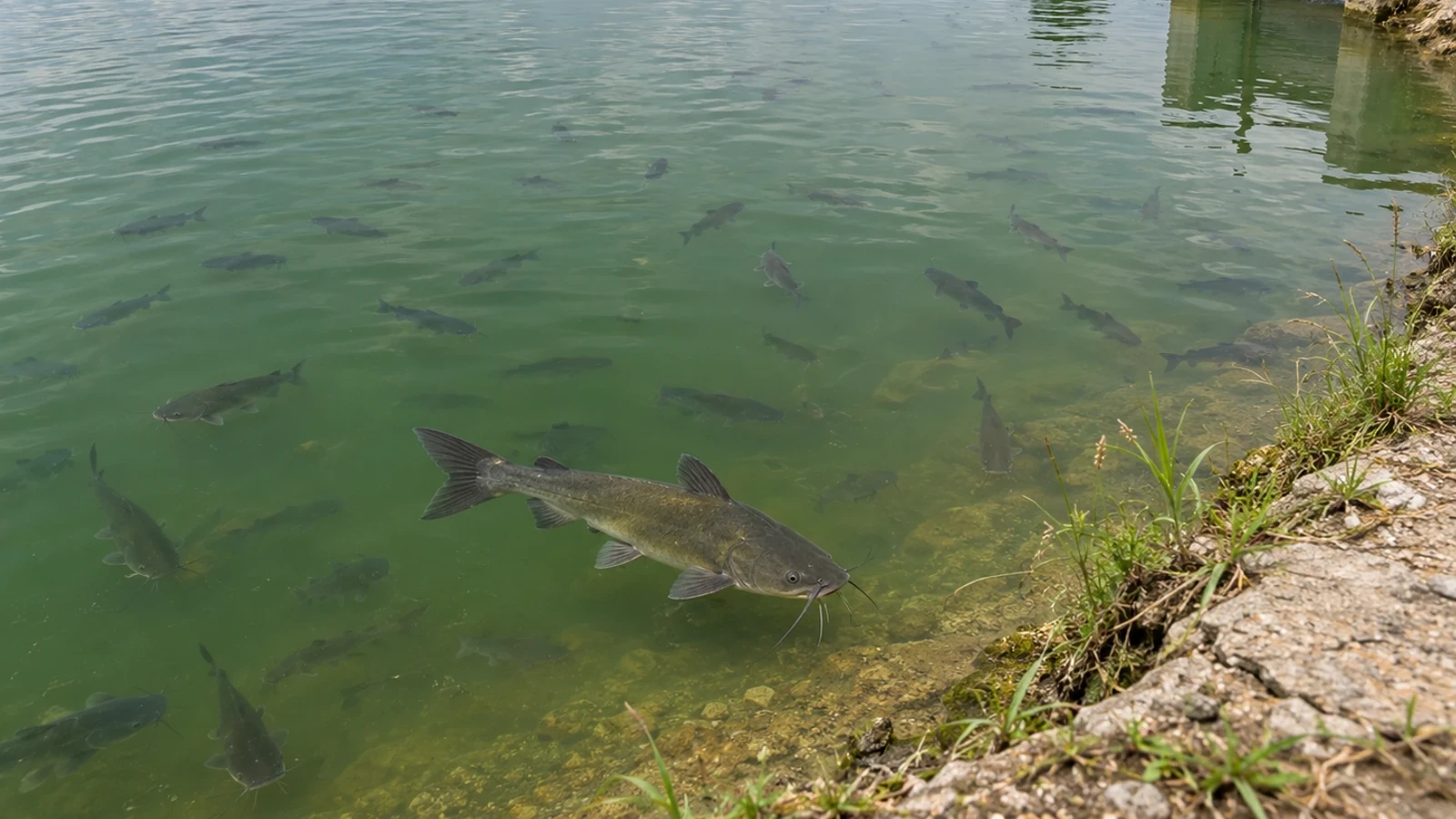
A chapter in SRAC Report 600, compiled by Craig S. Tucker in July 1998, illustrates this distinction using channel catfish, Ictalurus punctatus, production ponds. It reports monitoring at three ponds drained in Alabama in January 1992. This historical case explains how to connect measurements into an event balance. It does not describe present-day French farm practices or establish current discharge requirements.
The underlying calculation combines concentration with the corresponding water volume, then adds the masses associated with successive periods. Units must agree before that calculation makes sense. A result in milligrams per litre cannot be compared directly with a total mass per pond. Flow measurements link volume to time and help show which part of a drainage event a sample can reasonably represent.
Harvest changes the water reaching the outlet
A production pond is not a perfectly mixed container. Water level falls, fish occupy a smaller part of the pond, and harvesting activity may disturb bottom material. Water sampled at the surface before harvest may therefore differ from water leaving the drainage structure during seining. In the American case, monitoring included pond water and water flowing from the outlet, rather than treating their composition as necessarily identical.
Sample timing belongs with the laboratory result. A sample taken before fishing, one collected during net movement and another taken near the end of drainage describe different operational circumstances. The report considers these phases when interpreting effluent composition. Their contribution to the overall load also depends on how much water leaves during each phase.
Settling provides another distinction. Some particles fall out of suspension under gravity, while others remain suspended longer. Dissolved constituents are not represented by the mass of sediment that settles. Clearer-looking water consequently does not demonstrate that every measured component has fallen by the same proportion. A visual improvement and a quantified reduction answer related but separate questions.
Keep the analytical parameter attached to the number
The report examines solids, nutrient forms and indicators related to organic material. These measurements should retain their original names. Kjeldahl nitrogen, for example, does not by itself include every nitrogen form. A comparison that silently relabels different analytical measures as total nitrogen risks creating an apparent change that comes from terminology rather than from pond management.
Biochemical oxygen demand concerns oxygen consumption during biological breakdown under defined analytical conditions. It is not the same measurement as dissolved oxygen concentration in the pond or receiving water at a particular moment. Both may help assess a situation, but one cannot stand in for the other. The analytical method and reporting units remain necessary even when results are presented in a short summary.
Temperature and pH provide useful water-quality context. They cannot supply a missing discharge volume or convert a suspended-solids reading into an event load. The record should connect each sample with its location, collection time, drainage phase and associated volume. Where volume is estimated, that qualification should remain visible alongside the calculated mass, rather than disappearing from the final comparison.
Identify gaps before comparing events
Later drainage phases deserve explicit coverage because disturbance and changing water depth can alter what reaches the outlet. That does not establish a fixed percentage of total load that will always leave at the end. The three studied ponds had particular structures, harvest arrangements, stocking histories and seasonal conditions. Their results cannot supply a universal distribution for every pond drainage event.
An average based only on available samples may hide a period that was never observed. Before comparing two ponds or two years, check whether corresponding phases were sampled and whether the water volumes match those periods. If coverage is incomplete, a partial assessment is a more accurate description than a complete event balance. Extra decimal places cannot correct a missing part of the operation.
Discharged mass also differs from environmental effect. Receiving-water flow, dilution and ecological conditions matter when interpreting what that mass may mean downstream. Nutrient inputs and eutrophication cannot be assessed from the colour of one water sample alone. A useful environmental comparison describes both the farm discharge and the receiving system, while keeping measured results separate from assumptions about impact.
Build a monitoring record around the farm question
The durable lesson is to distinguish concentration, volume, mass and period. Historical management recommendations in the report do not constitute discharge permission or a ready-made operating programme for another jurisdiction. Current site requirements, animal health considerations and water-resource constraints need their own assessment. The report is a basis for asking better measurement questions, rather than a substitute for that assessment.
For aquaculture teams, the most useful record brings harvest chronology, pond observations and laboratory results together. It should expose uncertainty: an estimated volume, a missed phase, a changed method or a different sampling point. Those details help explain a variation before it is described as either an improvement or a deterioration in performance.
Vetofish provides advice and support to connect water monitoring, fish health and farm organisation. The starting point is the decision the site needs to make. Measurements can then be selected and interpreted within that question, with their limitations retained. An outlet result becomes one documented piece of evidence, rather than carrying an entire conclusion by itself.


