

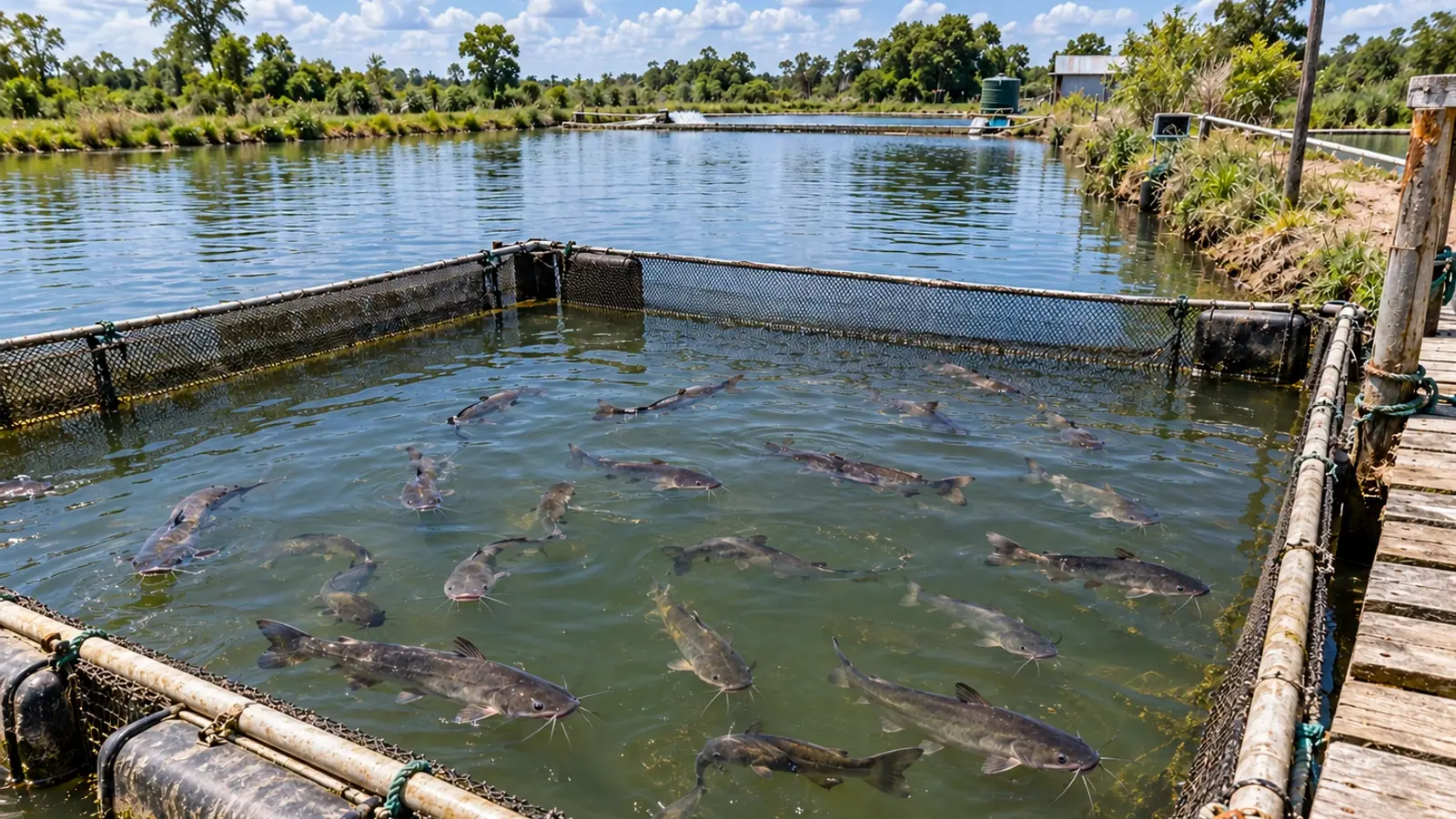
Pond fish grading: checking what the grader actually separates
Bar spacing does not create an exact weight boundary between two groups of fish. A Southern Regional Aquaculture Center technical guide explains in-pond catfish grading and why its outcome needs checking against the animals’ actual size, condition and handling environment.


- Content type
- Practical guide
- Sector
- Aquaculture
- Animal group
- Fish
- Keywords
- TemperatureOxygenStress
A grader separates body shapes, not exact weights
David Heikes’ September 2007 Southern Regional Aquaculture Center guide describes a grading system for American catfish production ponds, including channel catfish, Ictalurus punctatus. It offers a useful explanation of what an equipment setting can and cannot tell a farm. Its size relationships belong to the particular system and populations described at that time. They are not a current performance guarantee for every species or grader.
In the floating system, smaller fish can pass through parallel bars into a live car below. Retained fish move towards a separate holding compartment. Water helps move the fish, which remain submerged throughout this particular process. Separation therefore reflects body dimensions and behaviour together. An individual fish’s weight cannot be read directly from the gap between two bars.
The guide describes an approximate split point: around that size, some fish pass through while others remain. This does not mean that every retained fish lies above an exact weight boundary, or that every escaped fish lies below it. For a marketing or husbandry decision, the size distribution actually obtained matters more than the nominal setting alone.
Check both sides of the separation
Sampling should answer a defined question: does the resulting group meet the purpose for which grading was arranged? Selecting only fish that are easiest to catch can give a misleading impression. Records need to say which compartments were assessed, when measurements were taken and how fish were selected. Readers should be able to distinguish a representative check from a convenient observation.
Measurements of length and weight help describe the animals passing through the system. Two fish of similar length can differ in body shape and mass; fish with similar weights need not have the same body width. A condition index can describe the relationship between length and weight when its formula and reference population are stated. It does not turn a measurement into a health diagnosis.
Keep individual values, or a distribution, alongside the average. Groups with the same mean weight can contain quite different proportions of small and large fish. Where grading is intended to produce a commercial size category, comparing distributions before and after separation shows what changed. The sample-based estimates discussed in the guide retain uncertainty from the way fish were sampled.
Behaviour and water conditions affect the outcome
Heikes identifies fish condition, temperature and strain as factors that can alter observed separation. A spacing table cannot therefore be treated as a universal conversion between bar gap and fish weight. The equipment can remain unchanged while the group’s behaviour changes. An unsatisfactory result does not immediately identify a single mechanical fault.
Gathering and handling can cause stress and influence the way fish move through the grader. The guide emphasises water quality in live cars and the consequences of overcrowding. Dissolved oxygen belongs in that assessment. An acceptable reading elsewhere in the pond does not necessarily describe the compartment where fish have been concentrated.
Checking the outcome also needs to respect animal welfare. Additional sampling is useful when it informs a decision; repeated handling without a clear question adds a burden. If abnormal signs develop, assessment of the fish and their water takes priority over continuing a technical comparison. The guide does not provide a universal stocking load or water-flow prescription for another farm.
Grading efficiency is different from production performance
A sharper size separation does not, by itself, demonstrate improved growth or health. It answers a question about how sizes have been distributed between groups. Claims about production performance require other information, including subsequent group outcomes, losses, labour and appropriate comparisons. Observations during one pass cannot replace that longer follow-up.
The SRAC publication describes a particular technology in its historical United States production context. It is neither a recent multi-species trial nor a certification of equipment now on sale. Its economic estimates and historical operating rates should not become a promise for a farm in another country. The principle of checking the actual separation remains useful; application figures require a site-specific assessment.
Keep the grading question, equipment setting, measurements and water conditions together. This makes it possible to revisit the comparison at a later grading event. A different temperature or body condition can explain a changed result without making the earlier record wrong. A useful register shows what varied rather than reducing every event to a simple pass or fail.
Base the decision on the group actually obtained
Compare the nominal setting with the fish actually separated to check whether grading has met its purpose. A useful check describes animals on both sides of the device and retains the sample’s limitations. This supports a discussion of the result without turning a mean value or an old table into an individual guarantee.
Vetofish can help bring size observations, handling conditions and water monitoring into a coherent record. Our advisory and support service works with production teams to frame a measurable question before changes are made to a grading operation. Our aquaculture expertise provides the context for adapting that assessment to the farm’s animals and working constraints.


