

Fish ponds: does a falling water level prove a leak?
A falling pond level does not identify a leak by itself. University extension guidance recommends comparing observed losses with evaporation and checking water-control structures. On a fish farm, that investigation needs to account for the stock before drainage or sealing is considered.


- Content type
- Practical guide
- Sector
- Aquaculture
- Animal group
- Fish
- Keywords
- TemperatureOxygenStress
Read the water balance before planning repairs
A farm pond receives water through its supply, rainfall and sometimes exchanges with the ground. Water leaves through outlets, evaporation and movement through the bed or banks. The level reflects all these processes. It can fall without recent damage to an embankment, particularly when a dry period reduces the incoming supply.
Penn State Extension’s guidance, updated in May 2025, recommends establishing whether a pond is actually leaking before planning repairs. University of Missouri guidance, revised in 2017, likewise separates total water loss from estimated seepage after allowing for evaporation. These US resources offer a useful diagnostic approach. Their regional climate figures are not thresholds for ponds in France or elsewhere.
Start with a record that can be checked against other observations. Choosing a sealing material comes later. An incorrect diagnosis can lead to costly work that fails to address the cause and disrupts both the fish and the farm’s production schedule.
Put water levels and farm operations on the same record
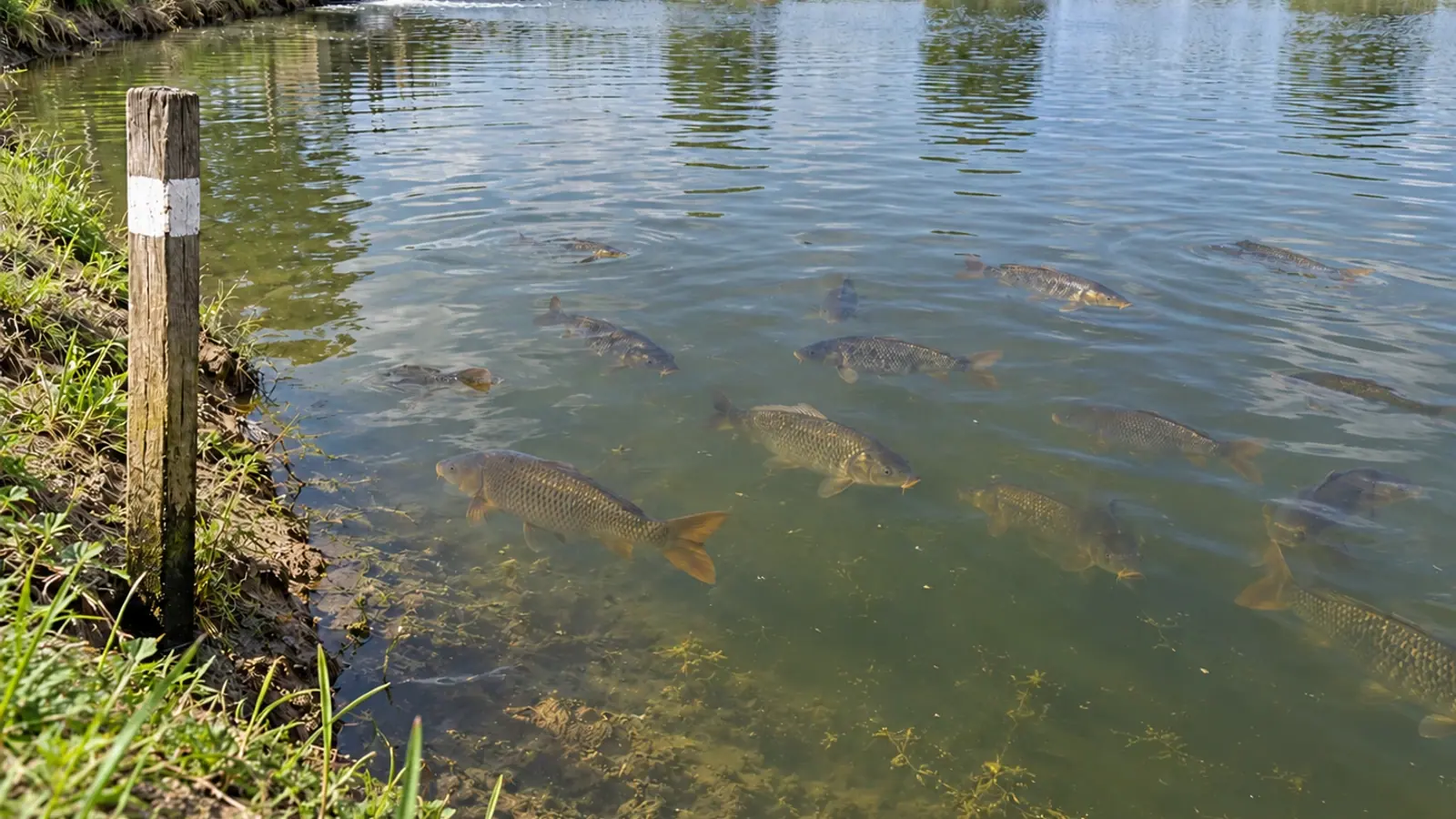
A fixed, stable marker provides a consistent reference for successive readings. Record the time, water height and relevant interventions together. Photographs taken from the same position can help, but the changing position of the water along a sloping bank is a poor substitute for a vertical reference: the bank’s shape affects how that movement looks.
Include rainfall, supply changes, valve operations and water transfers in the record. Inflow rate matters as well as water height. A pipe may still be running while supplying substantially less water; noting only that it is flowing misses this distinction. Separate routine discharge from water loss that appears abnormal.
A simple hypothetical calculation can illustrate scale. If the surface area remains at 1,000 square metres, a fall of one centimetre represents approximately 10 cubic metres of water. That calculation identifies no cause. With sloping banks, surface area changes as the level falls, so a more precise estimate requires information about pond geometry.
Allow for evaporation without compromising the stock
Evaporation transfers water from the pond surface to the atmosphere. Wind, warmth and air humidity influence that loss. Penn State also notes that nearby trees can remove pond water. A rainless period may therefore combine reduced inputs with greater natural losses.
The Missouri guide describes estimating total loss from two water-level readings over an interval without rainfall or inflow, then subtracting estimated evaporation. This approach depends on accounting for the other exchanges. On a working fish farm, closing the supply simply to simplify the calculation could compromise the water renewal or oxygenation needed by the stock. Animal care determines which observations are acceptable.
Nearby weather information provides context rather than a perfect measurement of evaporation from the pond. Wind exposure, shade and surface conditions may differ. Retain that uncertainty instead of assigning every unexplained part of the balance to a particular leak. An unexplained decline is a reason for further investigation, rather than proof of where water is escaping.
Check water-control structures before blaming the whole bed
Penn State recommends beginning the inspection with outlet pipes and drainage structures. Deterioration below the waterline can release water without producing a conspicuous surface leak. Examine accessible components and compare their behaviour with normal operation. Taking apart a structure under pressure is not a routine diagnostic shortcut.
An unusual wet area outside a bank or embankment may help direct the investigation. It remains a clue: groundwater or runoff from outside the pond can also wet the ground. Repeated observations linked to pond levels and weather are more informative than an isolated photograph.
Water loss that slows after the pond reaches a particular height may suggest an escape route near that elevation. Penn State describes this pattern as a possible aid to locating a leak. It does not establish that the whole structure is sound. An evolving structural concern needs appropriate engineering assessment, particularly if the change is rapid.
Make the next decision around the fish as well as the structure
Temperature and dissolved oxygen measurements complement the water-level record. They describe conditions experienced by the fish while the investigation is under way. Having enough water depth for swimming does not by itself establish suitable water quality. Ventilation, distribution within the pond and feeding behaviour provide additional observations.
Both extension guides discuss repair options that depend on the soil and location of the loss, and explain the value of understanding the ground. A number of centimetres lost cannot identify a suitable product or application rate. Drainage, work on the bed, stock transfers and refilling all need consideration of their practical and health consequences.
Adding water may temporarily maintain the level while leaving the cause unresolved. Its suitability depends on the available resource, its quality and the rules applying to the site. A hydraulic calculation provides no entitlement to abstract water. A plan also needs to remain workable during the periods when that resource is most constrained.
For an international reader, the US permitting examples in the source documents should be read in their own jurisdiction. Decisions about abstraction or repairs belong within the local framework. The transferable point is to investigate before intervening and to establish whether the proposed response can be sustained.
Conclusion and support from Vetofish
Compare levels, inputs, outlets, weather and the condition of structures before sealing a pond. A chronological record helps distinguish an expected loss from an abnormal change and prepares the ground for any technical assessment. It prevents every falling level from being treated as a leaking bed.
Vetofish can help farm teams organise observations, relate changing water conditions to the stock and prepare health measures for a possible intervention. Protecting the fish and investigating the structure need to be planned together around the working conditions of the site.
To move from evidence to action, explore our advice and support service and our expertise in aquaculture.


