

RAS enrichment: assess fish benefits and maintenance
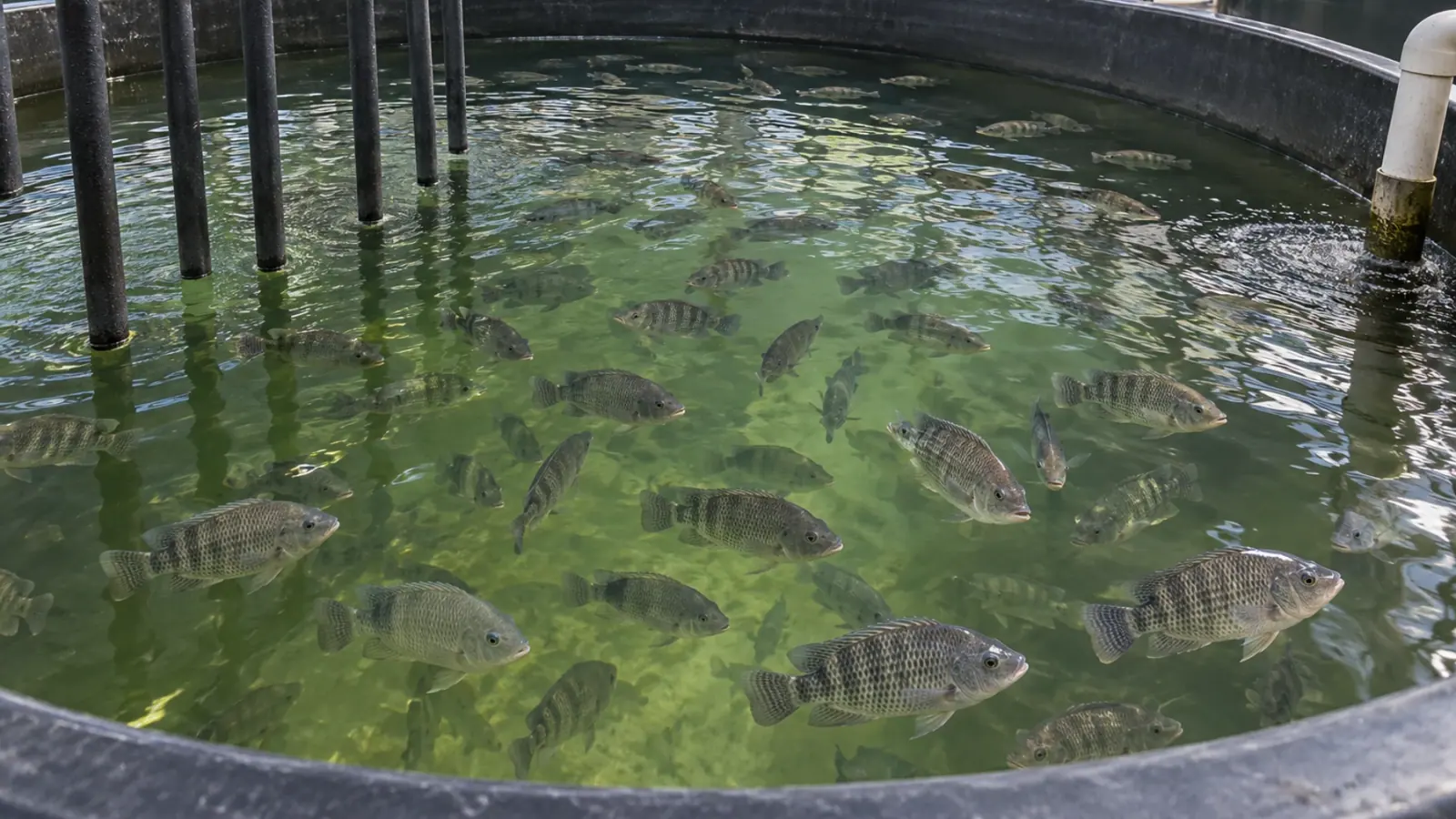
Enrichment in recirculating aquaculture needs to benefit fish while remaining compatible with observation and maintenance. A 2026 review describes potential gains and uncertainties at commercial scale.
- Content type
- Practical guide
- Sector
- Aquaculture
- Animal group
- Fish
- Keywords
- EnrichmentStressBiosecurity
Start with an animal need
Recirculating aquaculture systems, usually called RAS, rely on tanks that can be inspected, cleaned and kept free of accumulating solids. A simple layout supports those tasks, but may offer fish few opportunities to explore or choose between different conditions. Environmental enrichment deliberately changes the environment to address behavioural needs. Its value depends on what happens to the fish, rather than how natural the tank looks to a visitor.
A 2026 review by Fruscella, Passantino and Kotzen considers enrichment within RAS design and management. It describes potential welfare benefits while highlighting the difficulties of moving from research to commercial production. It does not establish one tank design that works for every species. For a farm, the practical starting point is a specific improvement that can be observed and checked under normal operating conditions.
Define the function before selecting equipment
Enrichment can involve physical structures, sensory conditions, feeding opportunities or the social environment. These approaches address different needs. A shelter may offer spatial choice, but a desirable structure can also become something that one fish defends against others. Species, developmental stage and group organisation influence that outcome.
The review describes contrasting aggression responses to greater environmental complexity in different tilapia species. Even a closely related species therefore needs its own assessment. Likewise, an arrangement used by young fish may become unsuitable as the stock grows and its biomass increases. An apparent preference during one observation is a reason to investigate further, rather than proof of a lasting welfare benefit.
A farm team can make the intended function explicit: wider use of the tank, fewer damaging interactions, or more equitable access to feed. Equipment should follow that question. This makes it possible to reject or revise an attractive installation when the animals do not benefit from it.
Examine the whole water and cleaning circuit
One uncertainty identified in the review concerns the balance between welfare gains, maintenance and hygiene at commercial scale. Structures can retain organic waste and interfere with effective water treatment. Their design therefore needs to be assessed as part of the operating system, including the work required to remove and clean them.
A technical review can follow water movement and the path of solids. Does the equipment obstruct waste removal? Can staff inspect the area beneath it? Will retrieving it involve prolonged pursuit of fish? A structure that conceals individuals may make health surveillance harder even when fish use it readily.
Biofilms require a contextual interpretation. Microorganisms also perform essential functions in recirculating systems, so the presence of a biofilm does not by itself establish a hazard. The practical concern is whether additional surfaces can be inspected and managed. Moving enrichment equipment between tanks or cohorts should be considered within the farm’s biosecurity arrangements, rather than treated as an inconsequential transfer of furniture.
Use several measures of outcome
Growth is useful information, but cannot describe welfare on its own. Neither can a single stress measurement. The review argues for considering behaviour, biological functioning and the animal’s ability to respond to its environment. This supports an assessment that combines several observations and actively looks for adverse effects.
An internal trial can record space use, feeding access, interactions and body integrity alongside the water measurements already collected by the farm. Losses and interventions also belong in the record. A simple ethogram helps staff describe the same behaviours in the same way. It still requires clear definitions and consistent observation conditions; giving a behaviour a name does not eliminate observer bias.
Record changes in feed allocation, stocking, grading and temperature during the assessment. Otherwise, an improvement associated with a new structure may actually reflect another change in husbandry. Where the installation allows it, comparison with similarly managed tanks provides a stronger basis for interpretation. Repeated observations within one tank do not create independent tank replicates.
The comparison should include maintenance effort as well as animal outcomes. A reduction in aggression accompanied by obstructed drainage or poor visibility requires further work. Conversely, an arrangement that adds a little maintenance may remain worthwhile if its benefit is credible and the extra work can be carried out reliably.
Decide in advance when to reconsider
Before installation, staff can agree on events that require review: new injuries, persistent monopolisation of equipment, impaired flow or loss of adequate visibility. These are examples of operational decision points, not universal thresholds. The review does not provide an object density or a single configuration suitable for all RAS.
Removal, cleaning and reinstallation should be feasible without compromising fish welfare. The arrangement should also be reassessed as animals grow or production conditions change. A successful short trial is not an assurance that the equipment will remain suitable for the full production cycle.
Staff need a shared way to report problems, including observations made outside formal assessment periods. A feature that functions during a scheduled inspection may behave differently during feeding, cleaning or other routine work. Those observations help determine whether the arrangement can be maintained safely in everyday use.
Conclusion: validate enrichment in its operating context
The review supports examining enrichment as part of recirculating aquaculture, while leaving important questions about commercial implementation and hygiene unresolved. A defensible decision links a specific animal need to an observed benefit, checks alternative explanations and keeps maintenance achievable. The result may be retention, redesign or removal of the equipment.
Vetofish support
Vetofish can help define the assessment question, select observations and establish review criteria. Our animal welfare service connects species requirements with practical husbandry and maintenance through our aquaculture expertise. Circuit plans and cohort records provide useful starting material for that review.


