

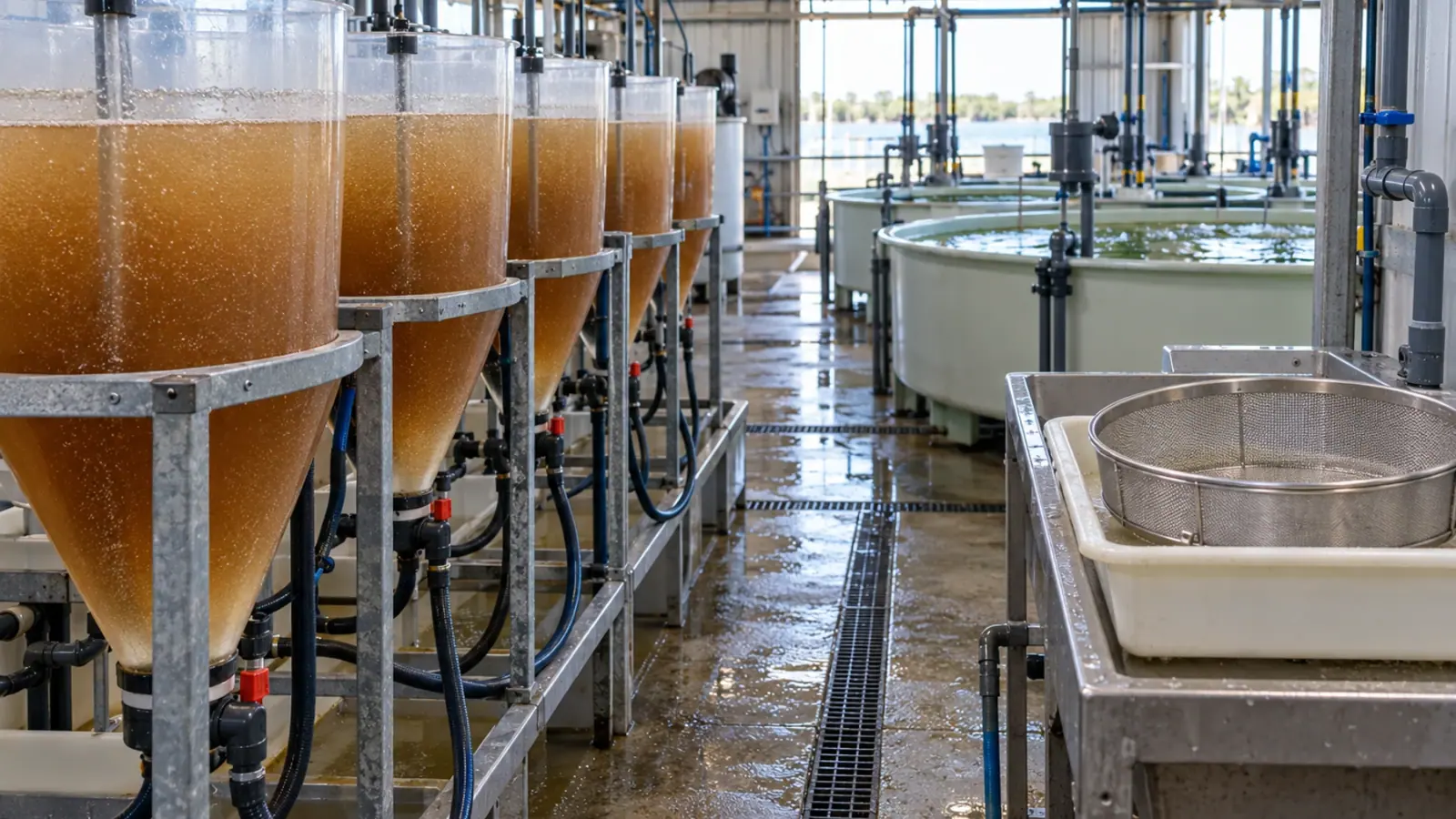
Artemia cysts: checking disinfection in the hatchery
Disinfecting cysts does not make a hatchery sterile. Useful checks distinguish contamination control, preservation of hatching performance and removal of residual chlorine before incubation.
- Content type
- Practical guide
- Sector
- Aquaculture
- Animal group
- CrustaceansFish
- Keywords
- BiosecurityDisinfectionSalinity
An Artemia cyst lot becomes part of a hatchery food chain before incubation starts. Its outer shell, treatment water and handling equipment can carry contamination towards hatching tanks and, eventually, fish larvae. The control question is specific: what does the treatment reduce, and what evidence allows the treated material to move to the next stage?
Gilbert Van Stappen’s chapter in the 1996 FAO live-feed manual distinguishes disinfection from decapsulation. This established technical reference helps organise checks. It is not a new disease alert or a guarantee that applies to every commercial product and hatchery arrangement.
Give each operation a clear purpose
Artemia produce dormant embryos protected by a resistant envelope. Disinfection aims to reduce contamination of the material. Decapsulation chemically removes the outer shell, changing the material that will enter the hatching vessel. Using the same term for both makes records difficult to interpret. A batch record should identify the operation, its purpose and the procedure followed.
The FAO manual explains that hypochlorite surface treatment may leave microorganisms within some layers of the shell. It also describes decapsulation as a way to avoid introducing indigestible shells. Neither observation establishes that a tank supplied subsequently with water, air and feed will remain sterile. Control of the treatment and control of the production system need separate consideration.
This distinction also helps when assessing a supplier’s claim. A statement about treated cysts must be read for its actual scope, rather than extended to the water, equipment or nauplii used later in the hatchery.
Check the batch before mixing chemicals
Start with the cyst source, commercial batch reference, opening date and storage conditions. Keep documentation of any treatment already performed by the supplier. It complements, rather than replaces, the hatchery’s own observations of hatching performance and nauplius quality. Combining batches can conceal a recurring problem and makes subsequent investigation less informative.
The responsible operator then checks whether the written procedure matches the available product. Commercial disinfectant concentration and active chlorine content cannot be replaced by a volume copied from a different product. Changing brands without checking those details can change the exposure. Ian Bricknell’s institutional decapsulation protocol illustrates a documented sequence of hydration, treatment, rinsing and neutralisation. It requires assessment before transfer to another installation.
The relevant comparison is between complete procedures. Matching only the name of the chemical misses preparation, contact conditions and the steps that follow treatment.
Record treatment and release separately
A record captures start and finish times, prepared quantities, required conditions and any deviation. An interrupted process or uncertain preparation must remain identifiable. Extending exposure to compensate for uncertainty may damage embryos without establishing better microbiological control.
Release from treatment deserves its own check. Bricknell’s protocol includes rinses and a thiosulphate stage; the FAO chapter likewise distinguishes washing from deactivation of remaining hypochlorite. Residual chlorine should be assessed before material enters incubation. A measurement suitable for the water and chemical in use provides more useful evidence than appearance alone.
Chemical handling and effluent management belong in a validated workplace procedure, including protective equipment and ventilation. The practical objective is a controlled operation that can be carried out consistently while other staff manage larval production. An improvised chemical step beside feeding operations makes that consistency harder to achieve.
Measure hatching and contamination as different outcomes
Good hatching performance shows that embryos remained viable under the conditions tested. It does not establish the absence of an infectious agent. Conversely, microbiological results from a few samples cannot describe every part of production. Each question needs its own indicators and, where an investigation is justified, a sampling plan agreed with the laboratory.
Successive lots can be compared using a consistent method: initial quantity, incubation duration, live output, nauplius appearance and recorded abnormalities. Temperature, salinity and aeration also affect hatching. Recording them reduces the risk of blaming a disinfectant for a change that coincided with altered incubation conditions.
A microbiological submission needs to identify the material sampled: cysts, final rinse water, hatching water or nauplii. A higher total bacterial count does not identify a pathogen. Targeted testing should address a defined health hypothesis, rather than follow automatically from cloudy water.
Keep the controlled material from being recontaminated
Biosecurity continues after neutralisation. A clean sieve placed on a contaminated surface, shared tubing or a container moved between stages can reconnect production flows. The route from receipt through treatment, incubation and distribution should remain easy to follow.
Organic matter and the water carried with live feed add another source of variation. Rinsing and separation help control transfers, while ration quality still requires its own assessment. Following a deviation, batch references and distribution times allow staff to identify receiving tanks and select samples that can answer a useful question.
A repeated problem should therefore be investigated across the sequence. Increasing chemical exposure alone cannot correct contaminated equipment or an uncontrolled transfer after treatment.
Make the barrier demonstrable
The useful endpoint is a repeatable operation whose purpose, checks and limits staff can explain. A missing shell or a high hatching yield is insufficient evidence that the complete food chain is free of risk. Deviations need a recorded batch decision, supported by the relevant production and laboratory information.
For aquaculture hatcheries, our aquatic health expertise service can help map live-feed pathways, define control points and prepare a laboratory investigation when failures recur.


