

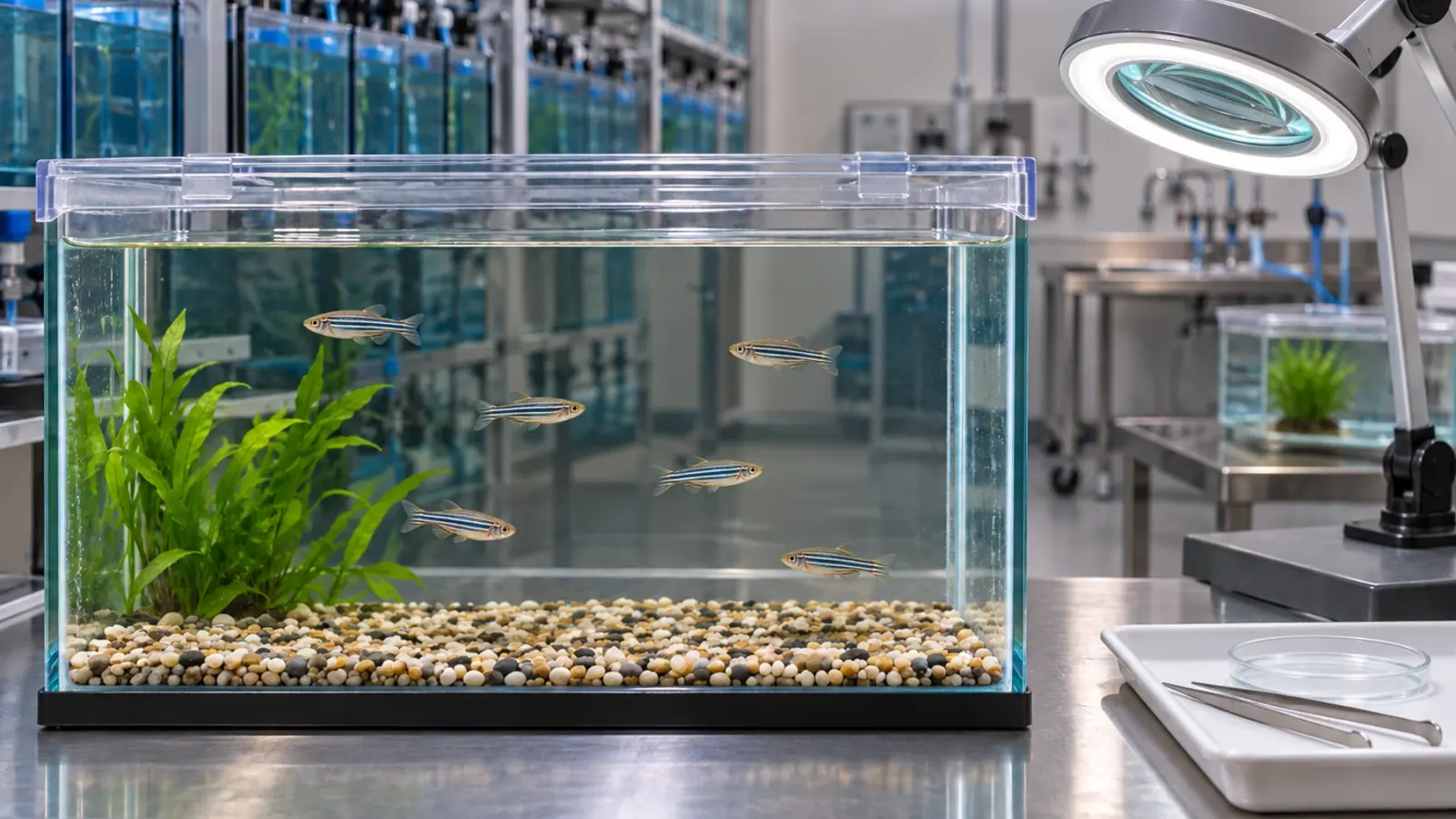
Research fish: confirm death after euthanasia
Stillness and absent gill-cover movements do not always establish irreversible death. FELASA’s 2025 recommendations place completion and confirmation within the planning of research fish euthanasia.


- Content type
- Practical guide
- Sector
- Research facilities
- Keywords
- AnaesthesiaStressHistopathology
A motionless fish may still be alive. Anaesthesia, stunning, completion of killing and confirmation of irreversible death address different questions. Treating them as interchangeable creates a risk of starting sampling or disposing of an animal while recovery remains possible.
FELASA’s working group recommendations, published in 2025, make that sequence part of planning a laboratory fish procedure. Species, developmental stage, staff competence and the intended use of tissues all matter. The practical starting point is to decide how death will be established before preparing for sample collection.
What the survey can and cannot tell facilities
Mocho and von Krogh published an international survey in 2022 based on responses collected in 2018 from 145 facilities. Most questions were optional, and response numbers differed across topics. Zebrafish, Danio rerio, were the most frequently used species among participating laboratories.
For adults, 58% of the 137 respondents to the relevant question reported a completion method following the initial killing procedure. The questionnaire did not observe what staff actually did or explain why other respondents did not report such a step. These were voluntary survey findings, not a representative audit of compliance in research facilities in 2026.
The interpretation was more difficult for younger fish because of missing answers and the categories used. An overall percentage should not conceal life stage or turn missing information into evidence of a particular practice. The useful message is that procedures and reporting needed to describe completion more explicitly.
An observed sign is not the whole conclusion
Absent opercular movement means that movement of the gill cover is no longer visible. By itself, it does not demonstrate irreversible loss of every function necessary for life. Similarly, inability to move is not direct proof of unconsciousness. An observation needs to be interpreted within the method used and the animal being assessed.
The 2025 recommendations distinguish induction, loss of relevant responses and completion intended to prevent recovery. Confirmation then concerns the irreversibility of the outcome. A written procedure should describe those steps and the signs that can actually be assessed, rather than summarising the entire process as “fish immobile”.
When a reflex is used, specify the stimulus, expected response and assessment time. Failure to see a response under inadequate viewing conditions is not a reliable negative observation. Animal size, visibility, equipment and training can all influence what an operator is able to detect. These practical limits belong in the procedure as well as in training.
Life stage changes the assessment
FELASA notes that some embryonic or larval forms may recover after apparent cessation of the heartbeat. Conversely, residual cardiac activity in an adult does not necessarily indicate that the animal retains all integrated functions. Either sign can be misleading when removed from its biological and procedural context.
Assessment criteria need to identify species, developmental stage and size. Evidence from an adult zebrafish does not automatically validate an approach in larvae, cold-water species or larger fish. A duration reported for one experimental method should not become a standard waiting period throughout an aquatic facility.
The complete sequence therefore needs review by the establishment’s competent personnel. This includes the conditions under which local staff will use it. FELASA provides professional recommendations; these do not replace assessment of the framework applicable to the project or the procedure authorised for that setting. Facilities outside Europe also need to interpret the recommendations within their own requirements.
Resolve tissue requirements before the procedure
A method suitable for one assay may compromise another. Histopathology requires preservation of tissue structure and attention to autolysis. Other analyses may be affected by a chemical or physical intervention. These constraints should be discussed before the day of sampling, with the laboratory receiving the material where appropriate.
They do not justify beginning a potentially perceptible dissection before the planned completion step. The scientific lead, animal-care team and veterinarian need a sequence that protects welfare while producing interpretable samples. If the intended tissue is incompatible with the proposed method, that conflict should be resolved during preparation rather than at the bench.
The record can identify required tissues, selected method, confirmation criteria, operator and stopping conditions. Timing the stages helps connect sample quality with the actual procedure. Timing alone, however, is no substitute for recording an unexpected response, a sign of recovery or a difficulty applying the method.
Make confirmation a demonstrable skill
Staff need to be able to apply the written procedure consistently. Training needs to cover recognition of relevant signs, limitations of observation and the response when uncertainty remains. Operators should know when to maintain the specified conditions, obtain assistance and use the contingency already defined in the procedure.
Before a large series, check that equipment, people and instructions match the species and stages present. Consider less favourable circumstances, including very small animals, poor visibility, interruptions and urgent sample requests. Pressure to work quickly should not remove a confirmation step from the sequence.
Internal review should examine actual records: criteria completed, incidents, deviations and corrective actions. A checked box is not necessarily a description of an observation. When a procedure changes after an incident, the change needs to reach every affected user and be understood before the next session.
Complete one stage before moving to the next
Irreversible death needs appropriate methods and criteria; it should not be inferred from stillness alone. The practical contribution of the recommendations is to plan induction, completion, confirmation and sampling together while preserving the differences between species and life stages.
Vetofish can support research facilities in reviewing that sequence and provide training for aquatic animal teams. The focus is competence, traceable observations and coherent local procedures, rather than a universal set of killing instructions.


