

Zebrafish: how should analgesia be assessed?
Resumed swimming does not necessarily establish pain relief. Zebrafish studies and FELASA guidance show why analgesic assessment needs several behavioural measures, appropriate controls and a clear timeline.


- Content type
- Practical guide
- Sector
- Research facilities
- Animal group
- Zebrafish
- Keywords
- AnalgesiaAnaesthesiaEthogram
Recovery and pain relief are different outcomes
An adult zebrafish returning to visible swimming after an invasive procedure has recovered a function that staff need to monitor. That observation does not answer every question about pain. General anaesthesia and analgesia have different purposes and may persist for different periods. A check confined to emergence from anaesthesia can miss later behavioural changes. Assessing pain relief therefore requires a timeline that extends beyond the first apparently successful recovery.
The FELASA Working Group report published in the 2024 volume of Laboratory Animals considers physical, physiological and behavioural indicators, while acknowledging the absence of a single gold-standard measure. Its recommendations support planning with the veterinarian, care team and researchers. They do not remove the need to examine whether an indicator is appropriate for the species, developmental stage and intervention involved. A general monitoring framework still needs to be adapted to a particular scientific question.
An example with controls and repeated observations
Deakin and colleagues used video to assess adult female AB-strain zebrafish in a 2019 study. Their first experiment included seven groups of seven fish: undisturbed controls, a sham group exposed to anaesthesia and handling without the invasive intervention, and groups undergoing different experimental procedures. Recordings were obtained before treatment and at 1, 2, 3 and 6 hours afterwards. Fish were observed individually, which matters when considering whether the findings apply to group-housed animals.
After experimental removal of 40% of the caudal fin, reduced swimming speed and exploration were accompanied by increased use of the lower part of the tank. Some changes persisted at six hours. A second experiment evaluated several analgesic compounds with six fish per tested dose. Effects varied across behavioural measures and time points. These observations show why several behaviours and observation times need comparison. They do not establish a universal prescription or transfer directly to a much smaller biopsy. A single behavioural result cannot identify pain unambiguously.
Give every comparison a purpose
A baseline from the same fish helps describe change, but a before-and-after comparison cannot separate every contribution from time, anaesthesia, handling and tissue injury. A sham group can address parts of that preparation, while an undisturbed group offers a different reference. The study plan should state what each comparison can establish and which explanations remain possible. Adding groups without a defined purpose does not automatically strengthen an experiment or justify additional animal use.
The drug may itself change movement or another study outcome. In the 2019 experiment, compounds were present before the pre-procedure recording, allowing an initial behavioural effect to be examined. In a new setting, movement approaching a control pattern is not sufficient on its own to establish relief: stimulation, sedation and motor effects also need consideration. Relevant existing evidence should inform these decisions, alongside a veterinary assessment of the procedure, rather than automatically repeating every control experiment.
Define the measures and keep their timing
An ethogram specifies observable behaviours and the rules used to record them. Swimming speed, exploration, water-column position, posture and feeding responses describe different functions. The chosen measures need to be observable reliably and related to an appropriate reference state. Failure to detect a statistically significant difference from a control does not establish equivalence or prove the absence of pain. Sample size and variability constrain what the comparison can resolve.
Stress and nociception may contribute to overlapping responses. Cortisol can provide complementary physiological information, but it is not specific to post-procedure pain. Water quality, temperature, lighting, isolation and recent handling all remain relevant. Averaging measurements across a whole day can conceal an adverse period. Treatment times, recovery observations and behavioural records should stay connected so an apparent improvement can be interpreted in relation to both the procedure and the intervention.
Check the recording system as well as the fish
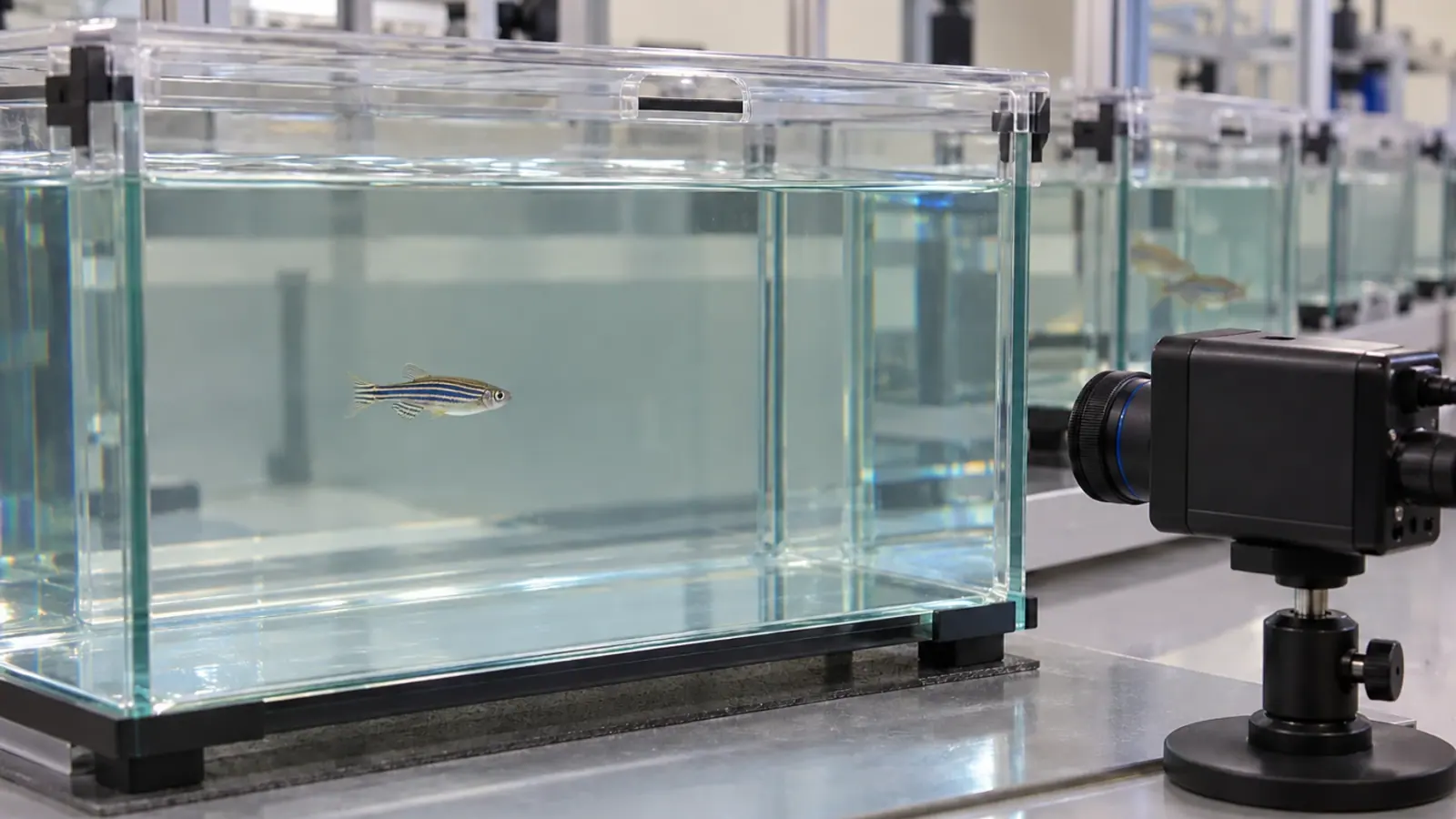
Automated tracking can quantify movement that is difficult to estimate by eye. Deakin and colleagues developed a Fish Behaviour Index combining activity and distance travelled to describe departures from reference behaviour. It can support an alert, but its categories are not an autonomous clinical diagnosis or a direct measurement of subjective experience. Applicability to another strain, males, a social group or a different tank needs to be examined rather than assumed.
Reflections, occlusion, an immobile fish missed by the tracker or mistaken identity in a group can alter the output. Reviewing raw footage alongside extracted measurements helps reveal those errors. Automation must not delay care when clinical signs already require attention. A monitoring plan should identify who receives an alert, who examines the animal and how decisions about treatment or stopping a procedure are documented. A technically complete recording is not sufficient evidence that welfare has been assessed successfully.
Plan an assessment that can guide care
Before the procedure, agree which changes will be sought, when observations will occur and what response will follow deterioration. The intended effect on pain needs to be distinguished from possible interference with inflammation or other experimental endpoints. Selecting a drug, route and duration requires veterinary assessment of that protocol. An experimental concentration reported in a paper is not a general instruction for a different intervention, stage or housing system.
An analgesic assessment is useful when it combines appropriate references, several observations and a clear sequence of events. The 2019 experiment provides an example in individually observed adult AB females; FELASA guidance broadens the framework without erasing those limits. Our training programmes can help research teams develop consistent observation sheets, connect alerts to decisions and distinguish anaesthetic recovery, pain assessment and effects on the scientific results being measured.


