

River antimicrobial resistance: which samples work?
Downstream of a German wastewater treatment plant, resistance markers increased in water and sediment without a matching signal in the fish studied. Sample choice changed the answer.
- Content type
- Scientific news
- Sector
- Environment
- Keywords
- MicrobiomePCRBiosecurity
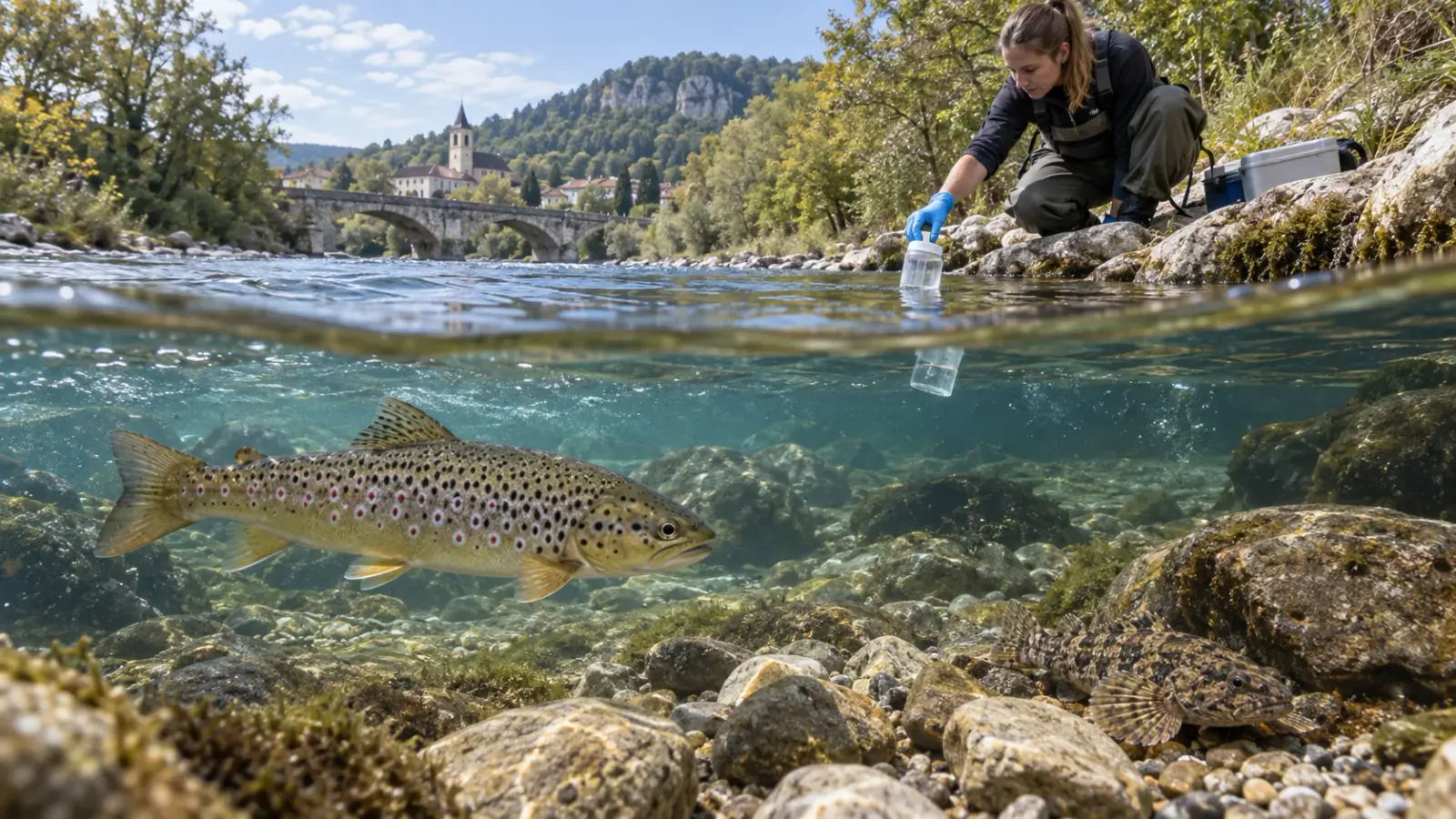
A fish caught in a river may seem to integrate everything moving through its habitat. Yet it is not necessarily the most sensitive indicator of antimicrobial resistance genes in that environment. A study upstream and downstream of a German wastewater treatment plant compared water, sediment, brown trout and European bullhead. Microbial communities changed in several compartments, but the downstream resistance signal measured in the environment was not mirrored in the fish in the same way. The lesson for monitoring is to state the question before selecting the sample.
One Health involves several compartments
Environmental antimicrobial resistance is more than one bacterial isolate or the detection of one gene. Treated effluent can introduce microorganisms, resistance determinants and other pressures to receiving waters. Tskhay and colleagues asked whether fish could indicate resistance pollution and whether effluent associated bacteria might colonise fish microbiomes. Their investigation did not test the food safety of caught fish or the clinical efficacy of an antibiotic in veterinary treatment.
They sampled two species with contrasting habits. Brown trout move actively in the water column; European bullhead are more closely associated with the stream bed. Upstream and downstream samples included water, sediment and fish gill, skin and faecal material. This design offers several views of the same site. One plant and two species cannot, however, represent every European river, season or wastewater treatment process.
The environmental signal was detectable
The authors report a downstream shift in microbial community composition and a significant increase in the six tested resistance genes in water or sediment. Finding a gene does not establish that its carrier is alive, pathogenic or able to transfer that gene to a clinically important bacterium. The sampled matrix, analytical method and setting of the discharge all matter.
Two easy interpretations should be avoided. Treated water can still have a measurable effect on the receiving environment. At the same time, a local increase in molecular markers is not a direct estimate of infection risk to people or animals. That risk needs further evidence about organisms, their hosts, mobility and exposure pathways.
Fish microbiomes and resistomes gave different answers
The microbial communities associated with trout and bullhead reflected some compositional changes seen in river water and sediment. In contrast, the increases in resistance genes found in the environmental samples were not reproduced in the resistomes of the fish material analysed. A resistome is the collection of resistance determinants sought in a particular community; its measured profile depends on the host, tissue and method.
The authors therefore regard these fish as poor sentinels for this kind of pollution under the study conditions. They do not claim that fish can never carry resistant bacteria or that fish health is unrelated to water quality. The conclusion concerns the sensitivity of these fish samples to a particular environmental signal. Failure to detect a statistical difference in fish is not proof that exposure was entirely absent.
Comparing trout and bullhead was useful because they occupy different parts of the river. Their movements and ecology can also affect contact with the bed and water. Different species, seasons or discharge conditions might produce another pattern. A proposed sentinel should be tested against the intended monitoring objective before it becomes routine.
Select samples for the decision at hand
If the goal is to detect change around a river discharge, water and sediment were more responsive than fish for the genes examined here. A design should consider upstream and downstream stations, the mixing zone, repeated sampling and contamination controls. Flow, rain and plant operation influence interpretation. Comparing results without describing those conditions risks assigning every difference to the effluent alone.
If the goal instead concerns fish health, gill, skin or faecal samples may still be useful, but the method and decision rules differ. Sampling animals needs a clear justification and suitable handling; nonlethal methods should be considered where they answer the question. Quantitative PCR provides a molecular signal. On its own it does not demonstrate bacterial viability or actual transfer of a resistance determinant.
A monitoring programme should state its target genes, sample matrices, detection limits, controls, timing and intended action in advance. Negative results and uncertainty belong in the record. Adding fish to every survey may increase cost and animal handling without improving the answer if the real target is a resistance signal in water.
A specific finding, not a universal ranking
The study contributes to One Health monitoring by showing that a visible animal is not necessarily the best integrator of a particular microbiological pollutant. The useful sentinel depends on the process, spatial scale and time frame of interest. For the treatment plant, species and genes examined, water and sediment revealed a change that fish resistomes did not capture. Other settings need to test that hierarchy rather than assume it.
For aquatic environment work, our analysis and diagnostic service can help select sample matrices and interpret findings within their methodological limits.


