

eDNA can support fish indices without replacing field data
Across 91 Flemish lowland river sites, eDNA produced ecological quality classes comparable to a conventional fish index. The result supports a hybrid approach, not immediate regulatory substitution.


- Content type
- Scientific news
- Sector
- Environment
- Animal group
- Fish
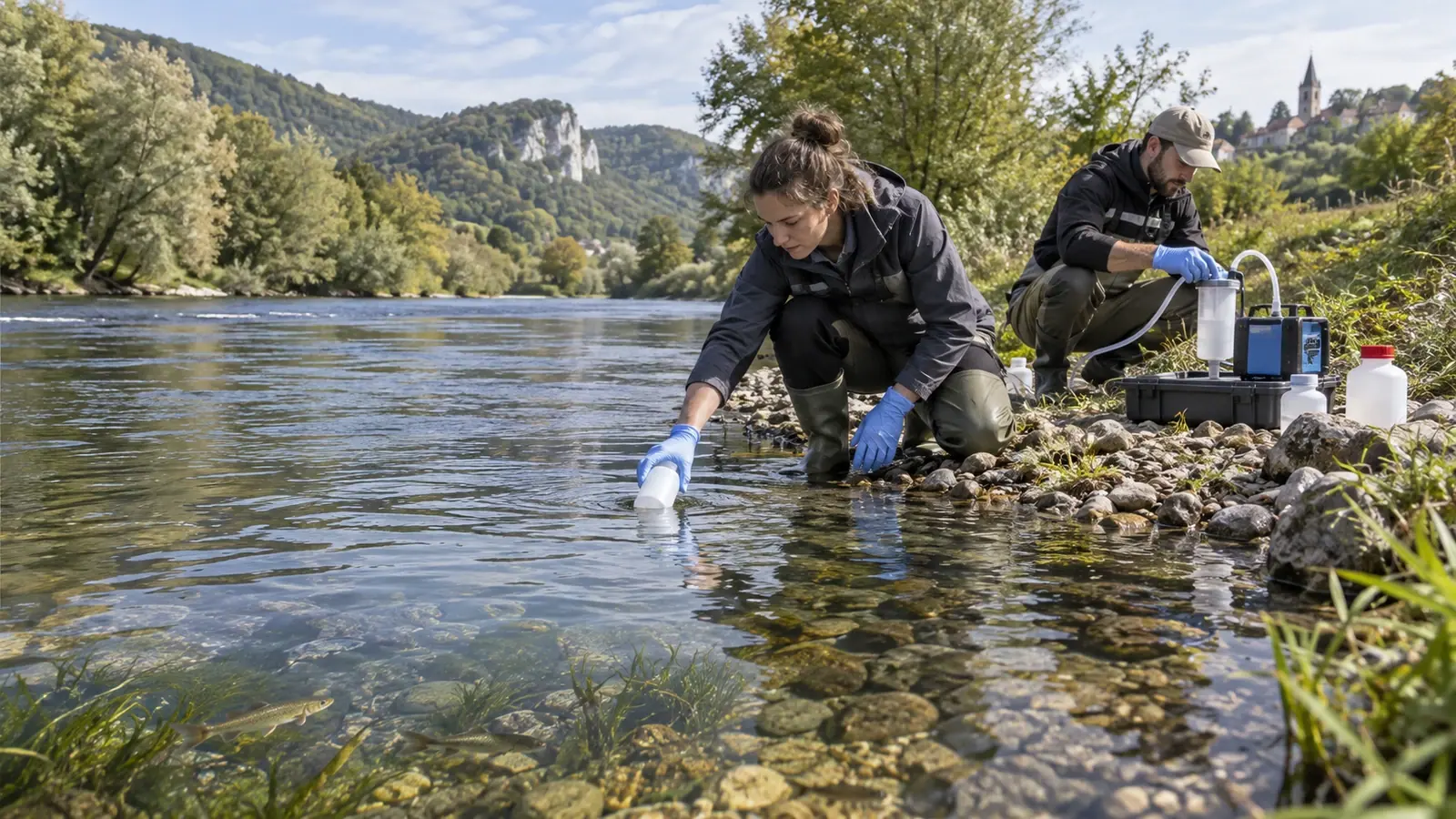
Environmental DNA (eDNA) can inventory fish from genetic traces collected in water. It reduces the need for capture and may detect more species than conventional surveys. For the EU Water Framework Directive (French summary) (WFD), however, the task is not merely to make a list. Monitoring must generate an ecological index that remains comparable over time, among methods and across jurisdictions.
Van Driessche and colleagues compared eDNA metabarcoding with electrofishing at 91 Flemish lowland river sites spanning a habitat-pressure gradient. They examined species richness, metrics within a fish-based Index of Biotic Integrity, Ecological Quality Ratios and final classes. The study therefore evaluates a decision-relevant application while stopping short of claiming universal regulatory adoption.
Higher richness does not mean the same measurement
eDNA consistently detected more species than electrofishing and showed high within-site replicability. This does not automatically make one method correct and the other inadequate. They sample different signals.
Electrofishing observes fish in a defined reach and provides size, relative abundance and sometimes recruitment information. Performance changes with conductivity, depth, habitat, effort and species. eDNA integrates fragments that are released, transported, diluted and degraded. Results depend on sampling design, discharge, primers, reference databases, contamination control and bioinformatics.
An eDNA detection may originate upstream or from a low-density species missed during capture. A captured fish may fail to amplify because of primer bias. Evaluation should therefore focus on whether each method provides the information needed, not on a contest between species lists.
Comparable ecological classes in this data set
Despite differences in individual metrics, eDNA-derived Ecological Quality Ratios did not differ significantly from those calculated with the conventional fish index. Both approaches produced seasonally stable values and consistent negative responses to increasing habitat pressure.
Ecological Quality Classes were comparable in this data set. That finding matters because it shows that eDNA signal can be transformed into ecological assessment information rather than being limited to species-presence confirmation.
The scope remains specific: Flemish lowland rivers, one index and a defined protocol. The authors identify eDNA-native indices and typology-specific calibration as necessary next steps. The results cannot automatically validate every marker, catchment or river type.
Why hybrid monitoring is credible
The proposed approach uses eDNA for broad, repeatable and potentially cost-effective status assessment, with targeted electrofishing when recruitment, size or population-structure information is required. This avoids demanding data that eDNA does not yet provide robustly.
A hybrid network could also increase spatial or temporal coverage. More frequent water samples may flag a community shift or unexpected species and direct field investigation. Conventional methods retain essential roles in reference calibration and detailed biological characterisation.
Benefits materialise only when hidden costs are included: field and laboratory blanks, replication, filter preservation, sequencing, taxonomic validation, bioinformatics, data storage and quality assurance. Collecting a bottle of water is simple; producing a defensible ecological class requires a complete chain.
Calibrate before considering substitution
Managers testing eDNA should begin with parallel surveys at representative sites. Protocols define water volume, replication, season, sampling position, filtration, preservation, negative controls and read thresholds. Hydrological and physicochemical metadata are retained to interpret signal transport and degradation.
Primer choice is critical. A set may preferentially amplify some groups or fail to resolve close species. Reference libraries must represent local fauna with verified identifications. Missing sequences, erroneous records and cross-contamination require documentation rather than silent removal.
Intercalibration compares ecological classes, not only species counts. It examines divergent sites, seasonality, habitat pressures, plausible false negatives and the influence of rare taxa. Tuning a bioinformatic threshold merely to force agreement would undermine transferability.
Independent positive controls and field blanks must travel through the full workflow. They show whether extraction and amplification performed as expected and whether contamination entered during sampling, filtration or laboratory processing. Replicates should be interpreted with a rule established before the results are seen. Otherwise, a weak detection can be accepted or rejected selectively to support the expected ecological class.
Define the professional decision first
Before integrating eDNA, name the intended use: exploratory surveillance, index supplementation, early detection, restoration follow-up or statutory assessment. Each requires a different level of validation. Laboratories, river managers and fish experts need shared acceptance criteria and a procedure for discordant findings.
Traceability covers filter lots, reagents, raw reads, database versions and scripts. Structured preservation allows reanalysis as taxonomy and tools improve. This advantage exists only when both data and metadata are retained.
Procurement and governance also need attention. A monitoring authority should specify data ownership, minimum metadata, audit access, retention periods and how pipeline updates are validated. Changing a reference database or classifier can alter a species list even when the original water sample is unchanged; version control is therefore part of ecological comparability, not merely an information-technology detail.
The 2026 study therefore supports progressive integration rather than a regulatory shortcut. eDNA can expand monitoring coverage and produce comparable classes under validated conditions. Electrofishing remains necessary for biological information that DNA traces do not directly describe.
This methodological choice sits within the wider challenge of monitoring aquatic environments and wildlife, where the method must remain proportionate to the decision it is intended to support.
Vetofish can support comparative survey design, contamination-control plans, interpretation of disagreements and translation of results into monitoring decisions. The aim is to add a robust method to the existing network without confusing analytical sensitivity with demonstrated ecological status.
To move from evidence to action, explore our advice and support service .


