

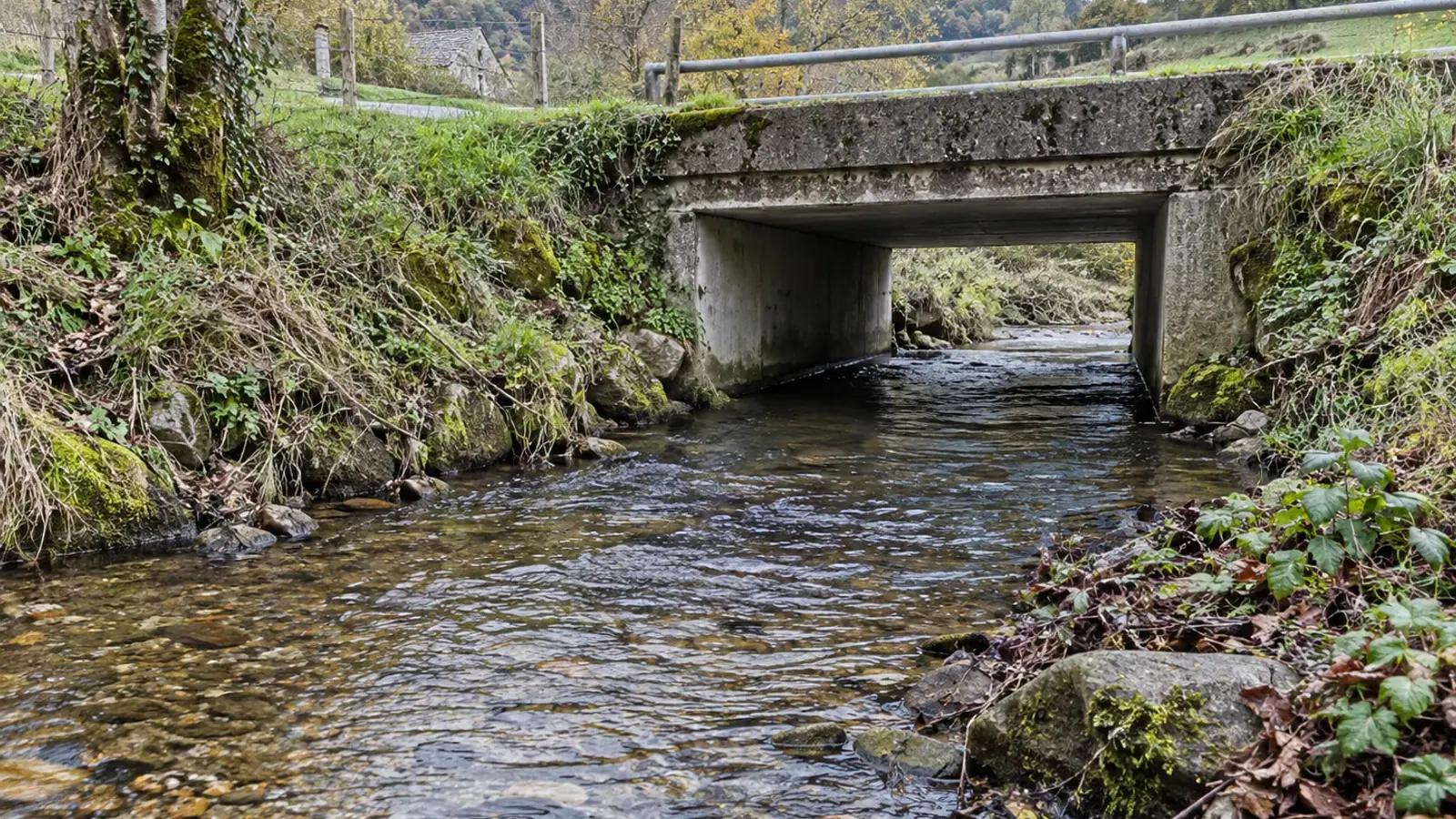
Road culverts: does slower water mean better fish passage?
Baffles can improve small fish passage in some culverts, but lower average water velocity does not establish success. Assessment needs to connect access, a usable route and biological monitoring.
- Content type
- Practical guide
- Sector
- Environment
- Animal group
- Fish
- Keywords
- ReproductionTelemetryTemperature
Assess the whole route beneath the road
A culvert can convey water beneath a road while preventing fish from moving under the conditions they require. Preparing an improvement therefore involves more than establishing that water flows through. Assessment needs to consider access, the route inside the structure, the exit and the habitats that fish need to reach.
This guide draws on Franklin and Baker’s 2025 synthesis of evidence on baffles for small-bodied fish. It does not report a new French field trial. The practical purpose is to help managers define the questions that should precede a technical choice and decide how the biological outcome will be checked. Recommendations for organising that assessment are distinguished from the findings of the review.
What the review supports
The authors compare several baffle families, including transverse, side-wall and longitudinal arrangements. Improved passage is reported in some circumstances, but responses depend on species and configuration. Large recirculation zones can disorient fish or delay movement, so reducing average velocity does not explain the whole outcome.
Evidence comes predominantly from the Southern Hemisphere and a limited range of fish groups. Longitudinal baffles have biological testing in rectangular channels, without equivalent pipe-culvert validation in the synthesis. The review addresses velocity barriers inside culverts rather than interventions for outlet drops.
These limitations rule out selecting a device solely because it worked elsewhere. The geometry and target fish must remain explicit in the reasoning. Dimensions used in an experiment are not universal design instructions. Applying the evidence in France, or any other setting, requires a local assessment rather than an assumption that the tested species and hydraulic conditions are interchangeable.
Start with access and the ecological objective
Before assessing equipment inside a culvert, describe the downstream approach. A drop, inadequate depth or an inaccessible entrance can prevent fish using a favourable route further inside. Record water level and discharge because a single visit cannot represent conditions throughout the year.
Define the objective at catchment scale: which habitats are separated, for which species and life stages? Connecting a growth area or refuge to spawning habitat is a different objective from connecting two similar reaches. A simple map can show what the project is intended to make accessible and where other barriers might limit that benefit.
This avoids treating every culvert as the same problem. Assessment should consider required movements, other obstacles and the limitations of available observations. Not seeing fish during a visit does not establish that connectivity is unnecessary. Equally, a general conservation objective needs a more precise biological question before it can guide a design or monitoring programme.
Describe a route fish can use
Average velocity is informative, but fish encounter local changes in flow speed, depth and direction. Orientation relative to flow helps explain why an apparently quiet area may not provide a straightforward upstream route. A baffle’s effect should be assessed against the path available to the animal rather than a single mean measurement.
A preparatory survey can describe culvert length, slope, shape, water levels and places where passage becomes constrained. Materials, deposits and existing structures also need recording. This is a proposed diagnostic approach, not a sufficient method for designing an installation without hydraulic expertise. Local measurements and biological interpretation need to inform each other.
The assessment should identify target species and stages explicitly. A result from one group of small fish does not establish effectiveness for all species, particularly where modes of movement differ. An intervention may improve one passage problem while leaving others unresolved. The limits of the chosen objective need to remain clear in the specification and final report.
Plan biological monitoring before installation
Define the outcome before fitting baffles. Is the goal to enable entry, increase the proportion of fish completing passage or reduce delay? These questions require different observations. Seeing a fish upstream does not establish effectiveness for all fish approaching the structure.
The denominator matters. Fish present in the reach, fish arriving at the entrance and fish entering the culvert are different groups. Sampling needs to suit the species, body size and site conditions. Telemetry may be appropriate where its constraints are compatible with the animals and question; it is not an automatic solution for the smallest life stages.
Monitoring should retain hydrological conditions and water temperature during observations. A before-and-after comparison that ignores environmental differences risks attributing those differences to the equipment. Defining observation periods and detection limitations helps distinguish failure to pass, failure to detect and lack of usable data. The proposed monitoring method should also explain how those uncertainties will affect interpretation.
Keep a route to reassessment
An operational plan should identify who inspects the installation, who interprets results and which observations trigger reassessment. Debris accumulation or a change in the water route warrants examination rather than an assumption that the initial design remains effective. Maintenance and monitoring belong in the project from the outset.
When evidence is insufficient, the report should say so. Encouraging hydraulic measurements do not replace the biological outcome being sought. Conversely, passage observed under certain conditions does not guarantee performance during every relevant period. Limitations belong in the technical conclusion and should remain visible when the result is communicated to decision-makers.
Choose through connected evidence
An intervention is justified through the ecological objective, access, a usable route and suitable verification. The 2025 synthesis supports considering baffles as an option while showing that designs cannot be treated as interchangeable. Prepare diagnosis and monitoring together, before equipment is installed.
Vetofish can contribute to identifying target species, biological constraints and useful surveillance questions. Our advice and support service works on environmental projects to connect aquatic expertise, site evidence and outcome assessment alongside specialists responsible for the structure.


