

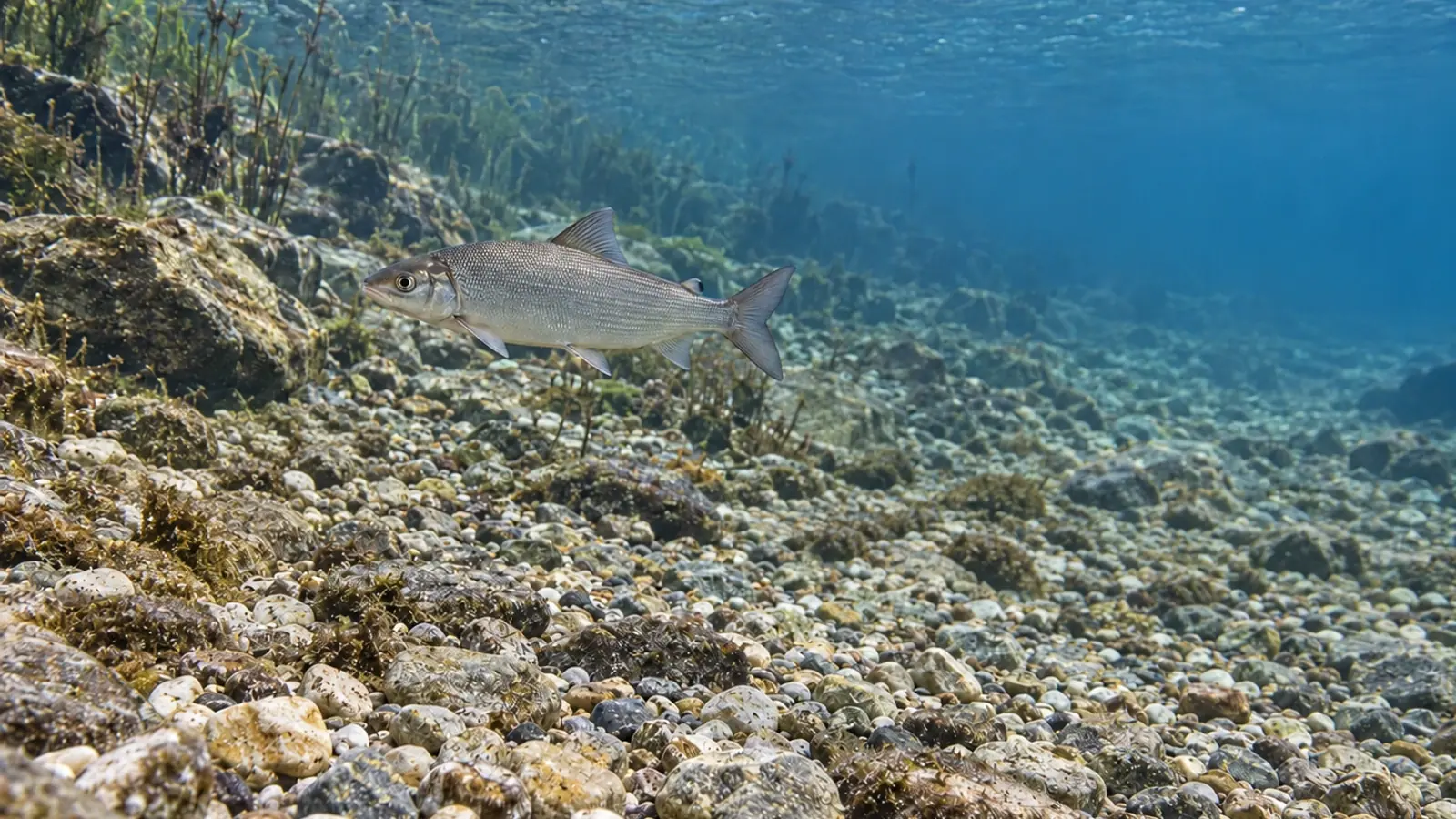
Lake Geneva whitefish: acoustic detections measure activity
The same fish can pass through an acoustic camera’s view more than once. In a June 2026 report, INRAE and OFB researchers describe how imaging sonar tracks whitefish activity at a Lake Geneva spawning site, and why those detections need careful interpretation.


- Content type
- Scientific news
- Sector
- Environment
- Animal group
- Fish
- Keywords
- ReproductionLightingTemperature
A repeat detection does not necessarily mean another fish
A whitefish can leave an imaging sonar’s view and return to it. Adding those detections does not directly give the number of individual fish in a lake. Jean Guillard and colleagues explain this distinction in their report on acoustic-camera monitoring in Lake Geneva, published on 10 June 2026.
The Sciences Eaux & Territoires paper presents two lake applications, including observations of whitefish, Coregonus spp., at a known spawning site. This part of the work primarily describes local activity over time. That information is useful for studying the reproductive season, provided its meaning is retained in graphs and management decisions.
Detection totals also depend on what the instrument can observe. A series may change because fish use the site differently, recording conditions deteriorate or processing retains more targets. The biological question guides how the count should be interpreted.
Observe a known spawning site within a defined window
For the whitefish observations, an ARIS Explorer 3000 camera operated at 1.8 MHz. It was positioned one metre below the surface and directed towards the shore at a site where whitefish presence was confirmed. Recording periods ran from 15 to 23 December 2020 and from 12 to 24 December 2023.
These are the field observation dates, distinct from the report’s publication in 2026. They describe two winter windows at a site chosen for its reproductive use. They do not represent a census of all Lake Geneva habitats or uninterrupted monitoring across several years.
Location is part of the sampling design. A fixed camera records its detection field; it does not automatically describe fish remaining outside that field. Recording orientation, depth, duration and interruptions makes it clearer which set of observations can actually be compared.
Acoustic images extend observation beyond clear daylight
An acoustic camera uses sound pulses and their returning echoes to form images. It does not depend on the lighting needed by an optical camera and can operate in turbid water. This makes it useful for continuous monitoring that includes night-time activity.
Darkness and turbidity are not the only constraints, however. The geometry of the detection field, fixed structures and movements of vegetation or the water surface can affect detections. A readable image does not establish that every target is a fish or that neighbouring targets have been separated correctly.
The report also identifies practical requirements for electrical power, data storage and processing. A monitoring programme needs to identify recording gaps and retain its settings alongside the files. Collecting a large volume of data does not by itself make the answer to an ecological question more reliable.
These requirements matter when comparing seasons. A technically interrupted period should not silently become an interval with zero fish. Preserving the difference between an observation of no target and a missing observation is part of keeping a time series interpretable.
Check automated processing against a reference
The researchers first removed static elements and small targets during preprocessing. Manual counts were then aggregated by hour to construct an activity series. Two experienced operators independently reviewed a subset of the data to examine variation in manual interpretation.
The same sequences were processed with Sonar5-Pro and FishTracker. In this comparison, Sonar5-Pro settings targeted fish larger than 20 centimetres. That threshold belongs to the processing of this dataset. It does not define the minimum size of all whitefish or a general biological threshold for their populations.
The report describes close correspondence between manual counts and software output under the conditions studied. Strong correlation indicates related patterns, but does not prove that every count agrees. Local validation benefits from examining difficult sequences and false detections rather than relying on one overall performance measure.
Waves change how much confidence to place in the series
Strong winds during the 2023 season disrupted detections and affected both software packages. A configuration that performs satisfactorily in calm water cannot therefore be treated as validated for every condition. Retain weather events that change image quality in the monitoring record.
An apparent increase in activity during a deterioration in the signal warrants a return to the underlying sequences. Review can distinguish plausible additional passages from artefacts associated with the surface or another moving element. Periods of uncertainty should remain identifiable in the final dataset.
At the spawning site, the reported rhythms included peaks near sunset and sunrise as well as night-time peaks. They illustrate the value of covering several parts of the daily cycle. They do not justify replacing all monitoring with a visit at one supposedly universal representative hour.
Keep activity, abundance and reproductive outcome distinct
The camera records presence and movement within a defined area. Population abundance requires a further inference, with assumptions about detection, return visits and the area covered. Moving between these interpretations without stating the assumptions turns the indicator into an estimate it has not supplied.
Activity over a spawning ground also does not directly measure egg survival or later recruitment. Depending on the management question, other observations are needed to link site use to the population’s renewal. Imaging sonar contributes a temporally detailed part of that assessment, complementing information that occasional site visits cannot provide.
The choice of method should follow the question. A programme concerned with the timing of site use may find an activity series informative. A programme seeking a lake-wide population estimate needs a design that supports that different inference. The equipment’s ability to produce clear images cannot substitute for the distinction.
Conclusion and support from Vetofish
Acoustic monitoring of whitefish helps describe when a spawning site is used. Its value depends on the field observed, checks on processing and the treatment of uncertain periods. Reporting detections as local activity preserves the useful scope of the result.
Vetofish can help define monitoring questions, assess indicators and connect them with the health and ecological condition of the fish. Equipment selection and validation follow that definition, in collaboration with specialists in the acoustic system being considered.
To move from evidence to action, explore our advice and support service and our expertise in aquatic environmental health.


