

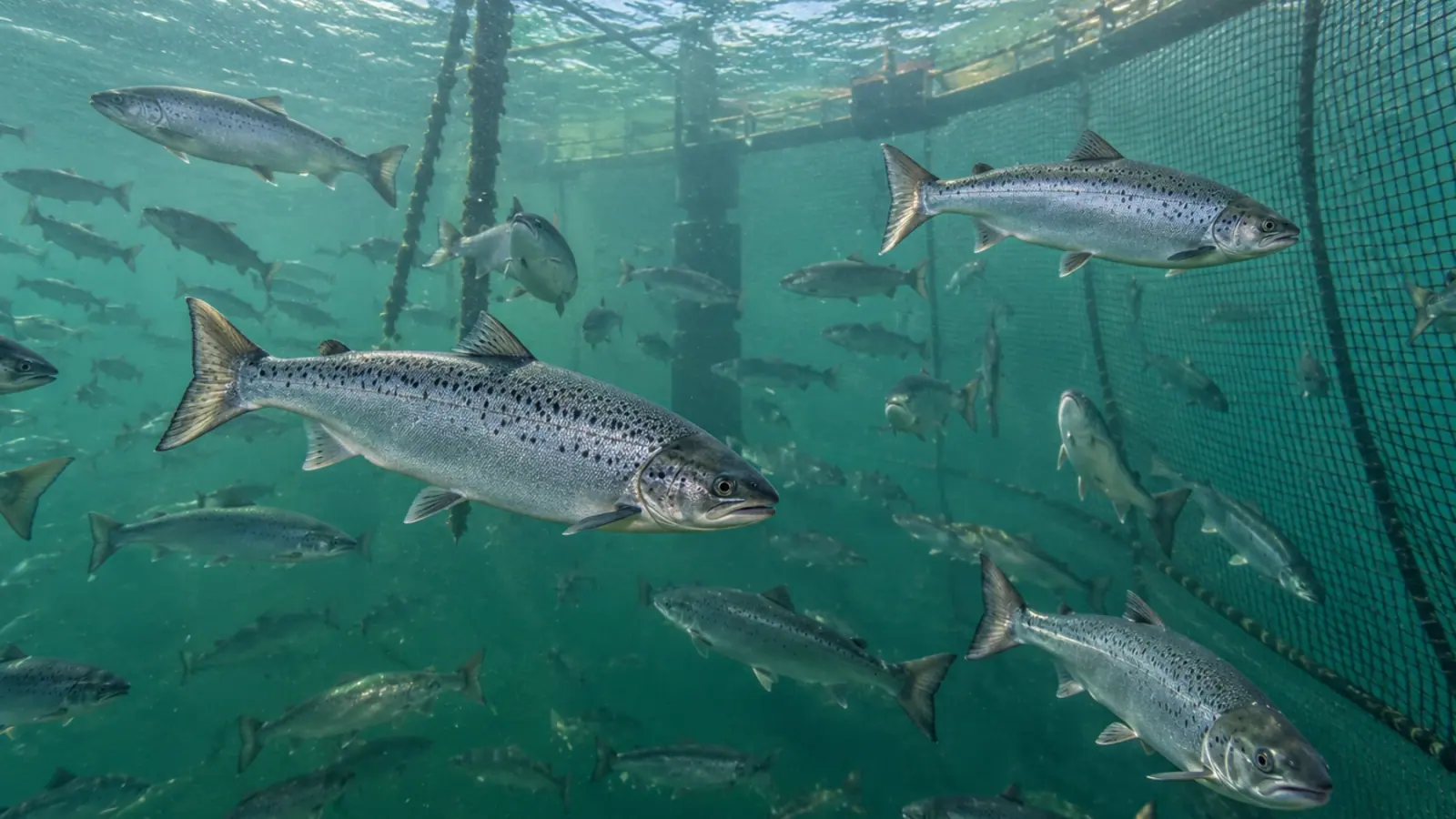
Salmon gills: combine observations with laboratory findings
An experiment in young Atlantic salmon found microbial and molecular changes after warming and reduced oxygen, without significant differences in visible gill scores. The findings expose the limits of isolated observations; they do not validate a new diagnostic test.


- Content type
- Scientific news
- Sector
- Aquaculture
- Animal group
- Salmonids
Gill appearance captures one part of the picture
Farmed salmon exchange respiratory gases through gills that remain in direct contact with the water. Visible changes provide useful evidence of injury, but cannot describe every response taking place within that tissue. A gross gill score and a molecular analysis address different questions. That distinction determines how much diagnostic weight each result can support.
The 2020 review by Boerlage and colleagues describes the range of marine gill diseases affecting Atlantic salmon. Infectious agents, plankton and environmental insults may contribute, sometimes together. The review supports investigations that combine observations, farm history, water conditions and appropriate examinations. Calling a condition complex does not identify a single cause that one sample could settle.
An experiment with several biological readouts
Toxqui-Rodríguez and colleagues published their experiment in August 2026. Young Atlantic salmon, Salmo salar, first underwent a 26-day phase comparing constant temperature, warming followed by return to the starting temperature, and the same warming pattern combined with reduced oxygen. Two tanks were used for each condition during this phase.
In a subsequent challenge, some fish were exposed to macerated material from the jellyfish Aurelia aurita, followed by recovery. Investigators assessed gross gill appearance, bacterial communities and gene expression. These measurements brought together a visible assessment, a description of the microbiota and a cellular response. They were not three equivalent ways of diagnosing disease.
At the final assessment, gross gill scores did not differ significantly between groups and no mortality was recorded. Microbial and gene-expression changes were nevertheless detected, particularly in relation to earlier thermal conditions. A relatively unchanged external appearance can therefore coexist with a measurable biological response. This does not establish the clinical importance of every molecular difference.
A bacterial profile does not establish causation
Microbiota refers to the microorganisms associated with a particular site. Here, sequencing targeted part of the bacterial 16S gene to characterise the communities detected on the gills. Such a profile does not by itself establish whether an organism is viable, invading tissue or causing disease in another farm population.
Likewise, identifying a bacterial genus that includes pathogenic species does not make every sequence assigned to that genus a disease finding. Relative abundance can change because other community members have changed. Investigators need to distinguish an altered community, identification of a particular organism and evidence supporting that organism’s clinical role.
Gene-expression measurements describe transcriptional activity at the sampling time. Responses associated with defence or repair can generate hypotheses without proving persistent respiratory impairment. The experiment does not provide a molecular profile that automatically justifies treatment or movement of a farmed stock. Diagnostic decisions still require the clinical and environmental setting.
Design limits matter when applying the findings
There was no treatment exposed to reduced oxygen alone. The experiment consequently cannot isolate an independent oxygen effect or demonstrate synergy between warming and oxygen reduction. Fish sharing a tank also share their environment: increasing the number sampled does not increase the number of independent tank replicates.
During the jellyfish challenge, fish from the earlier conditions were brought together in one exposed tank and one control tank. That arrangement limits conclusions specifically attributable to the challenge. The jellyfish material had also been frozen and macerated. It does not fully reproduce contact with living jellyfish in a marine cage, and the lack of a significant microbiota response cannot establish that natural blooms are harmless.
The study concerns young salmon under controlled conditions. A marine farm adds variation in currents, depth, stocking, handling and infectious exposure. Experimental observations can guide the questions asked during an investigation, but cannot supply a health threshold suitable for every cage or every stage of production.
Sample to answer a defined clinical question
A gill investigation should begin with the distribution and timing of signs. Which stocks are affected, and when did changes begin? Have feeding, ventilation or swimming changed? Earlier events, including handling or a temperature shift, help place laboratory findings in sequence. Records should identify the fish and locations examined, rather than presenting a context-free average gill score.
Dissolved oxygen and temperature records need timestamps and positions that can be aligned with animal observations. A reading collected away from the fish, or after conditions have recovered, may fail to describe the relevant episode. Water monitoring is essential evidence, but does not replace examination of the fish themselves.
Histology examines tissue organisation and microscopic lesions. Other tests may target a suspected agent or explore a microbial community. Before sampling, the veterinarian and laboratory should agree the question, selection of fish and preservation requirements. Different examinations may need different material; a sample collected for one purpose cannot always be repurposed for another.
Resolve disagreement through interpretation
When gross appearance and laboratory findings disagree, the next step is to examine what each method measures, its timing and its limitations. A positive result does not remove the need to consider alternative causes. An unchanged visible score does not exclude every biological response. Clinical signs and the subsequent course of the stock remain central to a defensible health decision.
Our diagnostic and laboratory service can help plan a gill investigation and interpret its findings. Through our work with aquaculture facilities, we support sampling strategies matched to the site and clinical problem, rather than treating an isolated laboratory result as the whole diagnosis.


