

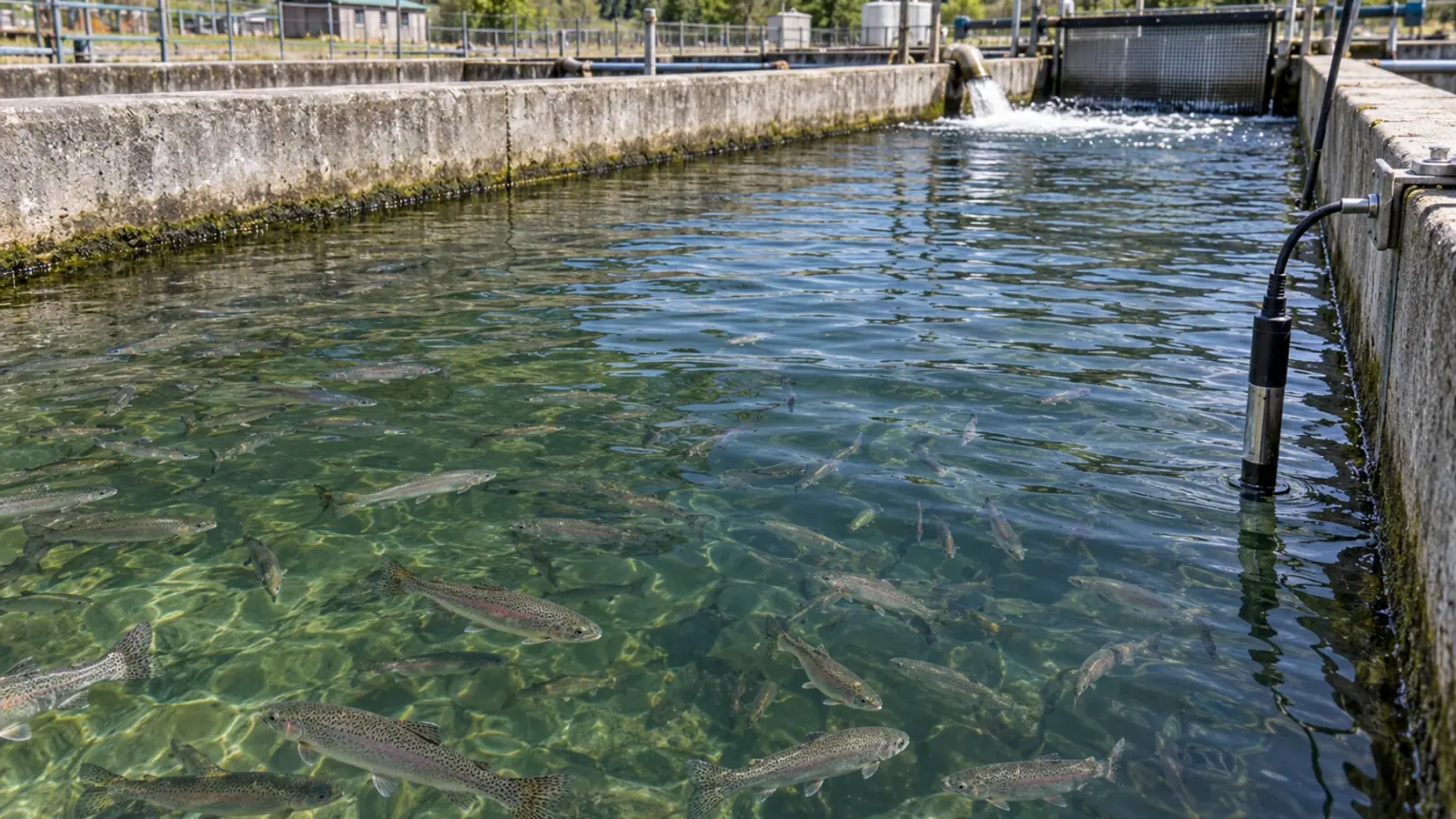
Rainbow trout: extra oxygen offers limited protection from heat
An August 2026 experiment found little evidence that oxygen supersaturation improved rainbow trout tolerance of acute warming. For farms, securing oxygen supply still leaves a separate task: controlling exposure to heat.


- Content type
- Scientific news
- Sector
- Aquaculture
- Animal group
- Salmonids
- Keywords
- OxygenTemperatureStress
Oxygen supply and heat exposure need separate assessments
On a rainbow trout farm, a satisfactory dissolved oxygen reading does not describe the whole thermal challenge. Dissolved oxygen measures what is available in the water; temperature also affects the fish’s demands and physiological functions. Adding oxygen can address one environmental constraint without ensuring that fish will tolerate further warming.
An experiment by Imogen Bellinger, Heather Bauer Reid and Graham Raby, published in the Journal of Experimental Biology in August 2026, examined this distinction. It compared water at approximately 100% oxygen saturation with water at about 150% during acute warming. Fish were tested both during sustained swimming and without an imposed swimming current. The study did not test a farm-wide mortality prevention programme.
Following one cohort through different challenges
The initial cohort consisted of sixteen hatchery-sourced rainbow trout, Oncorhynchus mykiss. Researchers first established each fish’s critical swimming speed. In the subsequent warming trials, swimming fish worked at 85% of their individual critical speed. A separate trial type assessed warming tolerance in a static chamber.
The endpoints differed: swimming failure in one test and loss of equilibrium in the other. Temperature rose in steps equivalent to 2°C per hour. Those conditions allowed an experimental comparison; they provide neither an acceptable warming rate for production nor a recommended temperature for holding stock.
Repeated trials allowed comparisons within individual fish, with recovery periods between challenges. Available sample sizes nevertheless changed: sixteen fish completed the normoxic swimming trial, fifteen the hyperoxic swimming trial, and eleven per treatment were available for the static trials. Repeated observations should not be counted as additional independent animals.
The apparent benefit depends on the analysis
A simple paired comparison suggested a small improvement in swimming thermal tolerance under hyperoxia, averaging about 0.66°C. The effect was no longer statistically supported in the overall model accounting for fish identity and differences in variability between trial types. Reporting the initial difference alone would therefore give an incomplete account.
The static trials did not establish a hyperoxia benefit either. Oxygen consumption measurements also provided little evidence of an increase under the enriched oxygen treatment. The experiment supports, at most, limited and uncertain thermal protection under its tested conditions.
The endpoint itself mattered. Fish reached swimming failure at lower temperatures than those producing loss of equilibrium in the other test. A fish can therefore lose the ability to sustain an activity while retaining its posture. On a farm, waiting for loss of equilibrium would overlook earlier changes in function.
What the experiment cannot resolve
This was a small cohort, and fish grew during the study. Trial types followed a defined sequence, and the authors report mortality during the protocol, reducing the numbers available for later comparisons. The findings cannot be transferred directly to other strains, body sizes, exposure durations or farming systems.
Respirometry estimated metabolic responses from oxygen consumption. It did not identify a single mechanism responsible for the thermal limit. Gill function and oxygen delivery are involved in performance, but the experiment does not establish them as the universal explanation for failure at high temperature.
Crucially, the comparison was between normoxia and oxygen supersaturation. It did not assess the benefit of correcting hypoxia. The results therefore provide no basis for relaxing oxygen monitoring or removing emergency oxygen equipment. They address the additional protection expected above normal oxygen saturation during a specific acute challenge.
Keep both decisions visible on the farm
The practical implication is to track oxygenation and thermal exposure separately. An improved oxygen reading should not cancel a temperature alert in the farm record. Measurements need a time and location, together with relevant flow, biomass and behavioural observations.
The effort required of fish deserves attention as well. A production current is not equivalent to a laboratory swimming challenge, and grading or transfer creates another context again. Before an operation during warm conditions, the team can review whether it is necessary, whether it can be postponed and what observations would trigger its interruption.
Distinguish the equipment setting, the conditions reaching the fish and the animals’ response. A reading at the head of a circuit does not replace observations elsewhere in the raceway. Nor can a single saturation percentage establish the overall stress response. Feeding, swimming, ventilation and the timing of incidents help explain what the stock is experiencing.
This approach also improves communication between the people following the water system and those observing animals. A shared record can show whether a change preceded a technical intervention, appeared afterwards or affected only part of a site. That chronology supports investigation without treating coincidence as proof of cause.
Plan for warm periods before they arrive
The experiment shows why one technical measure cannot represent the tolerance of an entire stock. Adequate oxygenation remains necessary, alongside a plan addressing heat exposure and planned activities. The paper does not supply a universal 150% saturation target or a safe farm temperature threshold.
Vetofish’s advice and support service can help connect water records, hydraulic operation and trout observations. For aquaculture teams, the useful output is a clear set of alerts, responsibilities and reassessment criteria established before warm conditions develop.


