

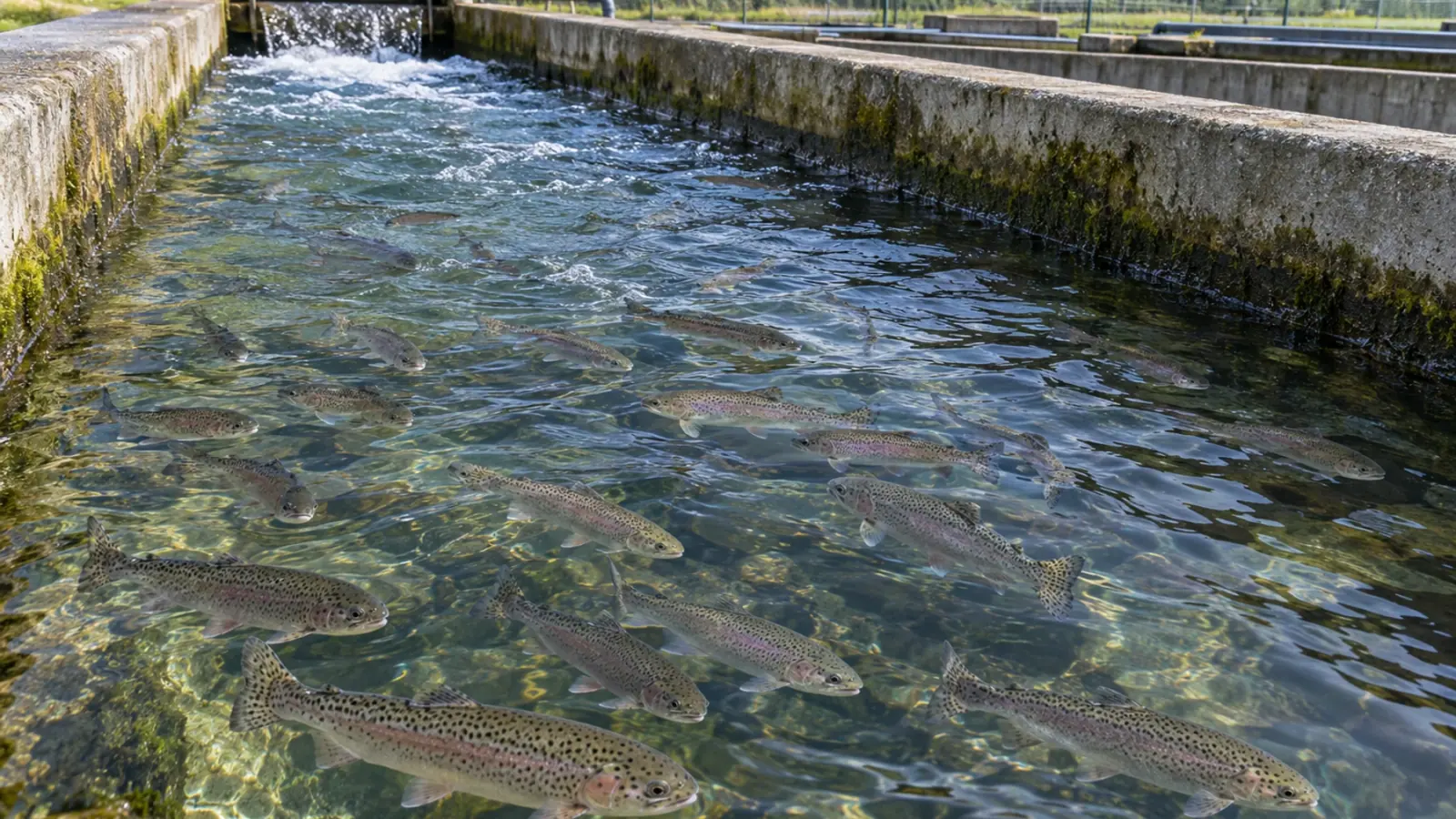
Farmed salmonid PKD: connect the parasite cycle to diagnosis
Proliferative kidney disease reflects interactions between a parasite, its hosts and the water’s thermal history. Salmonid farms can use that life cycle to plan surveillance and distinguish parasite detection from clinical disease.
- Content type
- Disease profile
- Sector
- Aquaculture
- Animal group
- Salmonids
Pale gills, reduced feeding and rising losses during warm weather can raise suspicion of proliferative kidney disease, or PKD, in a trout farm. None of those signs identifies the disease on its own. Other infections, deteriorating water conditions or several problems acting together can produce a similar picture.
Reviews by Sudhagar and colleagues and by Ros and colleagues describe a disease whose exposure pathways extend beyond a rearing tank. The causative parasite, Tetracapsuloides bryosalmonae, uses both salmonids and small freshwater invertebrates. River-fed farms therefore need to examine the incoming water and its temperature history alongside fish health.
Follow the life cycle beyond the fish
The parasite is a myxozoan, part of a highly specialised group of cnidarians. Its life cycle involves freshwater bryozoans, colonial animals that grow on submerged surfaces such as plants, wood and stones. Infected colonies release spores into water shared by susceptible fish.
Within a salmonid, the parasite reaches several tissues, particularly the kidney. Infection and the associated inflammatory response can enlarge the kidney and disrupt important functions, including blood cell production. Anaemia and declining condition may accompany disease, but their severity depends on the host and the circumstances.
Different trout species play different roles. European brown trout, Salmo trutta, can contribute to transmission back to bryozoans and may remain carriers after clinical recovery. Rainbow trout, Oncorhynchus mykiss, have a different relationship with European parasite lineages. Treating PKD as a simple chain of direct trout-to-trout transmission would overlook the invertebrate host that is central to this cycle.
This distinction matters when farms exchange animals or share water sources. A fish that appears recovered has a history that remains relevant to a receiving site. The absence of visible disease at dispatch cannot replace that history or a documented assessment of the receiving system.
Use temperature records to reconstruct exposure
Temperature affects bryozoan development, the production of parasite stages and the fish’s response. The reviews describe a generally stronger clinical expression during warm periods. They also show that parasite burden and kidney damage do not necessarily rise or fall together.
A measurement taken when losses become obvious cannot reconstruct exposure during the preceding weeks. Farms benefit from retaining temperature series at the intake and in rearing units, alongside flow records, changes in water supply and the arrival dates of fish batches. Tanks with the same temperature today may have experienced different exposure histories.
Temperatures tested in individual experiments are not universal safety limits. Colder water does not establish freedom from the parasite, while warmer water does not confirm PKD. Abrupt cooling or an unassessed transfer to another circuit may add stress and move a health risk elsewhere. Decisions about environmental changes need to consider the fish and the system together.
Ask what each diagnostic result establishes
Start with a map of affected animals and units: species, age, source, tank, water circuit, first signs and the course of losses. Clinically affected fish and apparently unaffected batches provide different information. The veterinarian and laboratory should agree on collection and preservation before treatment or poor sample handling makes interpretation harder.
PCR searches for a genetic target from the parasite. Histopathology examines kidney structure, tissue damage and visible parasite stages. Together, these methods help distinguish detection of an agent from the assessment of lesions and other possible causes. A positive PCR result alone does not quantify clinical severity.
A negative result also needs its sampling context. Species, infection stage, tissue choice, sample quality and the number of fish examined all affect the conclusion that can be drawn. Reports should identify the animals and epidemiological units represented, rather than describe an entire facility as free of infection after a small set of examinations.
Prioritise exposure pathways that the farm can control
Eliminating the parasite from an entire river is not a practical control objective for an open farm. Work instead on assessable pathways: water source, connections between circuits, fish movements, shared equipment and batch health records. Any proposed water treatment needs evaluation at the actual flow, including bypasses and maintenance requirements.
Finding bryozoans near an intake is not a diagnosis of PKD. It may justify a closer review of local conditions and hydraulic links. Equally, cleaning one submerged surface does not demonstrate removal of every parasite stage from a circuit or its water supply.
During a suspected episode, the immediate priorities are stable water conditions, useful diagnostic samples and avoidance of unnecessary transfers. Monitoring oxygen, feeding and behaviour supports fish care while the investigation proceeds. Record substantial husbandry changes so that subsequent improvement can be interpreted alongside the natural course of disease.
Keep the limits visible when planning the next cycle
The two reviews draw on different salmonid species and both farm and river settings. They are not a controlled comparison of every preventive option available to trout producers. River restoration measures discussed by Ros and colleagues mainly address wild populations; their relevance to a farm intake requires local assessment.
For production teams, the useful conclusion is to establish surveillance before the higher-risk season and interpret results through species, lesions and exposure. Falling losses do not prove that the parasite has been eliminated or that recovered fish cannot remain carriers. Retaining those distinctions makes the next production cycle easier to monitor and investigate.
Vetofish can help define a sampling plan and interpret findings through its diagnostic and laboratory support service. This aquaculture health support can be adapted to the farm’s fish batches, water supply and connected rearing units.


