

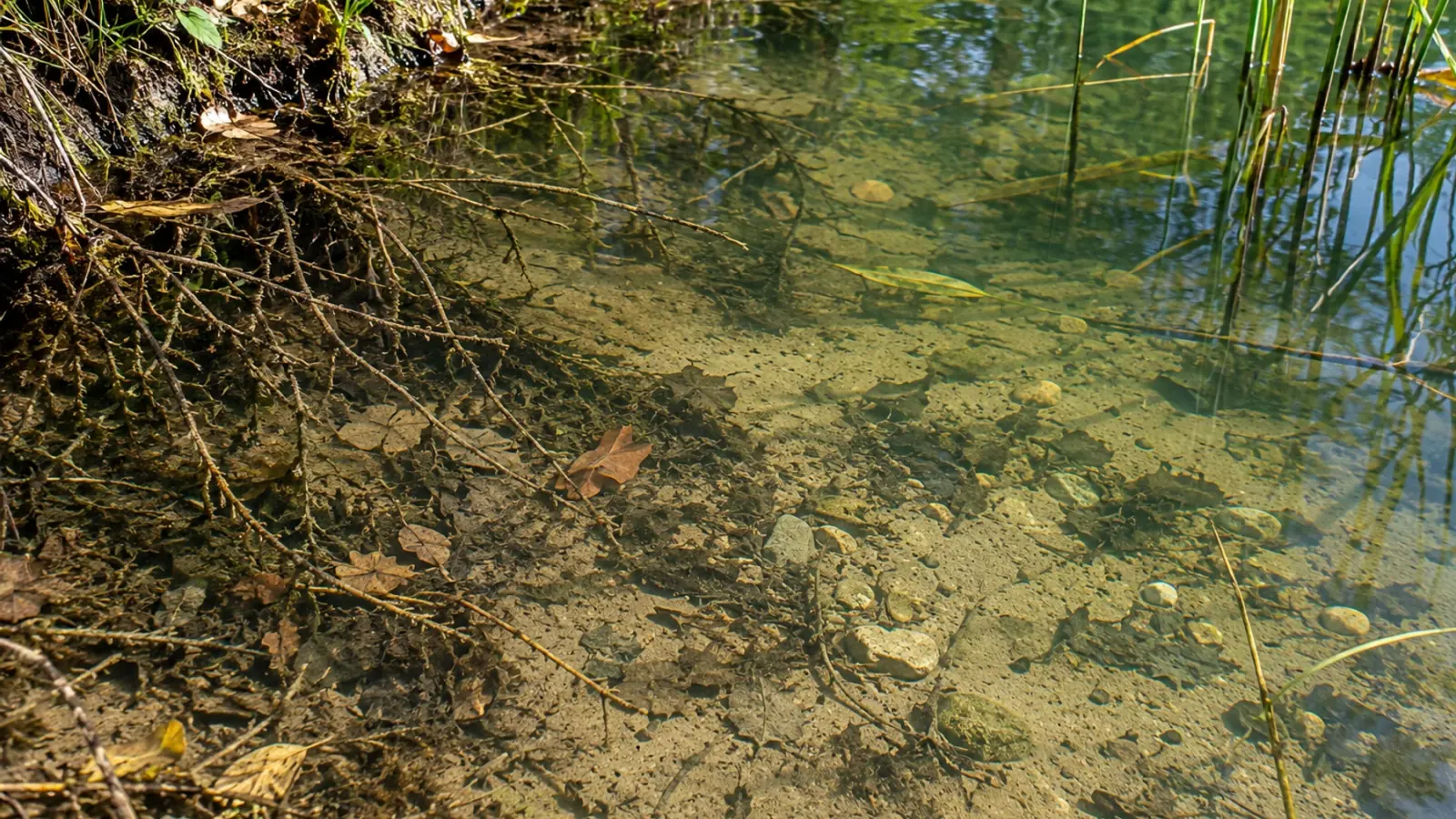
Sediment pathogens: assess persistence carefully
Water with no visible sign of disease provides little evidence about the sediment below. An Aeromonas hydrophila experiment demonstrates persistence in laboratory-prepared sediments, without by itself establishing transmission risk in a natural water body.
- Content type
- Practical guide
- Sector
- Environment
- Animal group
- Fish
Once an episode of fish disease has subsided, the sediment may remain largely unexamined. Its microbial condition cannot be inferred from the appearance of the water or the absence of visible signs in surviving fish. Yet finding a bacterial species in the bottom material does not establish that the sediment will cause another outbreak.
A 2023 laboratory experiment with a virulent Aeromonas hydrophila isolate helps separate several questions that are often combined: whether a bacterium remains detectable, whether it can grow in culture and whether it can infect a fish. Environmental surveillance needs to preserve those distinctions.
Prepared sediments, rather than an intact pond
Tuttle and colleagues collected sediment from four catfish production ponds on two farms in Alabama. Material from each pond was combined, sterilised and then inoculated with a defined isolate, ML-09-119. This allowed the investigators to follow that organism under controlled conditions, initially without its normal microbial competitors.
The pilot experiment continued for 113 days in a room at approximately 21°C. The main persistence trial followed twelve compartments for 28 days at approximately 28°C. These were different experiments; their durations cannot be combined into a single sequence or treated as equivalent field observations.
The target organism remained recoverable by culture at the end of both trials. Populations initially increased, then declined before levelling off under the study conditions. This demonstrates persistence of the tested isolate in the prepared material. It does not establish the survival time of all strains in undisturbed pond sediment.
What culture and molecular confirmation establish
The researchers counted colonies on selective medium and used PCR to confirm identity. Culture demonstrates that cells could multiply under the analytical conditions used. Molecular confirmation helps avoid counting similar-looking colonies of another organism as the target isolate.
A PCR assay applied directly to an environmental sample answers a different question: whether its DNA target is present. A positive result may arise from viable cells, cells unable to grow in the chosen test or residual genetic material. It does not, on its own, establish an infectious dose.
Infectivity needs additional evidence. The persistence experiment did not expose fish to the stored sediment to measure transmission. The known virulence of the original isolate is not a measurement of its virulence at every sampling date. A report should keep that distinction visible when discussing the implications for fish health.
Why the preparation limits environmental conclusions
Sterilisation and controlled inoculation helped make a particular isolate traceable. They also removed part of the original sediment community and altered the ecological starting point. Non-target bacteria subsequently appeared during the experiments, showing that the system did not remain perfectly sterile.
In a water body, microbial competition, benthic animals, organic inputs, oxygen conditions and temperature changes may modify persistence. A succession of warm and cold days is not equivalent to a relatively stable room temperature. The authors specifically call for work on other thermal conditions and isolates.
The sediment chemistry comparisons did not establish strong relationships with persistence in this study, which included few source ponds. The findings therefore cannot identify a pH, organic matter concentration or sediment type that guarantees pathogen disappearance. Failure to detect a relationship in this design does not establish that those factors never matter.
Sediment and biofilm describe different things
A biofilm contains microorganisms associated with a matrix produced by the community. It can occur on different surfaces. A visible deposit or an accumulation of organic material does not automatically demonstrate a disease-causing biofilm of a particular organism.
Nesse and colleagues reviewed biofilms in animal bacterial infections in 2023. Their review distinguishes observations in affected tissues from experiments showing that an isolate can form a biofilm in the laboratory. The latter capacity alone does not establish a role in natural disease, or prove that an environmental surface acts as an infectious reservoir.
Protection associated with a biofilm may alter tolerance to an intervention. That should not be equated automatically with genetically determined antimicrobial resistance. The concepts require different methods and interpretations. Neither provides a basis for improvising stronger disinfectant applications in a living aquatic environment.
Design sampling around the reservoir hypothesis
Start with a specific question: is the organism implicated in fish disease also present in sediment, on surfaces or in the water? Retain the location, depth, date, environmental conditions and recent interventions for each sample. Combining all compartments at the outset can remove information needed to interpret their differences.
Controls and replication should reflect the site’s heterogeneity. One depositional area cannot represent the whole water body. A single negative sample does not establish absence, particularly when the method has not been assessed for the sediment matrix. Detection limits and inhibition need consideration with the laboratory.
Connecting environmental findings to clinical isolates also requires enough discrimination. The same bacterial species name does not prove that the isolates are identical. Even a close relationship may leave the direction of transfer uncertain: infected fish could contribute organisms to the sediment, while another source could affect both compartments.
Let the evidence determine the intervention
The laboratory findings support considering sediment in some biosecurity investigations. They do not prescribe universal dredging, a fixed fallowing period or whole-site disinfection. Disturbing the bottom may resuspend particles and change environmental functioning, so an intervention needs a documented question and an assessment of its consequences.
A useful report separates measured persistence from suspected transmission. It states what additional observations would change the interpretation and avoids presenting a candidate reservoir as an established source of infection. This makes subsequent sampling or management decisions easier to evaluate.
Vetofish can plan diagnostic analyses for aquatic samples and help interpret findings for aquatic environments and their managers. The aim is to identify which evidence is still needed before concluding that sediment constitutes an infectious reservoir.


