

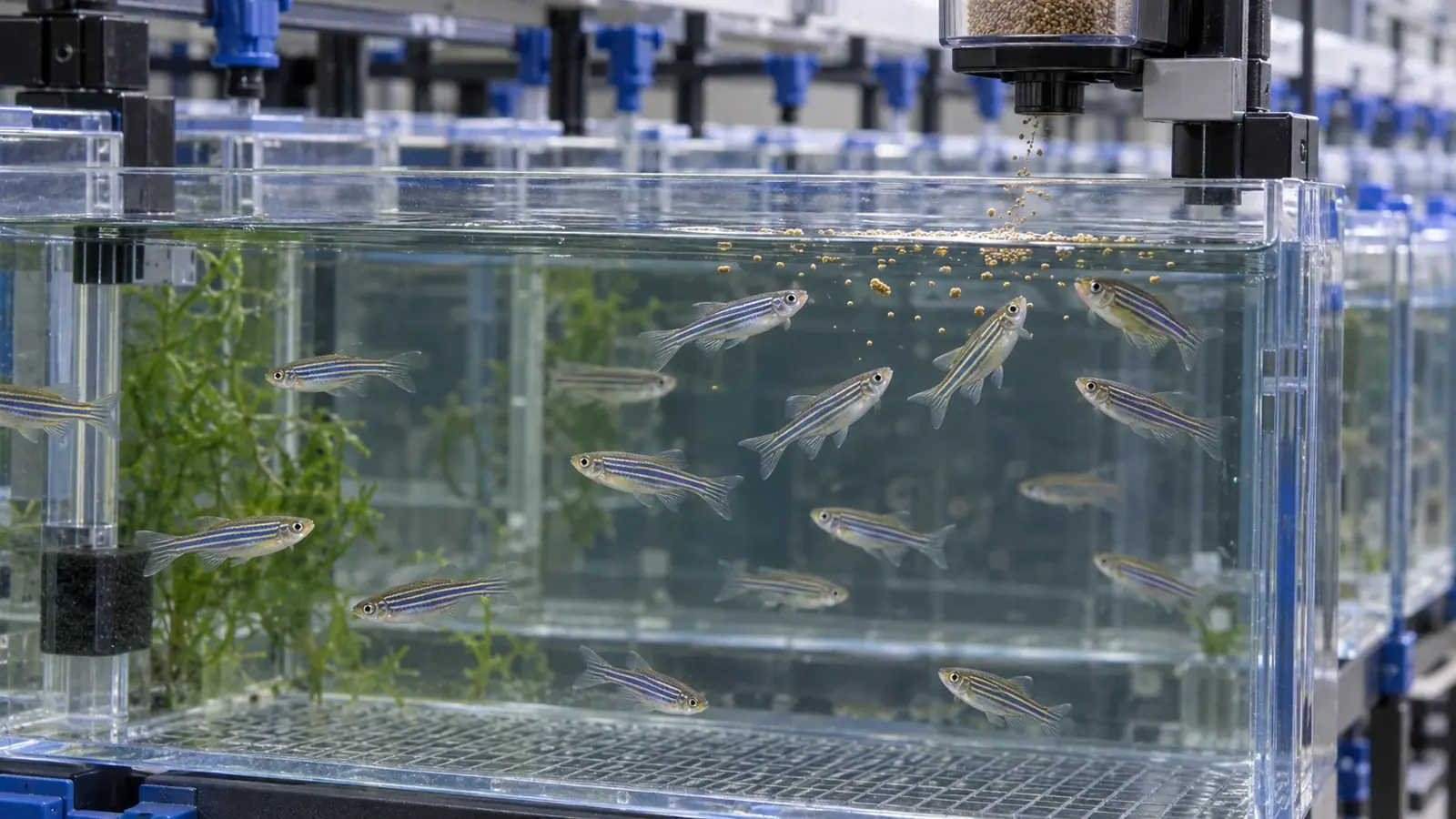
Zebrafish feeding: make the ration measurable
Giving every tank the same amount does not guarantee equal intake or nutritional status. A zebrafish ration must be recorded alongside life stage, density, feed and uneaten material.


- Content type
- Practical guide
- Sector
- Research
- Animal group
- Zebrafish
- Keywords
- StressMicrobiomeReproduction
Two zebrafish tanks can receive the same mass of feed while their occupants ingest different rations. Some feed sinks, enters the water loop or remains inaccessible to subordinate fish. Fish size, stocking density, feed type and delivery time alter the outcome further. A 2024 systematic review found that published methods were too heterogeneous to support one universal recipe. It does, however, clarify what a facility needs to measure.
Separate feed offered from feed eaten
The delivered ration is the amount placed in the tank. Intake is what the fish actually consume. Uneaten particles, material carried away by flow, feeder losses and unequal access sit between those quantities. Recording only “fed twice daily” cannot support replication or explain a change in growth.
Zarantoniello and colleagues examined 73 studies dealing with zebrafish feed intake or feeding management. Units, life stages, diets and frequencies varied widely. Some rations were reported per fish, some as a percentage of biomass, and others without a clear estimation method. The authors derive practical ranges from the evidence but stress that the data do not support a single standard for every line and system.
The first improvement is to weigh or calibrate delivery. A dry-feed dispenser should be tested over repeated releases because particle size and humidity can change output. Live prey records should include culture density, volume and quality. “Artemia to satiation” remains difficult to compare unless duration, concentration and the stopping criterion are defined.
Match the protocol to life stage
A larva does not have the same mouth size, reserves or digestive capacity as an adult. Particle size, movement and position in the water column affect access during early life. Housing and husbandry recommendations published in 2020 support gradual feed transitions and warn against prolonged periods without food in young animals.
For adults, frequency has to fit feeding behaviour and staff organisation. Splitting the ration may broaden access and reduce a sudden waste load, but extra rounds can also disturb tanks or increase operator variation. Automation improves consistency only when output is checked and a malfunction remains visible.
Broodstock need particular attention. Changes in energy supply or nutritional quality may influence body condition, spawning and egg quality. Those effects cannot be interpreted from embryo counts alone. Age, group composition, light cycle, temperature and reproductive history also belong in the record.
Observe the fish and the system
A ration is not validated solely by the feed mass. Staff can record feeding response, time until particles disappear, group distribution, visible waste and body condition. A fall in appetite becomes informative when it is compared with that tank’s normal response and assessed alongside water quality, recent procedures and clinical signs.
Uneaten feed adds organic and microbial load. In a recirculating system, the shared loop can spread its effects beyond one tank. Turbidity, solids, ammonia and biofilter performance provide context. Increasing the ration because fish appear small, without checking intake, may therefore impair water quality without correcting the reason for poor growth.
Stocking density adds another layer. A ration per tank does not give the same amount per individual, while a calculation per fish assumes equal access. Spatial delivery matters: several feeding points or suitable particle movement may reduce concentration in one location, but the effect must be observed in the actual system rather than assumed.
A diet change is an experimental event
Changing supplier, batch, particle size or live prey can alter intake, nutrient composition and the associated microbiota. Date, batch number, storage conditions and transition should appear in husbandry data. Comparisons between experiments become weaker when feed changes go unreported.
A planned fast should be described by duration, life stage, purpose and timing relative to sampling. It is not merely a scheduling detail: fasting may alter metabolism, behaviour and gut contents. Adult rules must not be carried over to larvae. Prolonged or repeated restriction requires scientific justification and welfare assessment under the establishment’s framework.
Feed quality is not captured by crude protein alone. Ingredient sources, lipids, micronutrients, water stability and storage all contribute to the diet the fish receive. The systematic review chiefly demonstrates the need to expose these variables; it does not identify one formulation as best for every facility. For materials marketed in the European Union, the catalogue of feed materials (French summary) helps identify ingredient names and processes. A catalogue entry does not establish nutritional suitability for a zebrafish line.
Define a minimum feeding record
A useful record combines species and line, age or life stage, number and density, estimated biomass, feed and batch, particle size, amount, frequency, delivery method, access time and observations of waste. Fasting days, transitions and equipment failures should also be logged. These data turn a change in growth, reproduction or water quality into a testable question.
The protocol should also state who checks feeder calibration and how often. A technically identical setting does not guarantee identical output after a hopper is refilled or the feed absorbs moisture. Periodic verification connects the written procedure to the ration that reaches the water.
Vetofish can help research establishments audit feeding protocols and build records suited to their tanks, life stages and scientific aims. Standardisation does not mean imposing the same ration everywhere. It means describing each decision precisely enough to monitor, discuss and reproduce it.
To move from evidence to action, explore our advice and support service and our expertise for research facilities.


