

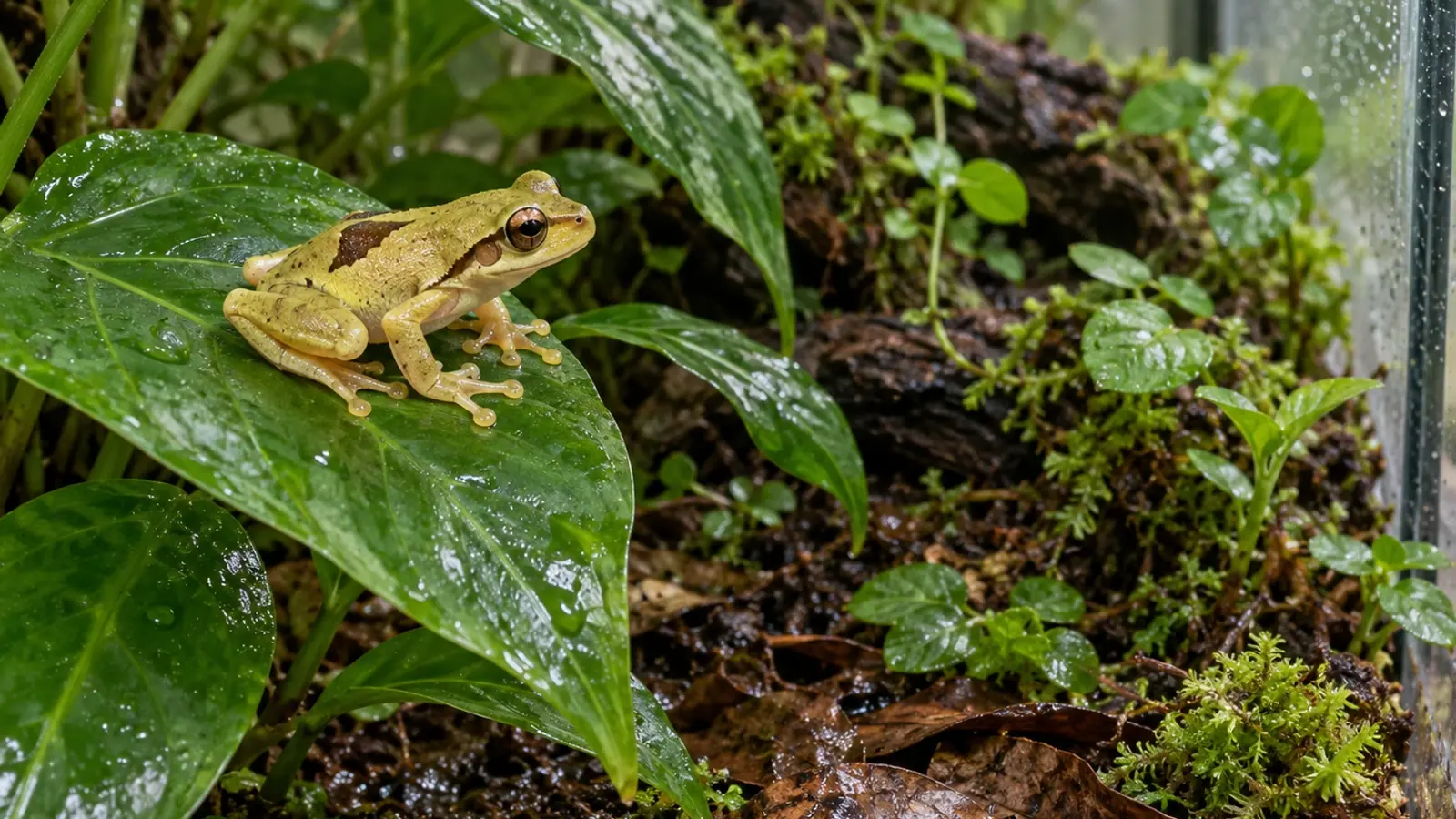
Research treefrogs: what faeces reveal about the gut microbiome
Can faeces provide information about a treefrog’s gut microbiome without collecting intestinal tissue? An open study published in December 2025 tests that relationship directly in Dendropsophus ebraccatus. Bacterial communities overlap substantially, although the sample types are not interchangeable.


- Content type
- Scientific news
- Sector
- Research facilities
- Animal group
- Amphibians
- Keywords
- MicrobiomeEnrichmentTemperature
Testing what a faecal sample represents
Justin C. Touchon and Myra C. Hughey’s study, published in December 2025, followed young Dendropsophus ebraccatus after metamorphosis. These treefrogs define the biological setting of the work. The results do not describe adult Xenopus or every amphibian used in research. The study examines housing conditions and the bacterial communities associated with the animals, including a direct comparison of sample types.
For that comparison, the researchers selected twenty-one frogs, seven from each of three rearing conditions. Skin, faecal and intestinal samples were analysed from each individual. The resulting sixty-three samples therefore represent matched materials from twenty-one animals, not sixty-three independent frogs. Matching matters because it allows the relationship between sample types to be examined within the same individual.
The analysis used bacterial sequence profiles based on the 16S ribosomal RNA gene. That establishes an important boundary around the term microbiome in this study. It does not provide a complete census of viruses, fungi and every other organism associated with the intestine. The biological compartment and the analytical method both belong in the description of what was measured.
Substantial overlap supports a useful proxy
Faecal samples contained a large proportion of the bacterial sequence variants detected in intestinal samples. The authors also found relationships between faecal and gut profiles using the diversity measures they examined. Together, those results support faeces as a non-lethal approximation of the gut bacterial community in this model. They provide more than an assumption that material leaving the intestine must describe it adequately.
A sequence variant is an analytical unit derived from molecular data. Detecting it does not mean that a bacterium has been isolated alive or that its function in the frog is known. Similarly, overlap between lists of variants is not a diagnostic accuracy percentage. It cannot establish that faeces and intestinal tissue will answer every biological question in exactly the same way.
Diversity within a sample and differences in community composition across samples describe different features. Two materials can have comparable diversity while containing different relative proportions of bacterial groups. The appropriate sample therefore depends on whether a project seeks a broad change over time, a community comparison or a particular target. Validation for one use does not automatically validate all the others.
Skin and gut are different sampling compartments
Skin profiles were more distinct from intestinal profiles than faecal profiles were. This gives a practical limit to the loose description of collecting an animal’s microbiome. A skin swab and a faecal sample examine different compartments, even when taken from the same treefrog and processed within the same study. Their relationship needs evidence rather than an assumption of interchangeability.
A sampling record should consequently name the material or anatomical site. Otherwise, an apparent change between dates may reflect a switch from faeces to skin rather than a change in the community the project intended to follow. Animal identity, life stage and housing conditions supply further context. Keeping these details with the result is more useful than recovering them after a surprising comparison.
Non-lethal sampling makes repeated observations of living individuals possible. It does not necessarily remove handling or other burdens. Faecal collection in this study included temporary separate housing. Research teams must consider collection arrangements with the relevant animal-care and analytical staff; the description non-lethal should not be taken to mean that every collection method has the same welfare implications.
Housing changed several factors at once
The frogs were reared in naturalistic group enclosures, regularly cleaned group enclosures or regularly cleaned individual containers. These arrangements differed in more than one respect. Substrate and vegetation, contact between animals and maintenance conditions were not isolated as independent experimental factors. The labels natural and clean consequently describe particular bundled environments rather than universal categories of husbandry.
Differences in growth or bacterial communities cannot therefore be assigned to the microbiome alone. Numbers of surviving animals and group densities also changed during the experiment. The authors discuss these limitations. The study does not demonstrate that a particular bacterial community caused improved growth, or that reducing maintenance would be appropriate for another species or research facility.
Environmental enrichment and temperature remain relevant details to document in housing records. Their role in the setting does not turn this comparison into a prescription derived from a single-factor trial. A transferable description should state what was actually present and how animals were managed. Calling an enclosure naturalistic without that information makes comparisons harder, especially when welfare and microbiological outcomes are both under discussion.
Define the research question before collecting samples
For research facilities, the useful starting point is to decide what the sample is intended to represent. The analytical laboratory can advise on suitable material, the information needed at receipt and limitations in comparing a new series with earlier results. Planning should preserve continuity of sample type and explicitly record changes that cannot be avoided.
A bacterial profile change does not establish disease or dysbiosis by itself. It does not justify adding microorganisms to an animal facility, changing treatment or abandoning health precautions. Interpretation brings together the scientific question, animal observations and the analytical method, including its controls and uncertainty. Molecular findings and clinical observations contribute different information to that assessment.
Vetofish offers advice and support to connect health, housing and scientific monitoring in aquatic animal facilities. In these treefrogs, the matched comparison supports using faeces to study the gut without terminal intestinal sampling. The strength of that approach comes from the direct comparison supporting it, and from checking its limits before transferring it to another project.


