

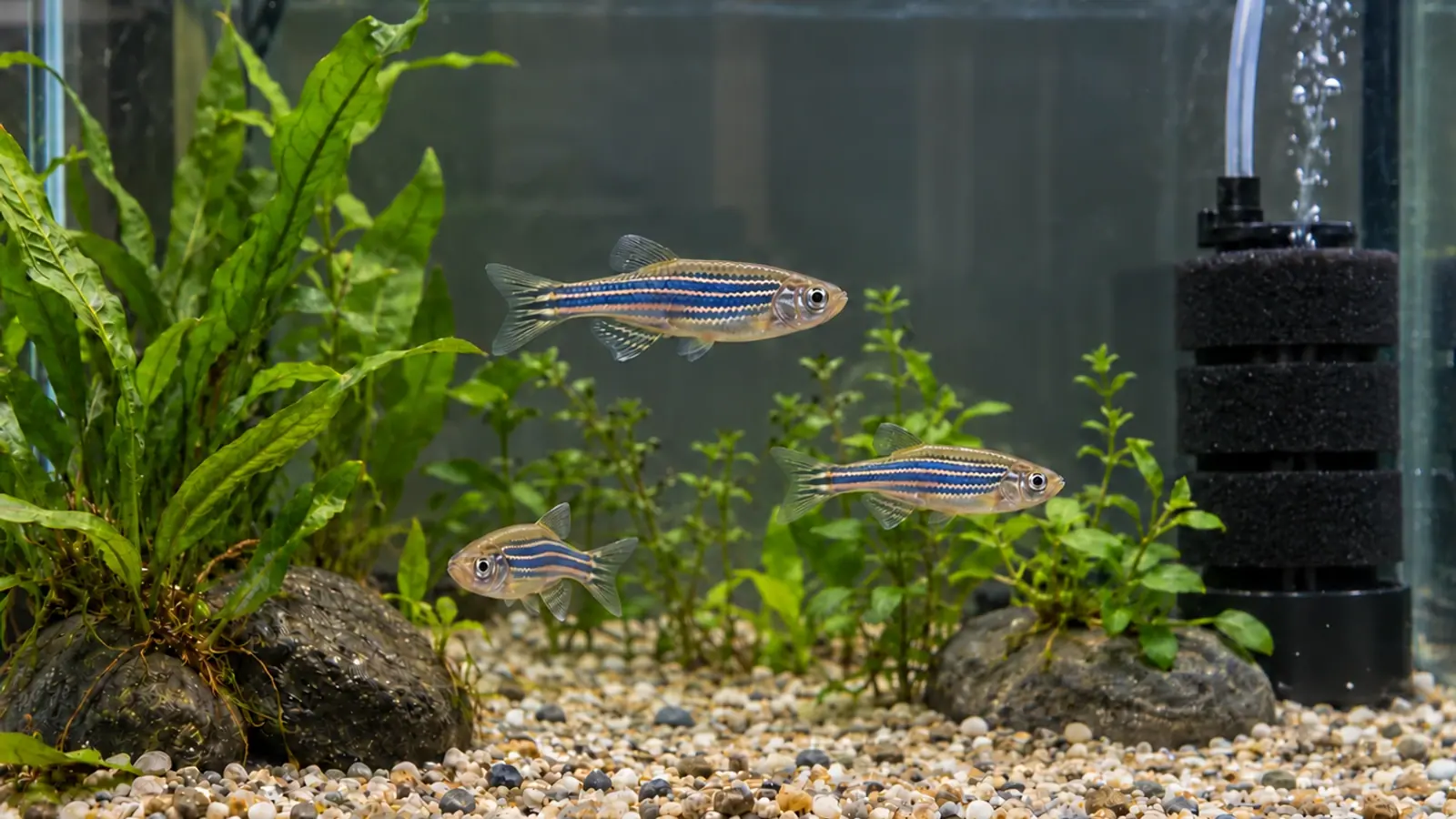
Zebrafish housing history shapes social information use
Zebrafish exposed to three months of variable housing were more likely to follow a social demonstration that conflicted with earlier training in a 2026 study. The effect was task dependent, and higher mortality in that group places an important limit on its interpretation.


- Content type
- Scientific news
- Sector
- Research facilities
- Animal group
- Zebrafish
- Keywords
- EthogramEnrichmentTemperature
A behavioural test also carries part of a fish’s housing history. Tank companions, resource predictability and changes in the physical environment can contribute to the response recorded on the day. Sekulovski and Miller examined this issue in a 2026 study of zebrafish, Danio rerio, using several social and behavioural tasks.
The finding is more specific than a general increase in sociability. Fish from variable housing more often followed a recent social demonstration when it contradicted earlier personal learning. Other comparisons did not show the same difference. Research facilities need to interpret the response within the task and the limits of the design.
Two housing histories over three months
The experiment began with 80 three-month-old zebrafish in eight tanks. Four tanks belonged to the Stable condition and four to the Dynamic condition. Exposure continued for three months before the final assessments, and the housing conditions continued during testing.
The Dynamic condition combined variation in water temperature, feeding times, group size and membership, and habitat arrangement. Stable fish experienced unusually regular schedules and an unchanged physical and social setting. Mean environmental parameters were matched, while predictability differed.
This was a comparison between packages of physical and social conditions. It cannot isolate temperature, plant rearrangement or unfamiliar companions as the cause of a later response. Selecting one component as the explanation would exceed what the design can establish.
Baseline tasks helped balance behavioural scores before exposure. The researchers could not track each fish’s identity across all assays, however. Before-and-after comparisons therefore concern housing conditions rather than a complete record of change within each individual.
When recent social cues conflict with personal learning
Social information in the experiment came from observing other fish feed near a feeder. In one task, an observer subsequently chose between two sides. Initial choices and the measured preference did not differ overall between housing conditions in this social-information test.
A second task introduced conflicting information. Fish first learned where food could be found, then watched demonstrators feed on the other side. Their subsequent choice placed earlier personal experience against a more recent social cue.
Dynamic-condition fish more often chose the demonstrated side than Stable-condition fish. The difference also appeared among animals that had first returned to the previously learned side. This supports a change in how information was weighted in that task. It does not establish a general improvement in cognition.
The task definition is crucial. Staying near a group, following fish in a home tank and choosing a feeder after a demonstration are different responses. Calling all of them sociability would conceal information about what the study actually measured.
Closer spacing did not mean greater coordination
The researchers also assessed collective swimming. Fish from Dynamic housing swam closer together, while their directions were less aligned and their movement was slower in this test. Reduced spacing between neighbours did not correspond to greater coordination.
Collective behaviour has several dimensions, including distance, direction, speed and change over a session. These can move in different directions. Comparing recordings requires the definitions and scales of those measures to remain available, rather than allowing a single number to stand for the whole group.
Exploration and several measures commonly associated with stress responses showed no final difference between conditions. This prevents a claim that every behavioural domain changed. It also cannot establish that fish in the two conditions had equivalent experiences. What a test detects depends on the task and the animals still available to participate.
Attrition limits the strength of the claim
Mortality was higher in the Dynamic condition, and its cause remained unknown. The authors discuss possible explanations without demonstrating one. This observation prevents variable housing from being presented as a proven husbandry improvement.
Numbers declined across the study. Sixty-one fish completed the social-information test and 50 completed the conflicting-information test. Assay exclusions occurred as well as deaths. Only 22 fish first returned to the trained side in the retention assessment used to define successful learners.
These are different denominators. A proportion calculated among successful learners does not describe all 80 initial fish. Selection of survivors and test participants may contribute to the observed differences and belongs in the interpretation, rather than being treated as an administrative detail.
Repeated mixing in Dynamic housing also made tank membership dependent. The authors therefore did not treat those tanks as independent replicates in their analyses. The number of fish tested cannot, by itself, overcome that limitation when making a broader causal claim.
The study raises a worthwhile question about information use, but the strength of any general conclusion depends on these constraints. Independent replication with clearer separation of housing factors would be needed to establish which components drive the effect.
Describe the cohort before interpreting its choices
For a research animal facility, a reasonable application is better documentation of housing history. Group changes, environmental alterations, feeding schedules and incidents can help explain why responses differ between testing periods. This is a proposal for traceability, not a recommendation to reproduce experimental instability.
A report should separate the initial stock, the fish available for each task, the exclusions and the unit being compared. Observed results should also remain distinct from proposed mechanisms. Familiarity between fish, physical variability and feeding experience were only partly separable in this experiment.
One behavioural assay cannot describe the whole social life of a zebrafish. Nor does a behavioural difference establish a health benefit. Preserving that distinction makes the finding useful without turning it into a husbandry recipe.
Vetofish can help document housing conditions, prepare behavioural monitoring and review health events affecting a cohort. Bringing those records alongside experimental results helps define what a comparison supports and which uncertainties should remain explicit in the research report.
To move from evidence to action, explore our advice and support service and our expertise for research facilities.


