

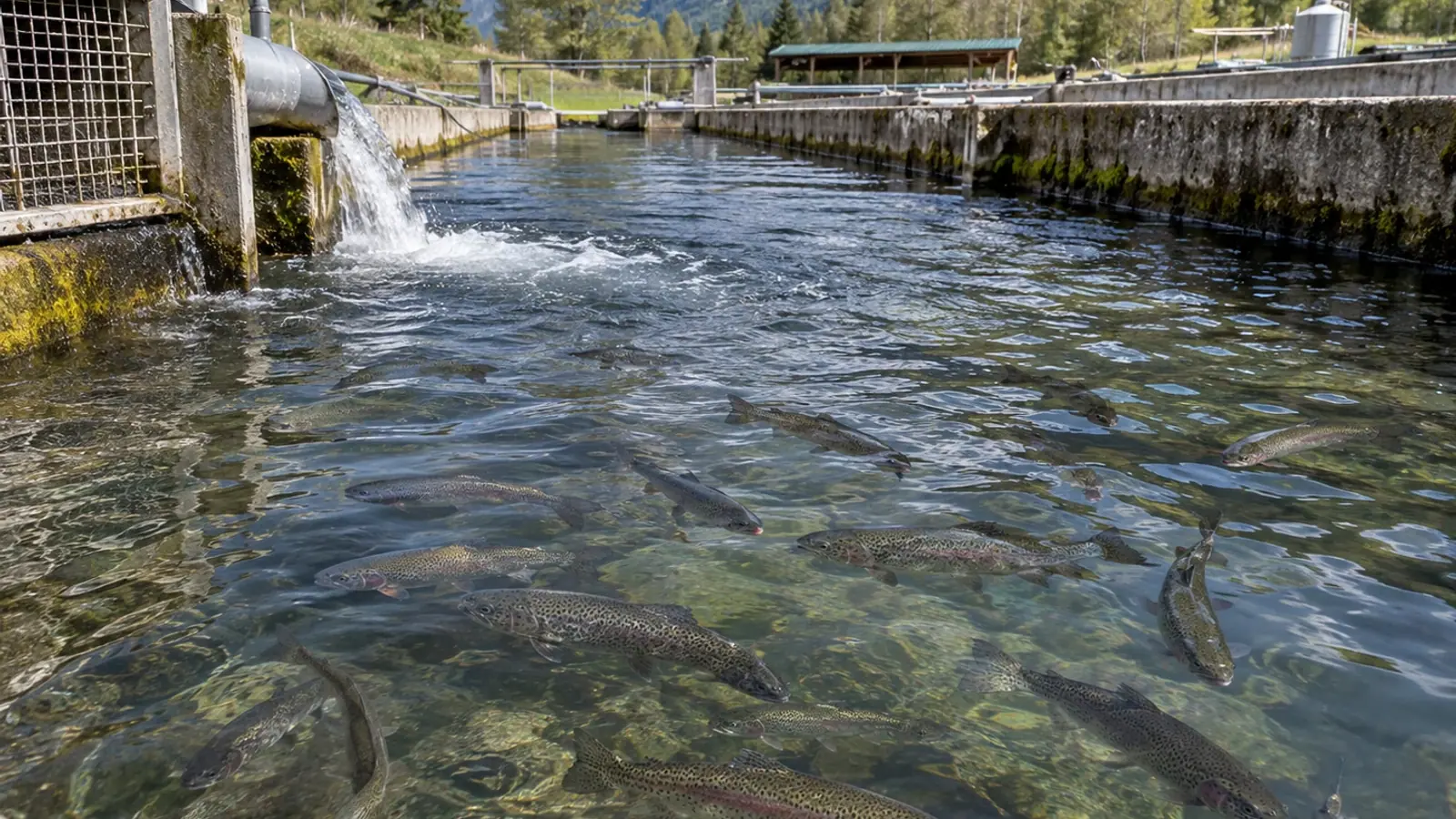
Farm water intake: trace the biosecurity pathway
Clear water is not evidence of disease freedom. A fish farm needs to know where its intake connects to other aquatic populations and whether each control barrier works under operating conditions.
- Content type
- Practical guide
- Sector
- Aquaculture
- Keywords
- BiosecurityDisinfectionPCROxygen
Map the route before choosing treatment
Water enters a fish farm as an environmental resource and a possible route for pathogenic agents. A river intake may connect stock to wild populations or another facility upstream. Transport water and overlooked cross-connections create additional routes. Chapter 4.1 of the WOAH Aquatic Code asks operators to identify these epidemiological links before selecting controls. Its recommendations are risk based; they do not certify that one named type of intake is safe in every setting.
A protected borehole, a spring, a river and treated municipal water have different exposure histories. Even within one farm, a header tank, bypass or shared drain can change the actual route. Staff can start with a map showing every source, production unit, return and discharge point. The map should be checked against physical pipework, valves and routine practice, since an undocumented connection can defeat a well designed plan.
Appearance offers little assurance. Water may be transparent while carrying an infectious agent, or turbid for reasons unrelated to infection. A single chemistry result cannot establish the health status of an intake either. The assessment needs the source, susceptible farmed species, potential upstream populations, previous incidents and the controls between source and stock.
Identify normal and exceptional pathways
WOAH distinguishes semi-open, semi-closed and closed production systems because their ability to control incoming and outgoing water varies. An open surface-water connection is different from a protected groundwater supply. A recirculating installation still receives make-up water and newly arriving animals, and maintenance can temporarily change its separation from the outside environment.
The review should include events outside routine operation. Floodwater can bypass an intake barrier. Leaks, blocked drains or a failed bund can connect units that are normally separate. Water arriving with a transferred lot can enter the system through a handling decision rather than a pipe. WOAH recommends assessing these routes and documenting emergency procedures. A diagram showing only steady flow on an ordinary day misses part of the risk.
The hazard must also be defined. Asking whether a source is “clean” is too broad to guide sampling or treatment. The useful question is which agent of concern might enter by which route, which animals are susceptible and what decision a result would change. Farm staff, aquatic animal health professionals and veterinarians should develop the plan together so that its controls are both meaningful and operable.
Match a barrier to the identified risk
Where feasible, WOAH recommends selecting a source free from susceptible aquatic animal populations and the pathogenic agents of concern. Groundwater, dechlorinated municipal water and artificial seawater are examples it identifies as potentially suitable for high health status animals. Each still needs evaluation at the facility. Groundwater is a category, not a test result, and treatment status can change after water enters a building.
For sources likely to contain susceptible animals, the Code recommends an appropriate level of screening, filtration or disinfection, selected for the risk. A filter that removes particles is not automatically a validated pathogen barrier. An installed UV unit does not prove effective exposure at an unmeasured flow or with an unmaintained lamp. Equipment selection should therefore include operating limits, checks and a response when those checks fail. No universal treatment train follows from the Code.
Incoming water is only half of the circuit. Outgoing water and retained filter waste may require management when they could transmit agents to wild animals or another farm. Intake and discharge siting should account for distance, currents and neighbouring activity. A site map and inspection of the actual structures help connect the written biosecurity plan to what happens in the water.
Keep records that support decisions
A practical file can contain the hydraulic drawing, source changes, barrier maintenance, water quality trends, animal movements and unusual health observations. Laboratory testing is useful when the sampled material, assay and decision question are specified. A positive or negative molecular result from one sample cannot certify the entire supply. Results should be read alongside sampling time, lot history and the agent under investigation.
Flow and seasonal changes deserve attention because they can move treatment equipment outside its intended operating range. Dissolved oxygen and other routine measurements describe the environment experienced by fish; they are not substitutes for pathogen surveillance. An unexplained rise in mortality, treatment failure or flood should trigger an agreed procedure for assessment, sampling where appropriate and stock movements.
The limit of a general guide
WOAH Chapter 4.1 offers international principles for biosecurity planning. It supplies no universal pathogen threshold, sampling interval or equipment approval. Local legal duties and source-water conditions must be assessed for the specific country and site. A barrier’s effectiveness depends on the target hazard and verified performance under farm conditions.
The first useful action is to trace the water and explain what each barrier interrupts. Vetofish’s aquatic health expertise can help a team review that circuit and its records in an aquaculture setting, without treating visual clarity as proof of disease freedom.


