

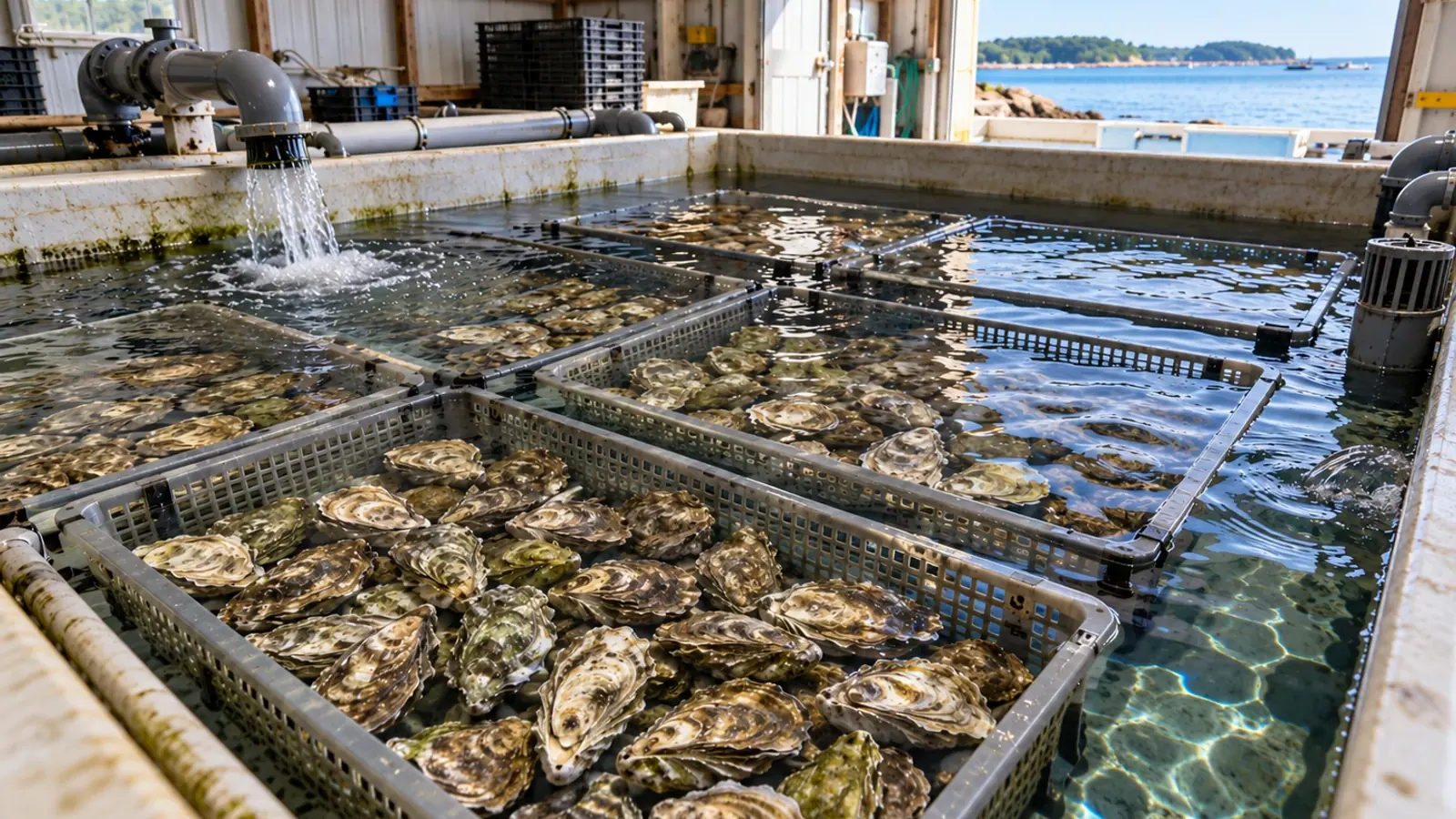
Bivalve depuration: clear water is only part of the process
Clear water alone cannot establish that a batch of shellfish has been effectively depurated. FAO’s 2008 technical guide connects bivalve activity, water movement and prevention of recontamination, providing a framework for reviewing a shellfish farm’s holding system.
- Content type
- Practical guide
- Sector
- Aquaculture
- Animal group
- Corals and invertebrates
A depuration tank is a biological system as well as a piece of water-treatment equipment. Live bivalves need conditions in which they can function, while the installation must carry expelled material away and prevent it from returning to the animals. FAO’s 2008 technical paper explains these connected functions. Water that looks clean provides no direct evidence that all three are working.
A cycle review needs records linking the batch, its condition on arrival, the loaded tank, water measurements and any interruption. The document remains a source of technical principles; its historical examples of national rules should not be read as current requirements in France or elsewhere.
Animal activity comes before the clock
Depuration uses the bivalves’ own filtering activity. An animal can be alive yet remain closed after handling or a change in conditions. Simply allowing more time does not establish that the intended biological process has resumed.
Temperature, salinity and dissolved oxygen need to be interpreted in relation to the species and the batch’s origin and acclimation. A range reported for a different species or installation cannot validate the conditions in another system. FAO also distinguishes conditions that support physiological activity from those that achieve satisfactory removal of contaminants.
Valve opening can form part of an observation record, with the time and circumstances noted. It is not a substitute for microbiological evidence. If a batch is unusually inactive, reviewing its arrival conditions and recent handling provides a more useful starting point than changing the duration alone.
Review the tank with its actual load
A running pump does not demonstrate that water reaches the shellfish evenly. Some water may bypass baskets, leaving other areas less well renewed. Stock placement, basket arrangement and immersion consequently belong in the assessment of the system.
The technical paper describes the need to remove expelled material without continually stirring settled waste back into the water. Aeration must be considered in that context. The visible number of bubbles is a poor description of whether the animals receive suitable oxygen conditions or whether the equipment disturbs deposits.
A straightforward water-path diagram can help an operator review the installation. It should identify the inlet, occupied areas, outlet and any treatment or return route. Comparing this diagram with a loaded tank helps identify questions for further checks. A pump’s nameplate power or control position describes the equipment rather than the water path through the stock.
The batch boundary may extend beyond one tank
A basket number is not always enough to define an exposure. Tanks sharing recirculated water may function as one connected system. FAO considers these connections when describing batch operation and the prevention of recontamination.
Adding shellfish part way through a cycle changes more than the inventory. New stock can introduce expelled material into shared water, while the associated handling can disturb deposits. Animals already in the system may therefore experience conditions that their original start time does not describe.
Records should make it possible to reconstruct these connections and events: which units shared water, when stock entered or left, and whether circulation was interrupted. This is a proposal for making an audit interpretable, rather than a replacement for process verification or the requirements applying to the business.
The same reasoning helps when investigating an unexpected result. If several batches were connected, examining only the tank from which a sample was taken may leave out part of the relevant history.
Give measurements a place and a time
A satisfactory start-up reading represents one moment. It cannot demonstrate that conditions remained similar after loading, during a pump interruption or towards the end of a cycle. Measurements become more useful when their location and timing can be recovered.
An entry such as “oxygen acceptable” loses information needed for later interpretation. The record should identify what was measured, its unit, where the reading was taken and the instrument used. A reading at an inlet does not necessarily describe every occupied part of a tank.
Checks on the measuring equipment and the action taken after a deviation also belong in the record. They help distinguish a change in conditions from an uncertain measurement. There is little value in a detailed log if the operator cannot explain what an unusual entry led them to do.
Drainage and unloading remain part of the process. Moving baskets or disturbing water at the end can resuspend material that had already separated from the stock. The technical review should therefore include the final handling stage as well as the period of immersion.
Keep the limits of depuration explicit
Depuration is not sterilisation. FAO describes differences between contaminants and explains why bacterial indicators and pathogens need not decline at the same rate. A satisfactory indicator result cannot establish that every hazard has been eliminated.
The paper also sets out limitations for marine biotoxins, metals and chemical contaminants. Holding a batch longer in clean water does not automatically make the process appropriate for these hazards. The stock’s origin and upstream controls remain part of the evidence needed to assess risk.
For the same reason, the guide cannot supply one duration suitable for all shellfish batches. Time has meaning within a defined and verified combination of species, loading and operating conditions. The appearance of the animals should remain separate from the criteria used to validate a process or release a batch.
Build an audit that supports decisions
A useful review brings together animal observations, water conditions, circulation and batch events. It identifies which parts of the process were demonstrated and which still require investigation. This provides a stronger basis for discussion than an assurance that the water stayed clear.
Vetofish can help prepare a sanitary review, organise the operating information and define how deviations are recorded and assessed. The aim is to make decisions about each batch traceable, alongside the specialists and competent bodies involved in validating the system.
To move from evidence to action, explore our health expertise and biosecurity service and our expertise in aquaculture.


