

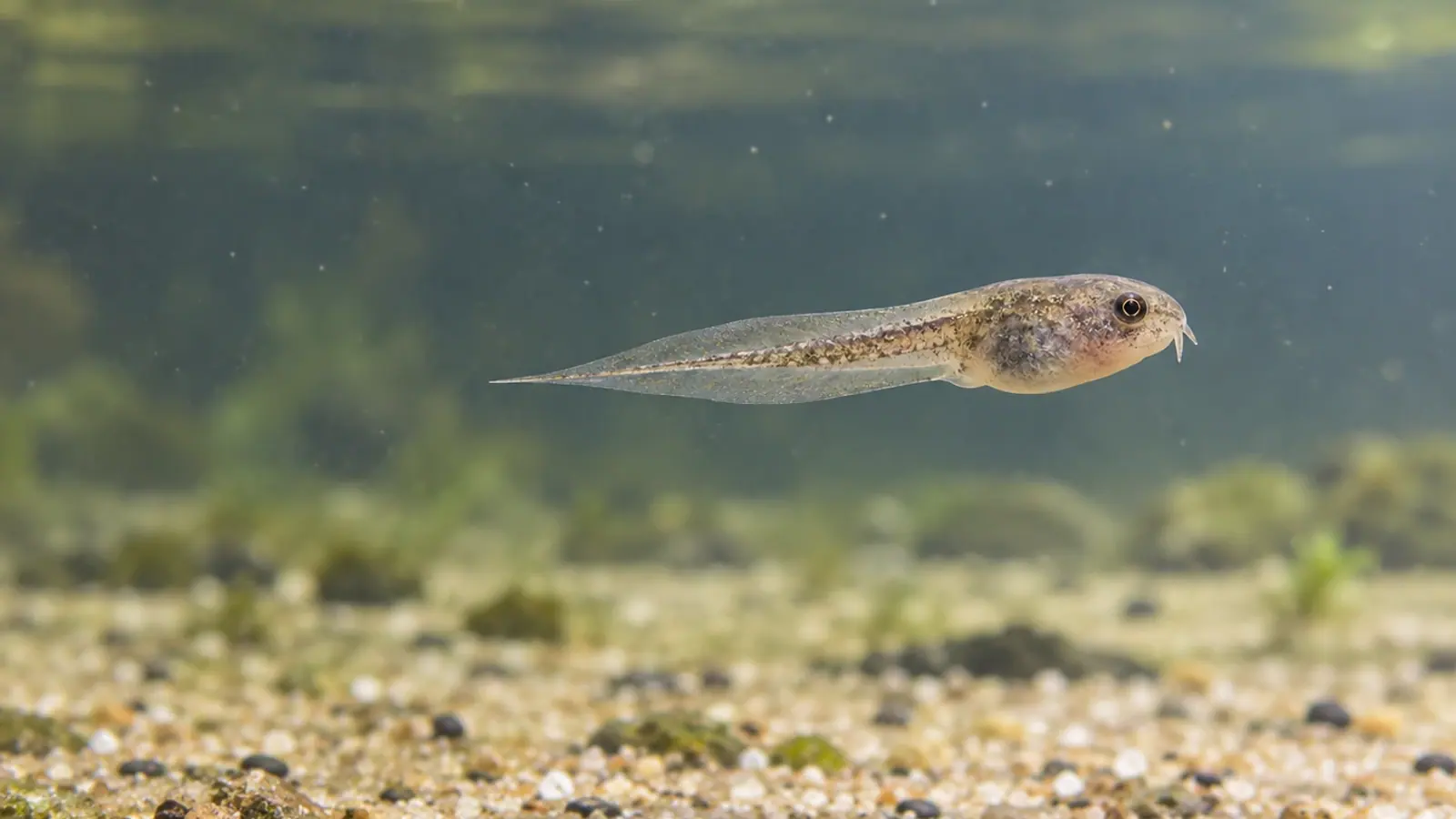
Xenopus: assigning stages from anatomical landmarks
Tadpoles of the same age need not be at the same developmental stage. In Xenopus laevis, staging depends on anatomical features viewed from a defined direction. A graphical resource published in 2022 helps researchers document that judgement, including cases in which an important landmark cannot be seen clearly.


- Content type
- Practical guide
- Sector
- Research facilities
- Animal group
- Xenopus
- Keywords
- TemperatureReproductionStress
A developmental-stage assignment is a judgement based on a combination of features. Making that judgement useful to another researcher means showing which features were recognised and from which view. A sharp lateral photograph may show the eyes and tail clearly while concealing the landmark needed to distinguish adjacent stages.
For Xenopus laevis, the Nieuwkoop–Faber table provides a common framework. Zahn and colleagues’ resource, published in Development in 2022, adds illustrations and a landmarks table that help make staging decisions explicit.
A graphical resource within the existing NF system
The Nieuwkoop–Faber system, usually abbreviated to NF, runs from stage 1 to stage 66, covering the fertilised egg through to the froglet after metamorphosis. The 2022 publication does not replace that numbering. It contributes 133 new illustrations covering 56 stages, alongside earlier drawings, and brings together anatomical and molecular landmarks.
The additions include views absent from the historical illustrations and more detailed depictions of intestinal coiling. The authors identify 67 views that were not in the original artwork. These figures describe the graphical resource, rather than 133 developmental stages or 67 newly recognised biological steps.
The drawings were developed from observation and photographs of specimens, with input from researchers familiar with the structures. They provide reference features to use with anatomical descriptions. A living embryo or larva may be harder to interpret because of its position, transparency or individual characteristics, and still needs to be examined on its own terms.
Choose the view for the feature being assessed
A dorsal view looks from the back, a ventral view from the underside and a lateral view from the side. Each reveals different structures. Interpreting the image also requires the anterior and posterior directions and a clear account of how the specimen was oriented.
Intestinal coiling is a useful example. The resource includes ventral views and complementary diagrams across several stages of this transformation. Recognising a tadpole’s lateral outline does not necessarily reveal the arrangement of its digestive tract. The feature needed for the decision should guide the view selected.
An important structure may also be obscured by another tissue or lie outside the plane of focus. “Not visible” describes an observation condition. “Absent” is a stronger anatomical conclusion requiring additional support. Confusing the two can create an apparent abnormality or make a stage assignment more certain than the image allows.
Keeping the orientation, scale and decisive landmark with an image makes the judgement open to review. The view and accompanying record should allow another researcher to review the decision made for the experimental question.
Record age alongside stage, rather than substituting it
Developmental speed in Xenopus depends in part on temperature. Hours after fertilisation describe elapsed time; an NF stage describes observed anatomy. Tadpole length is another measurement again. All may be useful, but their relationship should not be assumed identical across species or husbandry conditions.
An experimental record can therefore retain clutch identity, relevant dates, thermal conditions and the stage assigned at the observation. Timing matters: the stage recorded before a waiting period is not automatically the stage at the next image acquisition.
Morphogenesis is continuous, whereas the table uses discrete categories. A feature may be in transition. Difficulty placing an individual between neighbouring stages does not by itself indicate a defective reference or poor observation. It calls for a description of the criteria already present and those that remain uncertain.
Whether to observe at a fixed time or wait until a specified stage depends on the research question. The publication discusses both possibilities without making them interchangeable. Changing that choice after seeing the results could alter the animals being compared, so the approach needs to be defined and documented with the scientific team.
Preserve uncertainty and potentially altered features
A phenotype describes observable characteristics. If an experiment can change the feature used for staging, the assessment needs to avoid circular reasoning. Assigning an animal to an earlier stage solely because the structure under study appears less developed could conceal the effect being investigated. Other landmarks and the project’s agreed criteria then become particularly important.
A practical observation sheet can retain the proposed stage, the decisive feature, the available view and the reason for uncertainty. When a second assessment is needed, the image and comment make disagreement concrete. An inadequate image should remain identified as inadequate, rather than becoming a certain measurement once entered into a spreadsheet.
The resource also links external features with internal and molecular information. Their appearance in the same table does not mean that every landmark can be assessed by simply looking at the animal. Additional examinations need a scientific purpose and must fit the project’s constraints and welfare arrangements. Seeking a more precise stage alone does not justify repeated handling or stress.
The word “normal” also requires care. The table is a developmental reference against which features can be described. Resemblance to a drawing does not certify the health of a particular animal, and a difference needs interpretation in its experimental and husbandry context.
Make the stage assignment reproducible in practice
The resource’s practical value lies in connecting an NF number to recognisable features and an appropriate view. The reference used, observation time and uncertainty give that number meaning in a comparison. A record that preserves those conditions is more useful than an unexplained stage label, even when the label initially appears plausible.
Vetofish supports research facilities with training for their teams, linking biological observations, aquatic-animal husbandry and traceable records. Landmarks and observation conditions can be planned with the scientific project, without treating stage assignment alone as experimental validation.


