

Xenopus: preferring shelter does not establish better welfare
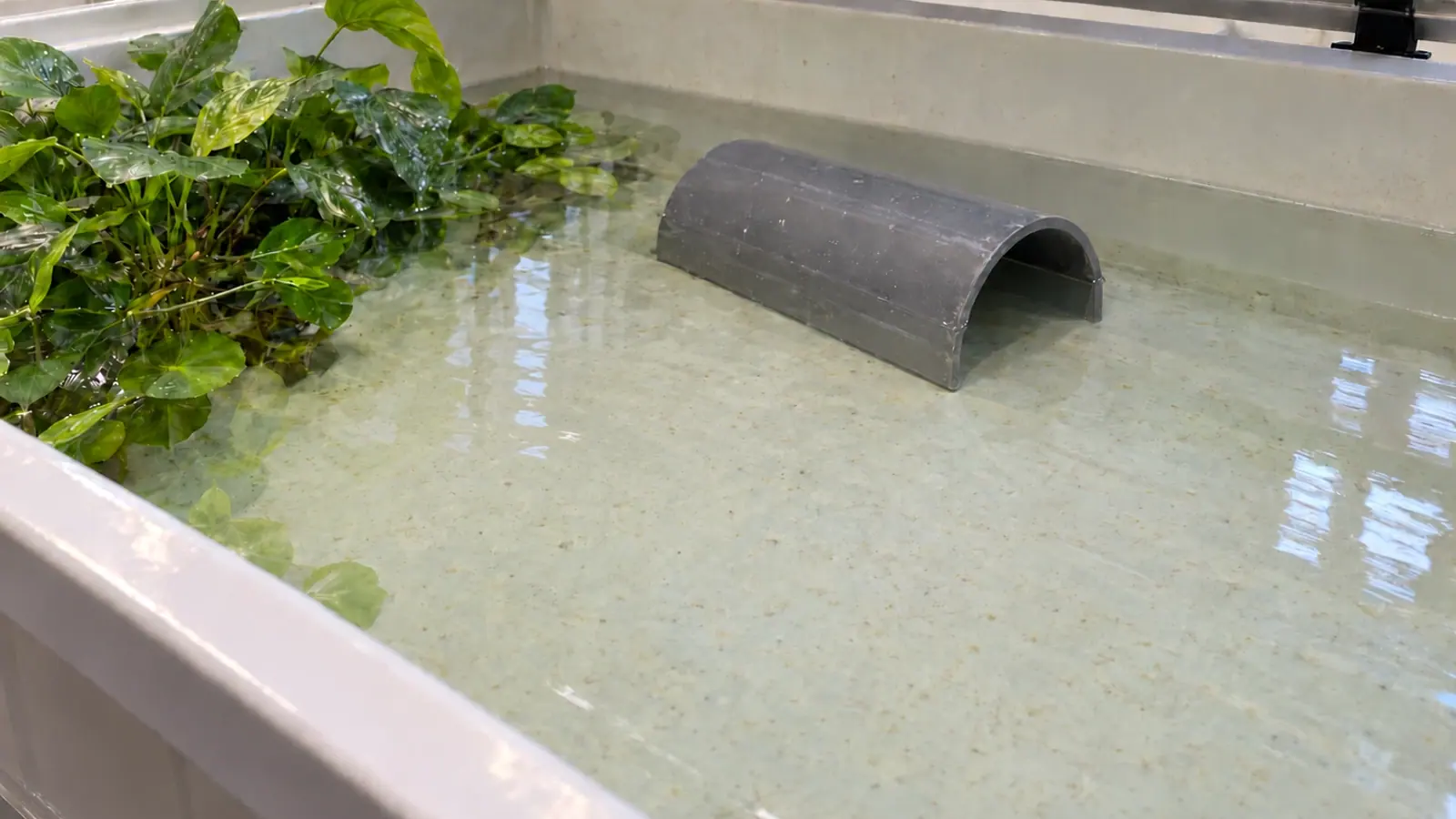
In a study published in 2021, female Xenopus laevis used areas with artificial plants more than areas with a PVC shelter or no enrichment. The finding describes a choice within those tanks. It does not by itself measure an improvement in health or welfare.


- Content type
- Practical guide
- Sector
- Research facilities
- Animal group
- Xenopus
- Keywords
- EnrichmentStressLighting
In a study published in 2021, female Xenopus laevis used areas with artificial plants more than areas with a PVC shelter or no enrichment. The finding describes a choice within those tanks. It does not by itself measure an improvement in health or welfare.
A preference within a particular setting
The African clawed frog, Xenopus laevis, is an aquatic amphibian used in research. Environmental enrichment raises a practical question: which features do the animals use when alternatives are available? Ramos and Ortiz-Díez examined this in twenty adult females housed in two tanks over six weeks.
Their daytime counts compared areas containing artificial plants, a PVC shelter or neither feature. Plant areas were occupied more often. The result provides a reason to examine opportunities for cover under those conditions. It does not establish that every artificial plant or every facility would produce the same response.
Spatial choice can be a behavioural indicator, but it needs a description of the available options and observation times. Absence from an area does not necessarily indicate a lasting rejection. A count initially tells the observer where animals were at the recorded moment. Interpretation should not advance further than the design allows.
The options differed in more than material
The plants and PVC structure did not provide identical shapes or amounts of cover. Several features therefore differed together. The study cannot isolate a single property responsible for the preference, such as material, form or covered area. Describing it as proof that frogs universally prefer one material would overstate the finding.
This limitation is useful when planning observations in a facility. Staff should describe an object’s position, accessibility and alternatives. A large addition occupying much of a tank cannot be compared casually with a small object in one corner. The distribution of available space is part of the question, rather than background detail that can be omitted from a report.
Availability and use also need separating. A photograph can show that plants were installed, but it does not show how animals use them over time. A descriptive record preserves the observation conditions. It avoids assigning a preference when the animals were not offered a meaningful choice or when no repeated observations were made.
Twenty frogs are not twenty independent tanks
The females were group-housed in two tanks. Repeated counts provide more observations, but they do not create additional independent housing groups. Animals share conditions and may influence one another’s positions. That structure remains relevant when assessing how widely the findings can be applied.
The population was adult females of this species. The experiment does not automatically validate the same arrangement for males, juveniles or Xenopus tropicalis. A facility holding several populations should identify the group concerned before circulating an enrichment recommendation. The species and life stage matter more than a general label such as laboratory frog.
Observations were made during the day. They do not describe the full pattern of nocturnal use. Light schedules and recording times should remain visible in any comparison. A different distribution at another time would not, on its own, either reproduce or disprove the published result. It may instead identify another question for a suitably designed assessment.
Connect use to welfare without assuming the outcome
Welfare is not captured entirely by counting animals beneath an object. A local assessment may combine space use with other observations relevant to the population, including the ability to inspect individuals, their condition and access to resources. Indicators and their interpretation should be agreed with the competent team and reflect the facility’s operation.
The 2021 paper does not demonstrate that plants caused lower hormone concentrations, fewer injuries or improved egg quality. Those outcomes should not be added to the account. A plausible benefit can motivate further assessment, but it is not a replacement for evidence of that particular benefit. Preference and welfare outcomes answer related but distinct questions.
Maintenance and visibility are design considerations too. Cover that hides individuals can complicate some checks, while a very open feature may serve a different purpose from the one intended. Describing the compromise is more useful than copying a universal number of plants or shelters from one experiment. The arrangement needs to be assessed with the animals actually housed.
Use observations to inform the next design decision
This study supports examining artificial plant cover for adult female Xenopus laevis within the limits of its design. It also illustrates why preference tests require careful interpretation. Occupancy is informative when the experimental setting, population and limitations remain attached to the finding.
Before changing equipment, a facility can frame a question that can be checked: what use is expected, and what observations would indicate that the arrangement addresses the need? Describing the starting conditions and observation method makes the comparison more informative than a judgement based on the tank’s appearance alone.
The resulting record should retain inconvenient observations as well as expected ones. If animals use a feature differently from anticipated, the team can reconsider the explanation rather than treating installation itself as evidence of success. This is a practical management approach, not an additional result claimed for the published experiment.
Vetofish can work with facility teams on suitable indicators, maintenance constraints and critical reading of enrichment research. The aim is to connect environmental arrangements with the population concerned while keeping observed preference distinct from a welfare improvement that has already been demonstrated.
To move from evidence to action, explore our animal welfare service and our expertise for research facilities.


