

Research fish: what a pilot study can establish
A procedure that works in practice has not yet demonstrated a biological effect. NC3Rs and ARRIVE guidance gives pilot studies a specific role: test logistics, identify problems and prepare the next experiment, with a sample size justified by the feasibility question.


- Content type
- Practical guide
- Sector
- Research facilities
- Animal group
- Zebrafish
Feasibility comes before a test of effect
A pilot study asks whether a larger experiment can be conducted as planned. NC3Rs describes it as a small preparatory investigation that tests logistics and gathers information. Its value lies in the decisions it supports: change a procedure, prepare staff, reconsider a measurement or stop pursuing an unworkable approach.
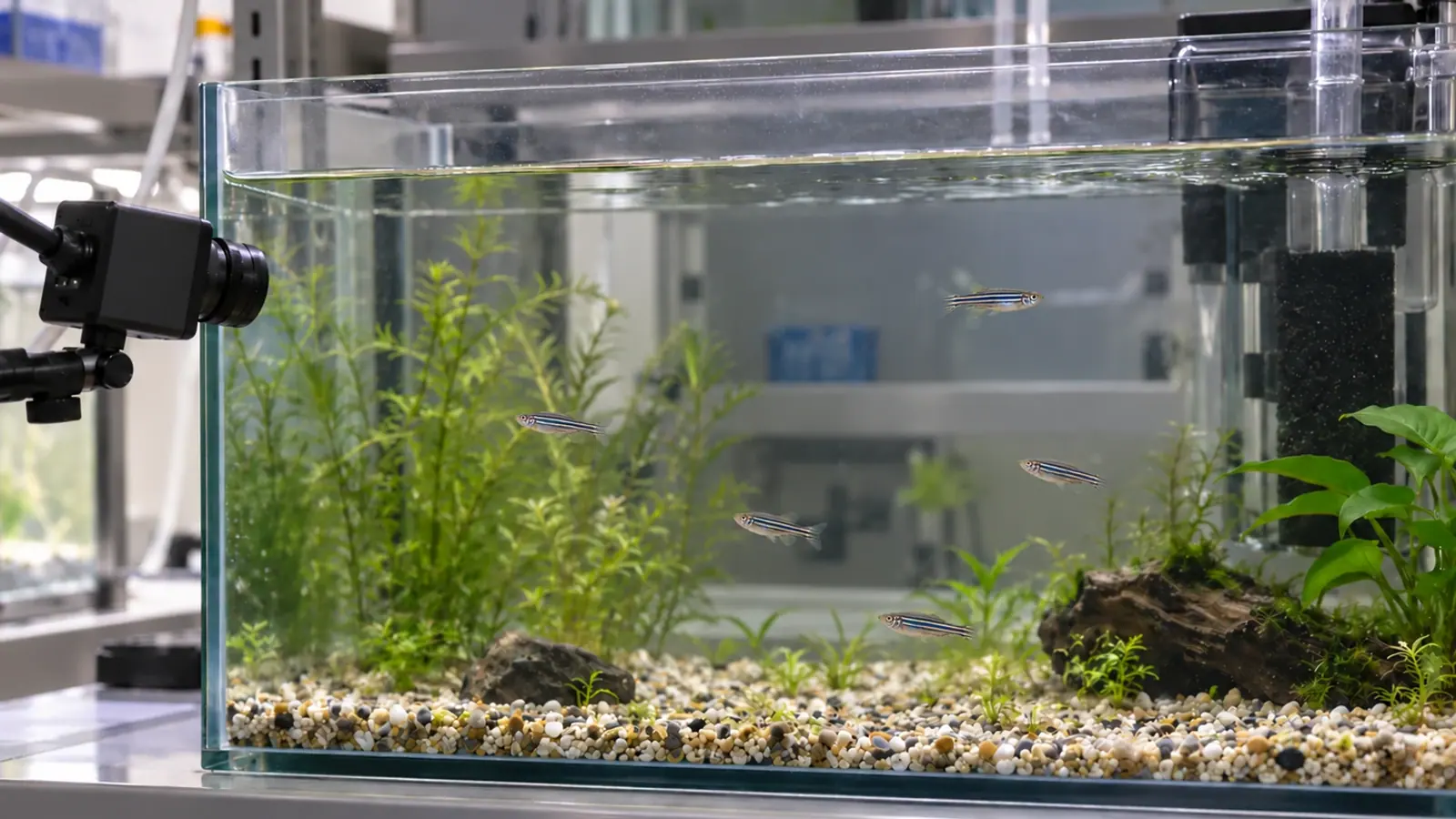
For example, a zebrafish video project may first need to establish whether fish remain visible, whether the camera works under the planned lighting and whether the files can be analysed. This is an application of the guidance, rather than a reported experimental result. Those practical questions come before a comparison intended to establish a biological effect.
Calling a study a pilot does not justify any small sample size. The term identifies a preparatory purpose. An experiment that cannot adequately test its hypothesis does not become informative simply by being renamed after the analysis.
Write down the decision the pilot must support
Before starting, the team defines what it needs to learn and how that information will determine progression. For video recording, this might involve readable sequences, tracking errors, file-processing time or the ability to synchronise observations with water measurements. Each criterion should address an identified problem.
Avoid choosing acceptance criteria after seeing which results look most favourable. Set them for the intended use and the consequences of missing data. There is no universal percentage of successfully recorded sequences that makes every experimental protocol fit for purpose.
NC3Rs also recommends examining staff skills, equipment performance and whether the animals can perform the task required. Floor and ceiling effects can limit a test: if almost no fish complete a task, or all complete it immediately, the measurement may be unable to distinguish the responses of interest. Finding this early can change the next stage of the project.
Count the units that answer the question
The sampling plan distinguishes fish, tanks and repeated measurements. The Experimental Design Assistant defines an experimental unit by whether it receives an intervention independently of other units. Several recordings of the same fish do not create several independent animals.
If a condition is applied to all the water in a tank, its inhabitants are not automatically independent replicates of that condition. A pilot may reveal that the proposed arrangement cannot support the intended comparison. Learning that before committing a larger cohort is a useful outcome in its own right.
Sample size for a logistical pilot depends on its purpose and what is needed to assess that purpose. ARRIVE’s explanation of item 2b distinguishes this situation from a hypothesis-testing study requiring an appropriate statistical design. Either way, the justification must be explicit: explain why the planned observations can inform the decision being made.
Include the animal’s experience in the assessment
The practical workflow can change handling, waiting time and transitions between environments. A pilot helps identify these difficulties. Stress cannot be inferred from a single trajectory or recording alone; interpretation needs the context, usual behaviour and other relevant observations.
NC3Rs guidance includes identifying adverse effects and defining early humane endpoints. The responsible people establish what will be observed, when a procedure will be interrupted and what action follows a problem. Using only a few animals does not remove the need for this preparation.
Keep temperature, timing, housing conditions and technical incidents in the study record. A recording that cannot be analysed does not erase the handling experienced by the fish. The assessment should distinguish technical success, missing data and the actual burden placed on the animals.
That distinction also helps the facility and research teams discuss refinement. A technically successful sequence may still require a different workflow if the observation period or movement of animals creates an avoidable difficulty. The pilot’s purpose is to identify such changes before the larger experiment, rather than to preserve an initial plan at any cost.
Give small results an appropriately limited interpretation
NC3Rs notes that a small pilot usually provides limited information about the variability expected later. A few unusually consistent observations can create an impression of precision that will not survive a larger study. Planning the main sample size requires justified assumptions and statistical input where necessary.
ARRIVE asks researchers to explain how the sample size was decided and which information informed it. The guidance notes that pilots alone rarely provide adequate estimates of variability for a future experiment. Relevant previous studies and systematic reviews may contribute, provided their conditions are sufficiently comparable to the planned work.
No adverse event in a small pilot establishes general safety. An observed difference likewise does not demonstrate efficacy. Descriptive results, practical difficulties and proposed changes are often the most useful information to pass on to the team. An apparently negative pilot can still prevent a larger, poorly prepared experiment.
Decide which information belongs in the next study
If the pilot exposes a methodological defect, its measurements may no longer be relevant to the main experiment. NC3Rs notes that including pilot data can sometimes be considered when procedures remain unchanged, but subject selection and possible changes over time must be examined. Combining files is not automatically a valid analysis strategy.
Major changes may require another pilot or abandonment of the original approach. Keep a record of failures as well as successes. They explain the decisions and help another team avoid repeating a problem already identified, even if the original main experiment never takes place.
Conclusion and support from Vetofish
A successful pilot supports a better decision about feasibility. It does not replace a coherent main study or demonstrate a biological effect. Defining the purpose, units, progression criteria and animal observations before starting gives this preparatory stage a useful role.
Vetofish can help facility and research teams connect care constraints with pilot planning, organise observations and examine refinement options. Statistical planning should involve the expertise appropriate to the project and its intended comparisons.
To move from evidence to action, explore our advice and support service and our expertise for research facilities.


