

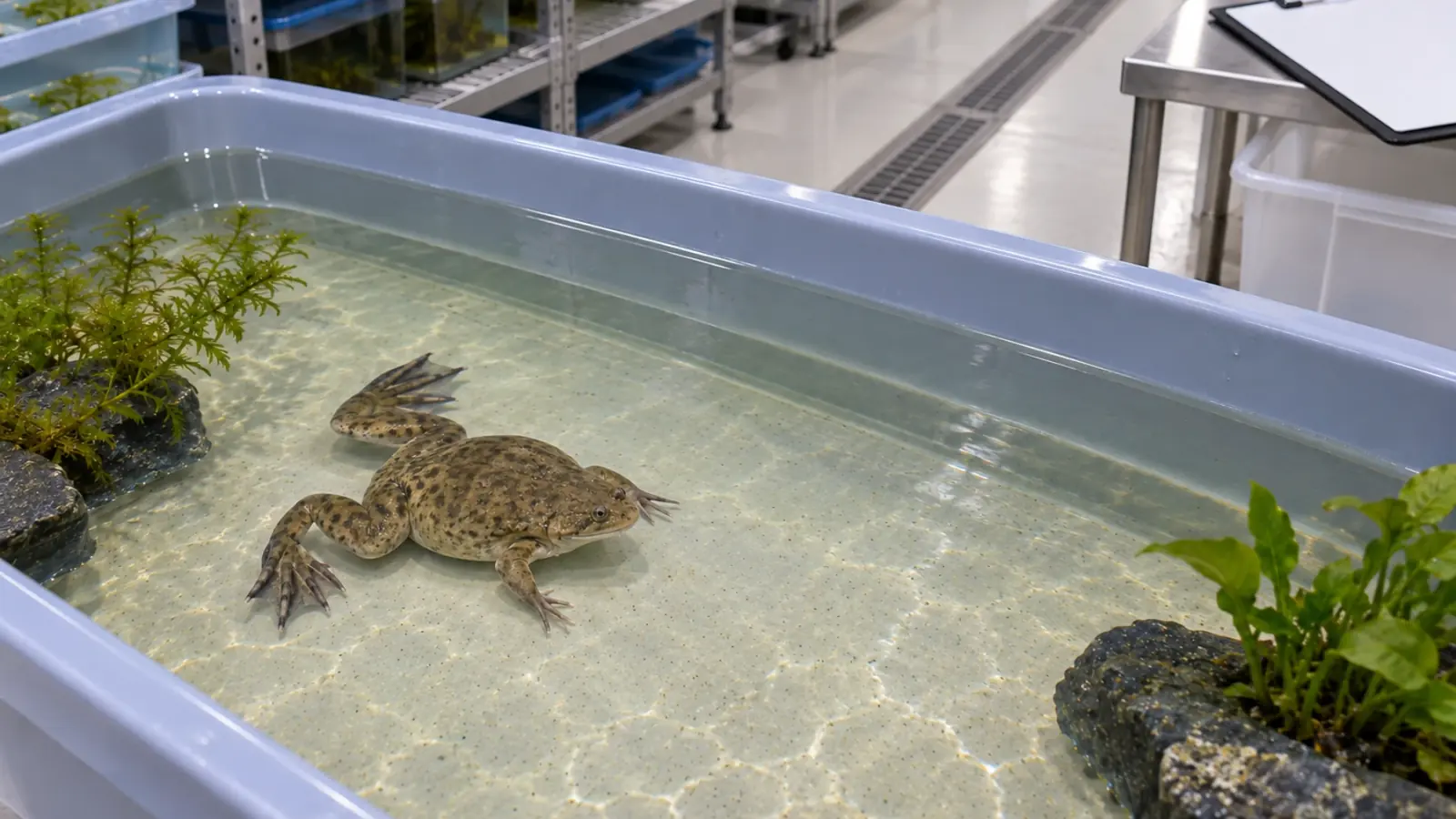
Xenopus identification: what tattooing can deliver
A 2024 method describes tattooing adult Xenopus laevis for individual tracking. Readability needs follow-up, and the procedure remains invasive. Its results do not establish suitability for froglets, every Xenopus species or every research programme.


- Content type
- Protocol / technique
- Sector
- Research facilities
- Animal group
- Xenopus
- Keywords
- AnaesthesiaBiosecurityStress
Connect identity with the animal’s history
Individual identification allows a research facility to connect health observations, experimental use and rest periods to the same Xenopus. That connection depends on a mark remaining readable and on its code matching the record without ambiguity. A mark visible on the day of application does not establish reliable identification throughout a long study.
Suber and Landino published a rotary-machine tattooing method for adult Xenopus laevis in 2024. Their paper describes a practical identification technique and the problems that influence its success. It does not establish tattooing as the best option for every colony or remove the need for veterinary assessment before a facility adopts it.
Keep the tested population in view
The authors report marks visible immediately after tattooing and after recovery, together with follow-up over time. They also illustrate how technique affects persistence. Poorly readable marks can lead to further procedures, making operator training part of the assessment of the method’s overall value rather than merely a technical detail.
The protocol was tested in adult frogs older than one year. Froglets were not evaluated. The authors also state that the method is not optimised for Xenopus tropicalis, whose chest pigmentation makes tattoo reading more difficult. Evidence from these adult X. laevis therefore cannot be extended automatically to younger animals, another species or all aquatic amphibians.
Define what readable means in the facility
Before selecting a mark, the team should describe how it will be read during routine work. A code distinguishable in a close photograph may be uncertain during an ordinary check. Animal position, lighting and the reader’s experience can all affect practical interpretation. An uncertain character should remain uncertain in the record instead of being resolved by assumption.
One possible local procedure is to use independent readings at planned intervals. This is an organisational suggestion, not a performance result demonstrated by the paper. Its purpose is to identify fading before an intervention or scientific result is assigned to the wrong animal. Staff should not silently change the record identifier to fit an ambiguous mark.
Assess the whole intervention
Welfare assessment must cover more than the eventual presence of ink. Tattooing breaches the skin and the published procedure involves anaesthesia. The paper describes recovery precautions and highlights the risk of drowning if an animal unable to maintain itself normally is placed in an unsuitable recovery position. These considerations belong in the plan before work begins.
Preparation, observation and return to housing therefore need to be organised as part of a single procedure. Drug doses, handling methods and recovery criteria require a veterinary protocol suited to the animal and institution. A methods article is neither a ready-made prescription nor permission to perform the intervention. Applicable project and institutional requirements still need to be satisfied.
Treat skin changes as clinical observations
Amphibian skin is functional tissue, not simply a surface for a code. The authors discuss irritation, injury and infection risks associated with excessive or poorly controlled tattooing. Their report that animals were not permanently injured or killed during the work does not eliminate those risks, and it does not demonstrate that tattooing is painless.
Biosecurity covers the workspace, equipment and return to the colony. Subsequent observations should remain linked to the individual, operator and marking session. A lesion or behavioural change deserves assessment rather than automatic classification as an expected consequence. Handling-related stress also belongs in the review of the procedure’s effects and practical burden.
Compare options across the intended follow-up
The required tracking period and identification accuracy should drive the choice. A mark needing frequent touch-ups can lose part of its initial advantage. Another method may be preferable if it answers the scientific question with fewer interventions. The published paper does not provide a comparative trial ranking every identification method available to Xenopus facilities.
Tattooing also cannot compensate for poor record management. Records should include the application date, code description, readability checks and any corrections. A reference photograph may help interpretation, but it cannot resolve an identification problem if neither the animal nor the mark can be recognised confidently. Discrepancies should remain traceable rather than being overwritten in the database.
Set review criteria before using the mark
The initial decision should identify circumstances requiring reassessment: ambiguous marks, skin changes, repeated touch-ups or a tracking period longer than originally planned. The veterinarian and project team should agree on these criteria. Maintaining a convenient identifier is not, by itself, sufficient justification for repeating an invasive procedure.
Identification supports refinement when it genuinely improves individual care and the organisation of animal use. Its mere presence does not demonstrate that benefit. A useful review considers data reliability alongside the procedures animals undergo and the observations recorded afterwards. This allows the team to distinguish the intended benefit from what its own programme actually achieves.
For a facility introducing the method, an initial review should also check whether the same code can be confused with another animal’s mark. The issue is not just fading: a clear but poorly designed numbering scheme can still create mistakes. Agreeing how uncertain identities will be managed protects both the scientific record and decisions affecting the animals.
Choose an identification plan, not only a technique
Adult X. laevis tattooing is a documented option with limitations concerning readability, persistence and transfer to other animals. Its suitability should be assessed within a complete tracking programme, including explicit reasons to retain, revise or stop the method. The decision should remain open to review when the research or husbandry context changes.
Our animal welfare service can support research facilities in assessing identification needs, planning observations and discussing appropriate procedures with their veterinary team.


