

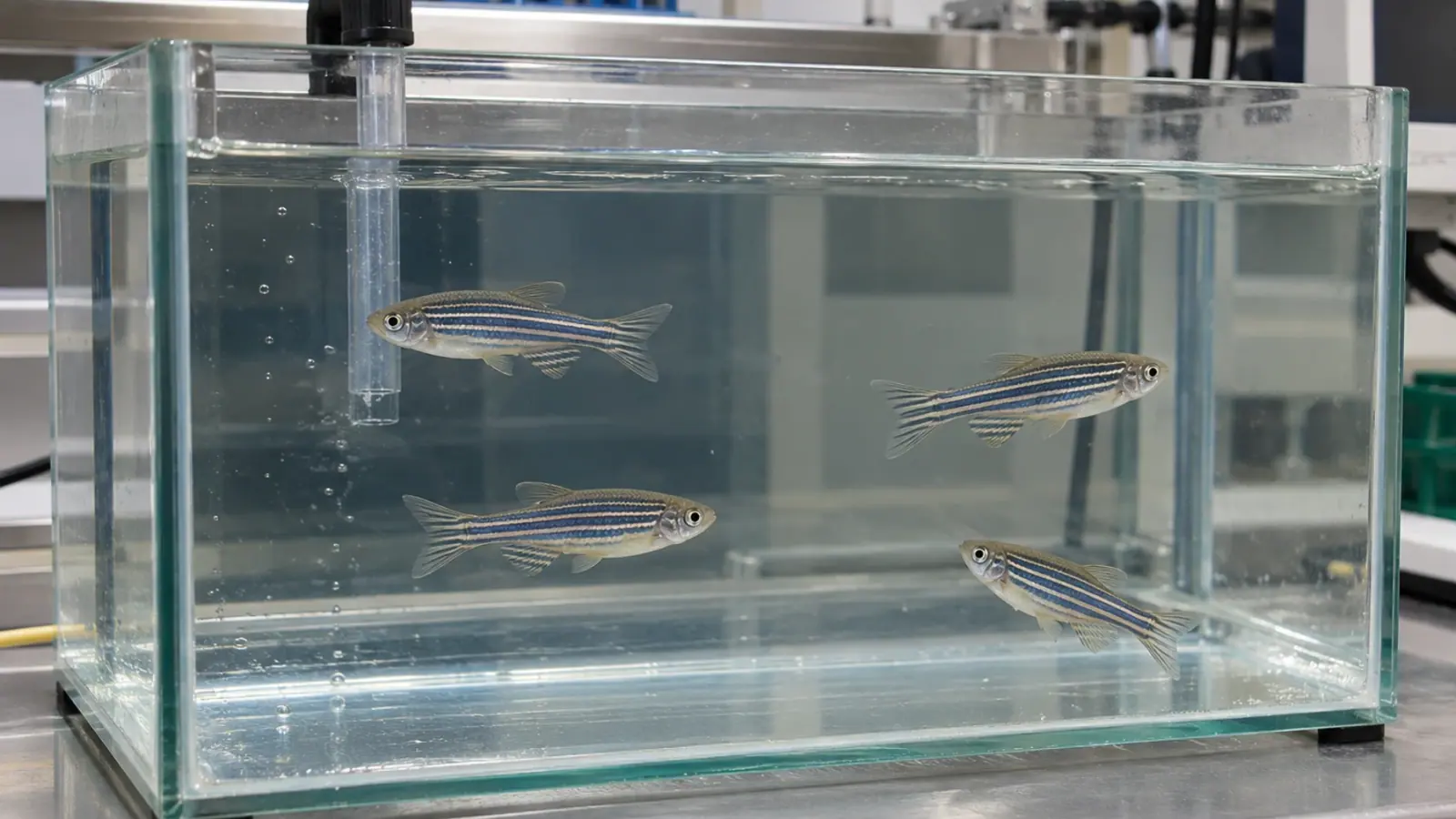
Zebrafish injection: validate the whole procedure
A known injected quantity does not guarantee an injury-free procedure or a measurement unaffected by stress. An open 2010 adult zebrafish protocol helps define what needs validating, from weighing to recovery.


- Content type
- Practical guide
- Sector
- Research facilities
- Animal group
- Zebrafish
- Keywords
- AnaesthesiaStressTemperature
Evaluate the administration route as a procedure
Intraperitoneal injection places a preparation in the abdominal cavity. In adult zebrafish, it can address an experimental question requiring a known quantity for each animal. Exposure through the water does not directly establish how much an individual fish has absorbed. That distinction alone does not settle the choice of route: handling, the vehicle and recovery remain part of the experiment.
Kinkel and colleagues published an open protocol in 2010 for a blood-glucose application. It provides specific questions for local validation, provided its historical conditions remain explicit. The report concerns adults in a defined experimental setting. It does not automatically validate the procedure for other stages, substances or all present-day applications.
Reliable quantities depend on reliable weighing
Individual body mass enters the calculation when the administered quantity is weight-dependent. Water carried with the fish can affect weighing and therefore influence preparation. The authors compared two weighing approaches and found no statistically significant difference in their arrangement. That finding documents their method; it does not remove the need to assess the balance and handling technique used at another facility.
Records should connect the animal’s identity with its weight, calculation and administration. Product concentration, quantity of active substance and actual injected volume also need to remain distinguishable. Together they allow an error to be investigated without assuming that all fish in a group received an identical exposure simply because they appeared on the same preparation sheet.
Vehicle controls help distinguish procedural effects
A vehicle-injected control undergoes handling and injection without receiving the test substance. A non-injected group provides a different comparison. In the 2010 protocol, that distinction helps examine whether the procedure itself changes blood glucose, a measurement that can be affected by stress. The relevant comparison therefore extends beyond the contents of the experimental preparation.
Under their tested conditions, the authors did not detect a significant elevation in glucose in vehicle-injected adults compared with non-injected fish. This does not establish physiological neutrality for every injection procedure. The vehicle, time before measurement and condition of the animals need to fit the experimental question. Findings for one formulation do not automatically establish the suitability of another.
Preparation can influence the measurement
Fasting, capture, restraint and anaesthesia all precede administration and can influence an experimental endpoint. The historical protocol was designed around a metabolic question and used cooling. That choice needs to be recognised as a condition of the 2010 study, rather than reproduced as an anaesthesia instruction for a new procedure.
Current anaesthesia and monitoring arrangements should be defined with the veterinarian and those responsible for the authorised procedure. Immobility alone does not establish an appropriate depth or absence of pain. Temperature, stage durations and respiratory observations should be recorded where the protocol requires them, together with a defined response if recovery differs from what is expected.
Report complications without implying zero risk
Kinkel and colleagues reported five brief bleeding episodes in 127 injections and no observed mortality using their method. The denominator is injections; it should not be converted without evidence into a number of independent fish. These observations do not quantify every possible internal injury and cannot guarantee an absence of risk for another team or application.
The abdominal cavity contains organs that can be injured by an unsuitable path or depth. Needle selection and control of the technique therefore require specific training. The paper describes its own equipment. Changes in equipment, fish size or test substance require the conditions of use to be reconsidered. A successful demonstration does not replace assessment of complications across the complete sequence.
Include recovery in the assessment
Returning the fish to water does not end the observation. Resumption of ventilation, balance and swimming, followed by the checks specified in the protocol, contribute to assessing recovery. A fish recovering slowly should not be recorded as an uncomplicated technical success merely because the intended volume has left the syringe.
Handling also needs to preserve mucus and body surfaces. The wet support described in the paper was intended to reduce damage and maintain appropriate conditions during injection. It does not make the time spent away from the holding tank irrelevant. Preparing the equipment and receiving tank in advance avoids extending a stage while the fish is already being handled.
Assess competence under the intended conditions
Practical training should evaluate preparation, anatomical recognition, traceability and observation after administration. An operator needs to know when to stop and how to report an unexpected event. The supervisor should be able to distinguish a problem with calculations, equipment, handling or monitoring, because each calls for a different response during training.
Analysis should retain unsuccessful administrations and adverse events under rules established in advance. Silently excluding them can make a method appear more reliable than it is and change the population being analysed. Animal welfare and data integrity have the same requirement here: describe what actually happened, including procedures that did not follow the intended course.
Conclusion and Vetofish support
A documented injection procedure links weighing, vehicle choice, administration and recovery. Knowing an individual quantity is an experimental advantage only when procedural effects and complications remain assessable. A published protocol provides a basis for evaluation, rather than a guarantee that every detail will transfer to another facility.
Vetofish can help develop supervised learning and observation criteria through its training services for research facilities. The aim is to match validation to the fish, equipment and scientific question, while keeping the limits of the historical evidence clear.


