

Zebrafish: do artificial plants leave enough swimming space?
A year-long facility study found no significant survival or breeding benefit from artificial plants in zebrafish tanks. Fish occupied the planted area less often, highlighting the need to assess usable swimming space alongside enrichment.

- Content type
- Scientific news
- Sector
- Research
- Animal group
- Zebrafish
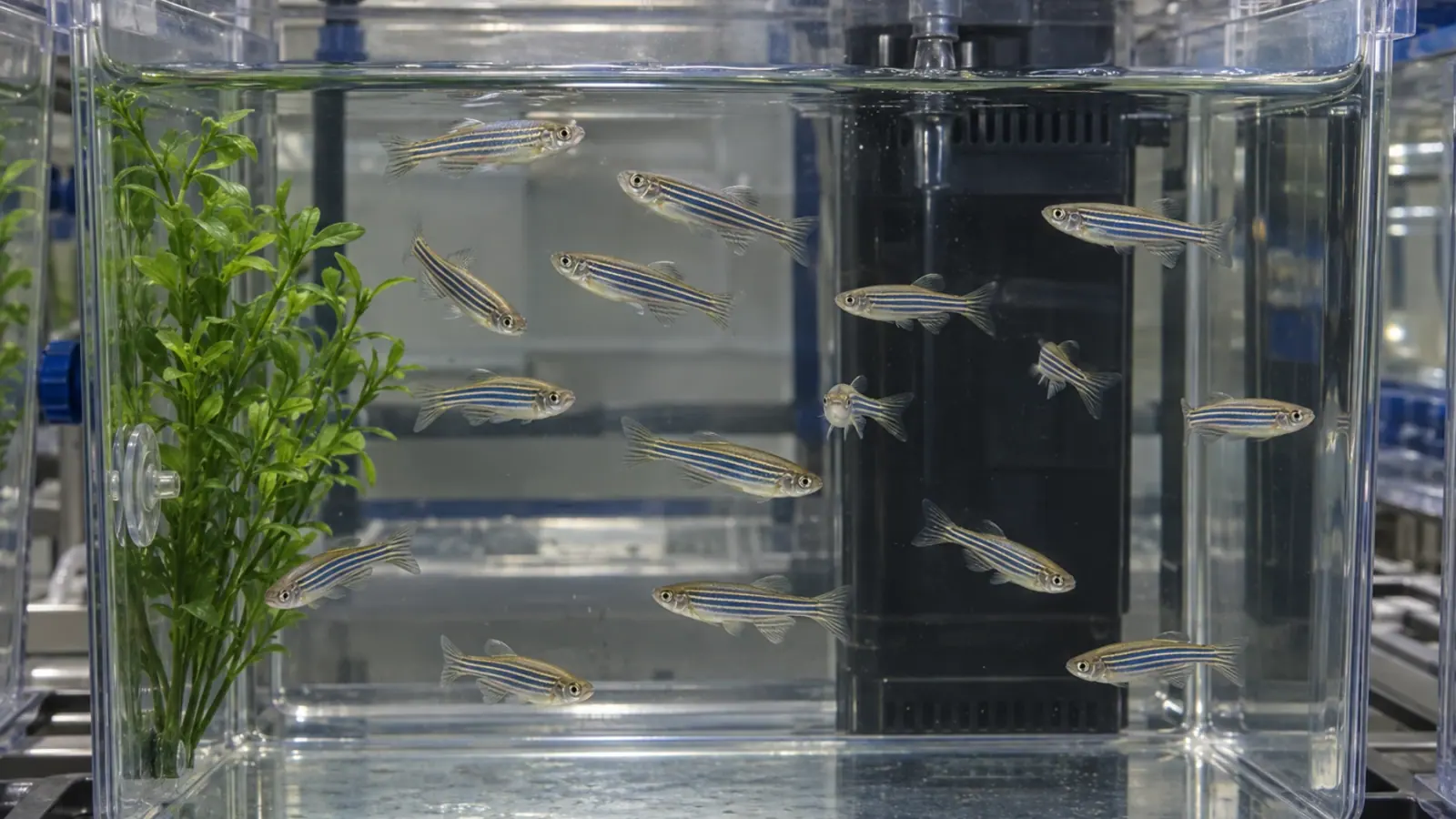
An artificial plant takes up tank volume. It may provide structure while also reducing the space available for fish to swim together. Researchers at Germany’s laboratory animal protection centre examined that trade-off in their zebrafish (Danio rerio) facility. Their PLOS One study, published in May 2026, follows animals under routine housing conditions over a year.
The findings concern the arrangement tested. They demonstrate why an intervention should be assessed through animal behaviour and relevant outcomes, rather than the appearance of the tank alone. The researchers detected no significant improvement in several production measures and found that fish occupied the planted area less often than open-water areas.
Sixteen tanks within one husbandry system
Eight tank pairs compared housing with and without artificial plants across several fish lines. A total of 470 larvae were raised, resulting in 360 adults. The work took place within the same facility over a year, using animals already required for line maintenance and other projects. It was a facility evaluation rather than a test across independent laboratories.
Polyethylene plants were attached to the left wall of the enriched tanks. Their shapes and dimensions had been selected to preserve water movement and access for maintenance. All tanks also had gravel pictures underneath. The comparison therefore assessed added physical structures against housing that already included visual enrichment, rather than comparing every possible enriched environment with a completely featureless setting.
Tank size, stocking density, fish line and maintenance practices are part of that context. The study did not test every enrichment material, tank volume or zebrafish population. Its findings concern a particular arrangement within a particular system. Keeping those details with the result is essential before another facility decides whether the same intervention would meet its own animals’ needs.
No demonstrated improvement in production outcomes
The researchers found no statistically significant difference in rearing survival, sex ratio, initial mating success or egg numbers. Mean survival was 74% without plants and 77% with plants. That descriptive difference is not a demonstrated survival benefit. Equally, a non-significant comparison does not establish that the conditions were identical or that every biologically relevant effect was absent.
Variation between tanks, including a cohort with poor survival, limited the ability to detect subtle effects. The team retained that cohort because it represented a real line-maintenance problem. This choice gives the report practical relevance while showing why a modest number of tanks cannot resolve every welfare question. A result can be informative without providing a definitive verdict on all enrichment.
Survival and breeding performance matter to research facilities, but they do not capture every affective state, behavioural opportunity or social interaction. Read the paper’s broad title alongside the outcomes actually measured. Failure to detect a benefit in those outcomes does not demonstrate that all structures are unhelpful to laboratory zebrafish, or that a different arrangement would produce the same findings.
Fish occupied open water more than the planted area
Behavioural assessment in eight-litre home tanks divided front-view images into spatial zones. Fish occurred less often on the planted side and more often in open water in the middle or on the opposite side. The pattern appeared during human activity and during undisturbed periods, although its magnitude differed. Observer presence therefore belonged to the interpretation of the spatial record.
Zebrafish are a shoaling species, making usable group-swimming space relevant to tank design. Some reduced occupancy near plants may reflect the physical volume taken up by the structures. The authors discuss several explanations rather than demonstrating a universal aversion to plants. Occasional individual behaviour close to a plant also cannot describe the preferences or welfare of the whole shoal.
Observations at different densities suggest that fish numbers influence spatial use. Those comparisons involved different tanks and fish lines, however, and cannot establish a universal optimal density. Multiple pictures from the same tank should not be mistaken for independent replications of the housing intervention. The number of observations and the number of experimental units need to remain distinct.
Microbial findings have a defined scope
The team collected water for total microbial counts from two tank pairs on three occasions. No significant difference was detected between enriched and non-enriched conditions. The result concerns microorganisms that grew under the culture conditions used. It does not demonstrate freedom from every pathogen or establish that adding structures carries no health risk in other facilities.
Biofilm was observed on suction cups rather than on the plants themselves. Attachment hardware and cleaning consequently belong to the assessment, alongside the main object. These findings arose within the study’s water-treatment and maintenance arrangements. Another facility needs to assess its own materials and procedures rather than treating the published microbial comparison as a certificate of safety for any tank accessory.
Define a local evaluation before changing routine housing
A facility can first specify the intended benefit: spatial use, opportunities to withdraw, social interactions or another observable behaviour. Describe the object, its position, available volume and monitoring conditions. An ethogram can make observations comparable without converting a few movements into an unsupported overall welfare score. The outcome needs to match the question that motivated the intervention.
Keep staff activity, time and recent feeding comparable or record their differences. Home-tank observations, as used here, can limit disturbance from moving fish solely for assessment. Agree when an object should be removed, including impaired visibility, waste accumulation or problematic interactions. Veterinary input may be needed when changes affect health or when their meaning remains uncertain.
The study’s limitations include a single facility, modest comparisons, visible treatment allocation and neighbouring tanks without visual separation. Aggressive interactions were not assessed systematically. The report supports further documented evaluations, not a replacement for evidence on other structures or conditions. Sharing inconclusive and unsuccessful attempts can help facilities understand which methods deserve a more substantial investigation.
Conclusion and Vetofish support
Enrichment should be judged through animal outcomes and its compatibility with routine care. Our animal welfare service can help research teams define proportionate evaluations, preserve health inspection and interpret findings without confusing a non-significant result with proof that an intervention has no effect.


