

Zebrafish housing: cortisol cannot rank welfare
Adult zebrafish housed in groups had higher whole-body cortisol than individually housed fish before behavioural testing in a 2022 study. That finding does not establish that isolation improves welfare; social history and the test sequence change what a measurement can mean.


- Content type
- Scientific news
- Sector
- Research facilities
- Animal group
- Zebrafish
- Keywords
- StressEthogramEnrichment
A hormonal measurement cannot describe every social condition
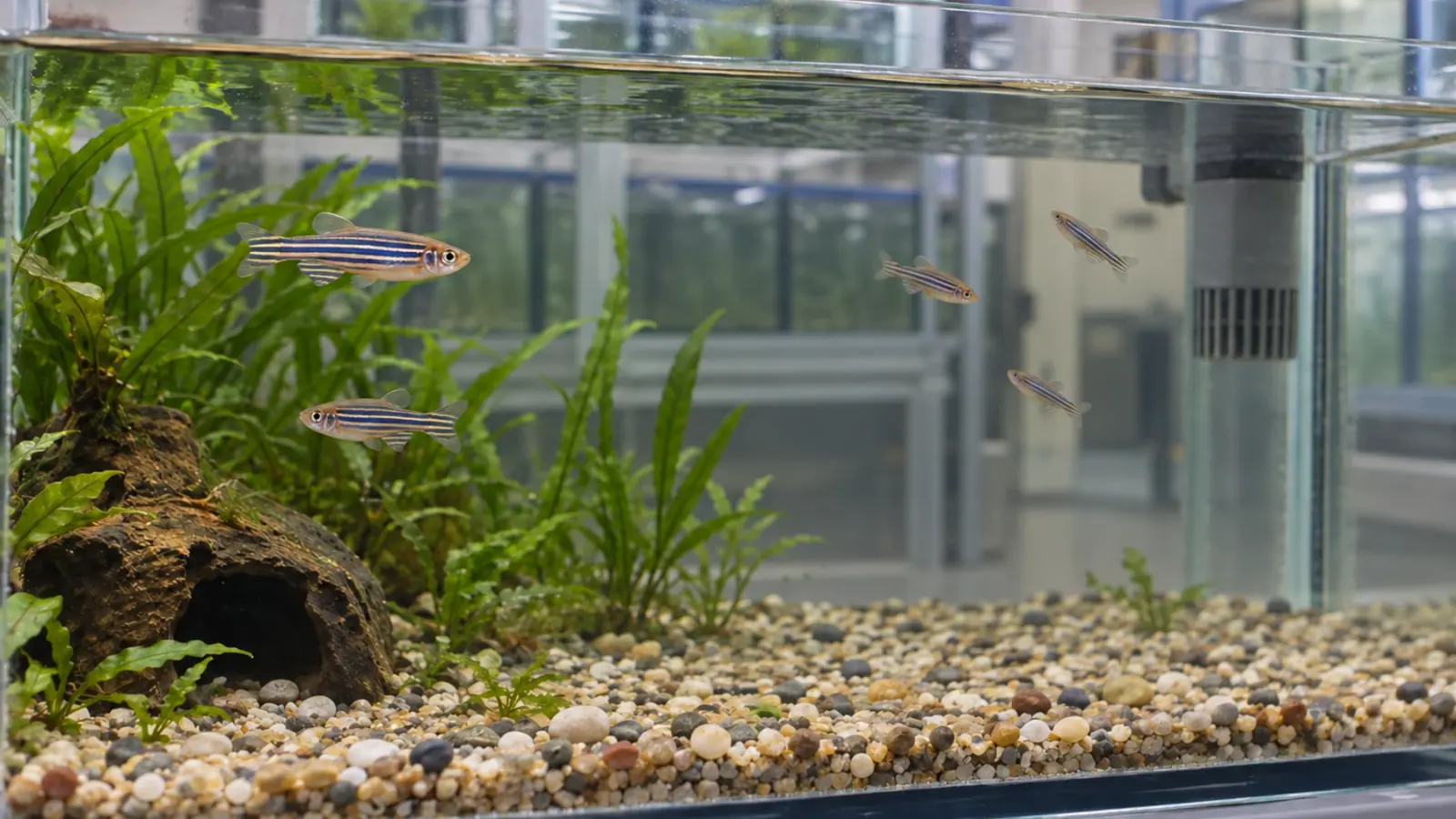
Zebrafish, Danio rerio, form groups and seek contact with conspecifics. Nevertheless, comparing cortisol across housing arrangements does not necessarily produce a simple welfare ranking. In a 2022 study, Onarheim, Janczak and Nordgreen compared adult fish housed in groups or individually and examined responses in two behavioural assays. The findings highlight the influence of context on interpretation.
Before behavioural testing, individually housed fish had lower whole-body cortisol than group-housed fish. Following the assays, the difference between housing treatments was no longer detected. These observations concern a whole-body measurement under the study’s particular conditions. They do not establish that social isolation is a preferable way to house this species.
Cortisol contributes to the stress response, but its concentration does not directly represent every aspect of welfare. Housing decisions require consideration of social needs, observations of the animals and the circumstances in which a measurement was obtained. Reducing a hormone concentration cannot become the sole objective of a refinement programme.
What the experiment compared
The experiment allocated 91 fish between housing treatments: 50 to group housing and 41 to individual housing. The conditions were maintained for five days before assessment. Some fish provided cortisol measurements without undergoing the behavioural assays; another 56 completed both tests. These subsets therefore address different questions and should not be treated as one interchangeable set of observations.
One assay recorded exploration in a novel tank divided into upper and lower compartments. The other offered black and white areas. Test order was balanced, an important feature because an animal undergoing its second assay has already experienced transfer and novelty. Its initial state is different from that of a fish entering the same assay first.
Group structure, space and earlier housing history remain relevant to the comparison. The experiment does not separate every component of the social environment. It cannot establish effects across all sex ratios, stocking densities or durations of isolation. Consequently, its observations should not be converted into a general recommendation for aquatic research facilities.
The assays did not produce one uniform answer
In the novel tank, the researchers did not detect an effect of housing on the behaviours recorded. In the black-white assay, individually housed fish made more entries into the white compartment when that test came first. The contrast was not found when it followed the novel-tank assay. Test sequence is therefore part of the finding, rather than a procedural detail that can be omitted from interpretation.
Fish generally preferred the lower part of the novel tank and the black area of the other apparatus. Yet this does not establish that time spent in those locations represents the same underlying variable. The authors found an association between transition counts across assays, but not between the durations in the compartments being compared.
Keep the actual measurement visible in reporting: duration, entry count or latency. Combining them under one label of anxiety may conceal distinct responses. Similarly, failure to detect a housing effect does not demonstrate equivalence between housing conditions. It describes the outcome obtained with the particular apparatus, sample and measurements used in the experiment.
Make pre-test social history traceable
For facility teams, the practical value is a stronger record of the fish’s social history. Experimental documentation should identify regrouping, separation, duration and recent events. Comparing two cohorts is difficult if one was reorganised shortly before testing while the other remained under a different, stable arrangement and that difference is absent from the case record.
The authors discuss possible explanations for the hormonal contrast, including interactions within groups and the abrupt loss of the social setting during individual testing. These remain hypotheses. The study does not establish which mechanism explains each response. Lower cortisol cannot, by itself, rule out an adverse experience or demonstrate that an animal’s behavioural needs have been met.
Tank and group records also support assessment of the experimental unit. Several fish sharing one environment are not automatically independent replicates of a housing treatment. Statistical planning should reflect how conditions are assigned and animals followed. This needs to be resolved before an experiment, with suitable methodological support, rather than inferred from the final number of fish measured.
Use complementary observations with explicit purposes
A welfare assessment may combine home-tank behaviour, access to food, social interactions, clinical condition and appropriate physiological indicators. The purpose is not to average away a serious adverse observation. It is to compare plausible explanations, identify information gaps and recognise situations in which the housing decision requires reassessment.
An ethogram defines the behaviours being recorded sufficiently clearly for observers to make meaningful comparisons. Record when observations occur and the environment in which they are made. A response in a novel apparatus cannot replace observation of the group in its home tank. Transfer, novelty and separation are themselves components of the animal’s experience during the assay.
We recommend defining decision criteria before changing housing. Where a project requires individual separation, its justification and monitoring arrangements should be explicit. The 2022 study cannot provide a universally acceptable duration of isolation. Nor does it establish an enrichment intervention that removes all potential effects of losing social contact.
Conclusion: retain the context around the result
The central lesson concerns interpretation: cortisol, behaviour and social history need to be considered together. Onarheim and colleagues did not establish an overall welfare ranking of housing arrangements. Their results show that responses may depend on the preceding assay and the variable measured, which makes accurate reporting of the sequence essential.
Vetofish can help develop observations and review housing decisions through our animal welfare service. Our support for research facilities connects scientific requirements, group monitoring and refinement criteria without treating a single hormonal indicator as validation of husbandry. A documented review can distinguish findings supported by the data from management questions that still need investigation.


