

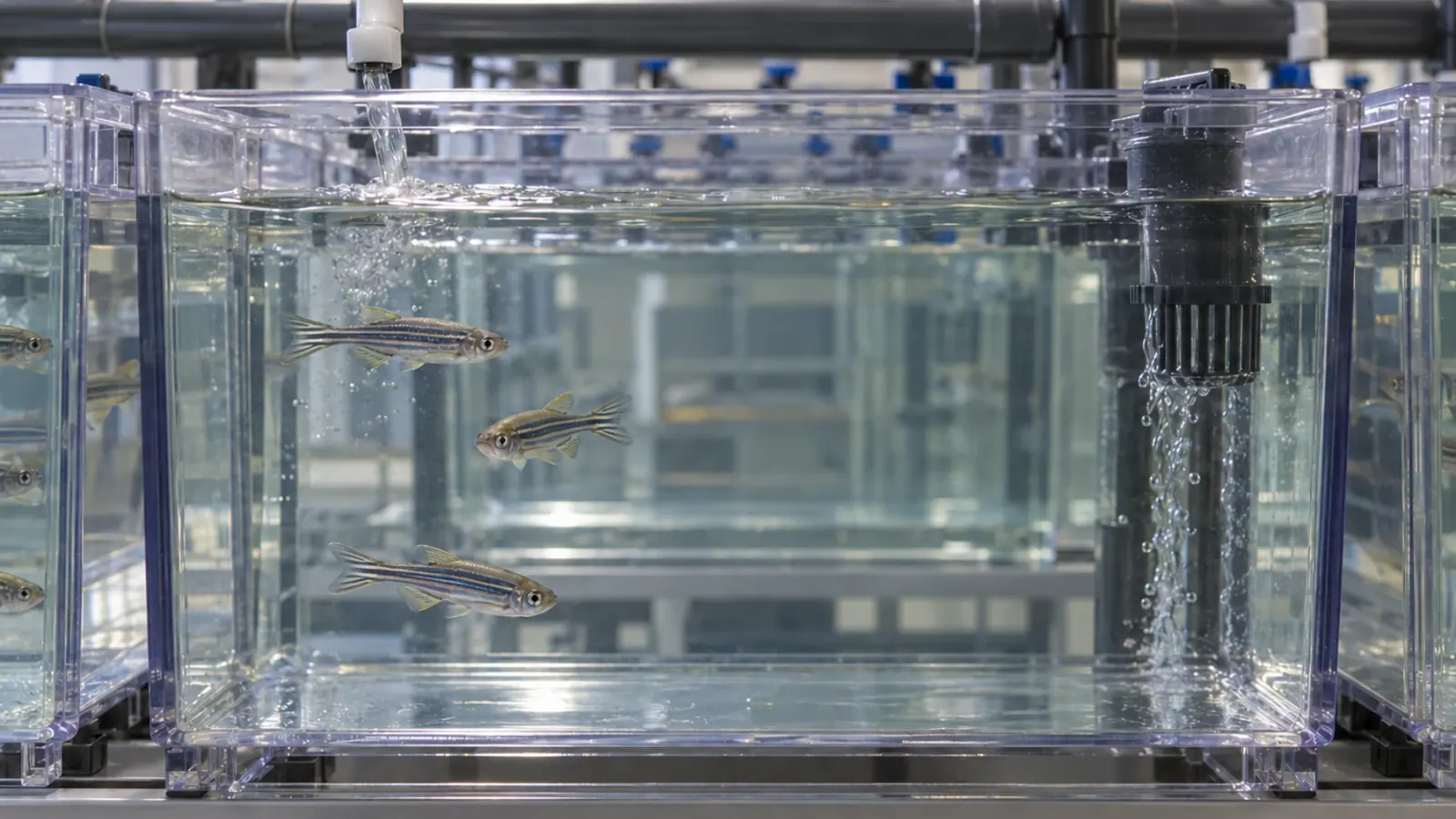
Zebrafish: validate automated water exchange
A valve opening on schedule does not guarantee suitable water exchange in every tank. Research facilities need to assess actual flows, environmental stability, fish observations and incident response before claiming an improvement.


- Content type
- Practical guide
- Sector
- Research facilities
- Animal group
- Zebrafish
- Keywords
- TemperaturepHOxygen
An automated valve can open on schedule without delivering the intended water exchange to every tank. In a research fish facility, checking the programme is therefore insufficient. Validation needs to examine the water reaching the animals, the water leaving their containers and the team’s ability to detect and correct abnormal operation.
Aleström and colleagues’ zebrafish housing and husbandry recommendations provide a basis for that assessment. Published online in 2019 and in the 2020 volume of Laboratory Animals, they address care and housing requirements. They are not an experimental comparison of manual and automated water changes, and they do not establish that automation itself improves welfare.
Specify the improvement being sought
Zebrafish, Danio rerio, are freshwater fish whose requirements vary with developmental stage and housing conditions. The commissioning plan should identify the tanks and animals concerned and the problem being addressed: unstable water conditions, interruptions, workload or incomplete records. Those objectives require different evidence and should not be treated as equivalent outcomes.
Less time spent opening valves can be demonstrated without showing a benefit to fish. Conversely, more stable water may require additional technical oversight. Commissioning should distinguish operational performance from observations describing the animals’ environment and condition. A reduction in routine labour is a valid operational outcome when accurately named.
Documenting the previous arrangement provides a reference: timing, actual delivered volumes, differences between tanks, maintenance events and animal observations. This proposed local assessment is not an experimental protocol supplied by the recommendations. It helps prevent acceptance decisions from being based solely on the operator’s experience of convenience.
Measure conditions where the fish are housed
Incoming water temperature can differ from tank temperature during an exchange. A measurement taken at one location outside the operating cycle may miss a short excursion. Housing recommendations emphasise stable, known conditions; assessment therefore needs to include the phases during which the equipment changes those conditions, rather than only its idle state.
pH, conductivity, dissolved oxygen and nitrogenous compounds provide additional information according to the installation. Records should retain the measurement method, location, time and instrument status. Automatic recording does not guarantee accuracy. Probe maintenance and verification remain necessary before a trend can be interpreted as a real environmental change.
Water replacement also differs from recirculation. Filtration may remove particles or transform particular compounds without adding new water. A higher flow through a loop does not prove that the claimed replacement occurred. The hydraulic assessment needs to identify where each flow originates and where it goes, including water leaving the system.
Include individual tanks and vulnerable life stages
The husbandry recommendations describe systems in which inflow and outflow must function together. An adequate supply does not compensate for a blocked outlet, unequal delivery or unstable water levels. Technical commissioning should examine differences between tank positions rather than infer every container’s performance from a measurement at the main supply.
Early life stages may require arrangements different from those used for adults. Body size, feeding and the ability to cope with current change during development. A setting accepted for an adult rack should not automatically be applied to larval containers. The validated scope should identify the developmental stages actually assessed and any exclusions.
Failure checks should first be planned without exposing fish to avoidable harm. Technical staff can assess a failed valve, supply interruption or alarm response on an empty arrangement or through safe verification methods. The record should describe what was tested and what remains untested. A hazardous trial with animals present is unnecessary to demonstrate that a safeguard is missing.
Connect each alarm to a workable response
Receiving a notification does not ensure that a fault will be corrected. Procedures need to identify the recipient, how the actual system state is confirmed and who can intervene. Periods without staff on site, as well as maintenance operations, deserve the same attention as ordinary working hours.
An incident record should connect the technical event to potentially affected tanks, the known or uncertain duration, animal observations and actions taken. If a failure began before detection, the alarm timestamp cannot safely be treated as its start. Preserving that uncertainty prevents an exposure of unknown length from being described as brief.
Automation transfers some work into maintenance, sensor verification and incident management. Training should address those tasks and assign responsibilities. A technically capable system can still be used poorly when staff lack the information needed to interpret its state or recognise when the automated record is incomplete.
Assess outcomes without overstating attribution
Following commissioning, animal observations may include feeding, swimming, ventilation, injuries and losses within a framework chosen by the facility. They should be considered alongside water measurements and husbandry events. No visible mortality is insufficient evidence that all dimensions of welfare have improved, particularly when observation methods also change.
Comparisons between periods need to account for age, numbers, feeding and other changes in the installation. If diet, stocking and hydraulics change simultaneously, an observed difference cannot simply be attributed to automation. Answering that causal question may require a structured study rather than a routine before-and-after review.
The assessment should retain unsuccessful results: excluded tanks, undelivered alarms, unavailable sensors and missing data. These findings define corrections and conditions of use. Successful completion of most programmed cycles does not erase them, and a completed commissioning checklist should not prevent further review when operating conditions change.
Conclusion and Vetofish support
Validating automated water exchange means checking actual flows, environmental stability and incident response, then assessing the fish. Our advisory service can help research facilities define that scope, select useful observations and organise traceable records. Any claimed improvement should match the outcome that was measured, with its limitations retained.


