

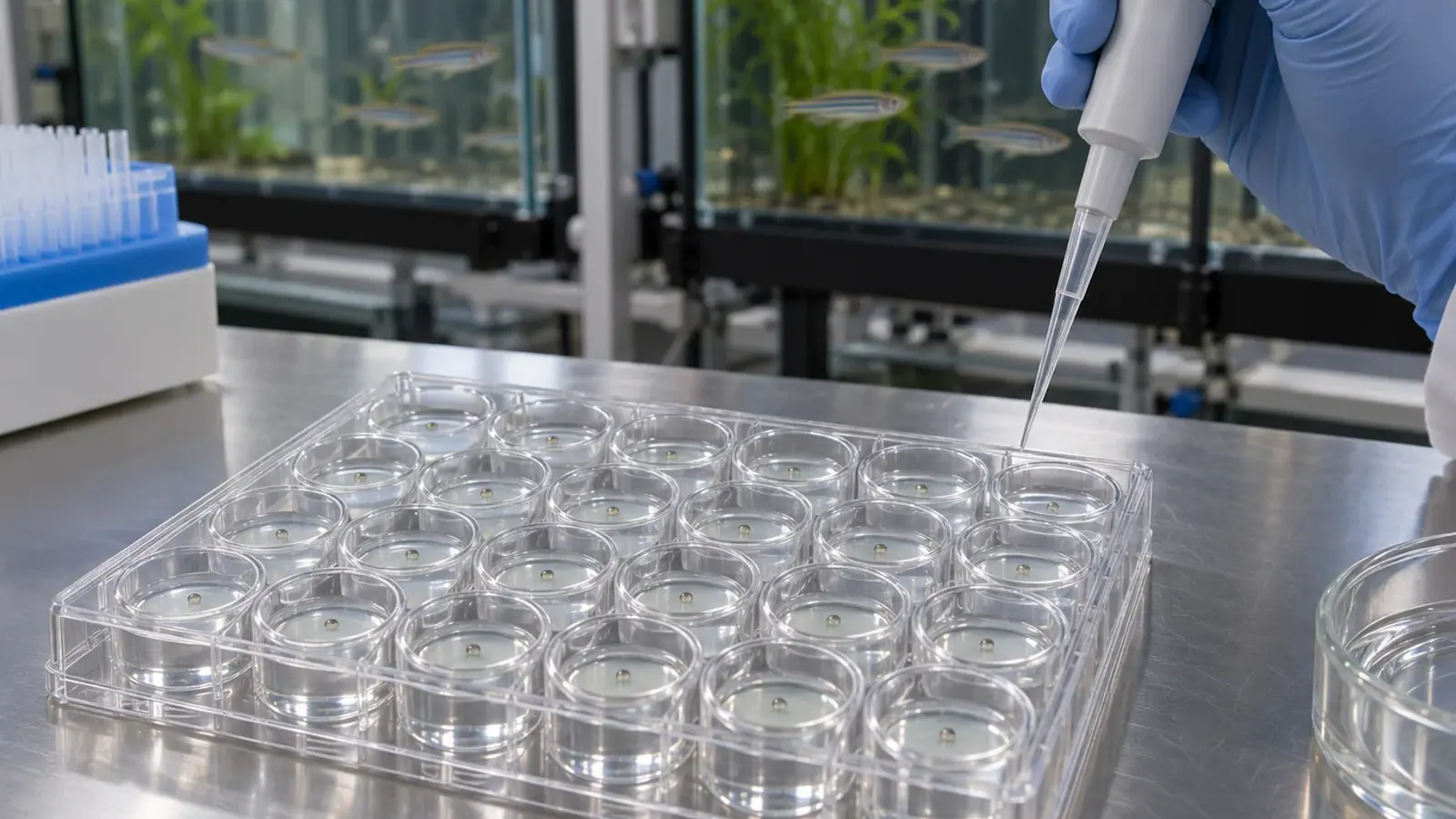
Zebrafish embryos off system: monitor the small volume
An embryo plate separated from the facility's water system develops its own conditions. Evaporation, temperature, oxygen and contamination need a monitoring plan matched to the experiment.
- Content type
- Practical guide
- Sector
- Research
- Keywords
- TemperatureOxygenpHBiosecurity
A separate container is a separate environment
Adult Danio rerio may live in a monitored recirculating facility while their embryos are placed in a dish, tray or assay plate. The small container no longer shares the same water renewal, thermal inertia or treatment path. Its conditions can change between observations without setting off an alarm on the central system. The separation matters when interpreting development, mortality and an apparent treatment effect: the environment of the embryo is the water in its own vessel.
Start by defining the purpose. A plate used for a standardised toxicity assay follows a specified design; temporary embryo holding for later rearing addresses a different question. OECD Test Guideline 236 describes a 96-hour exposure assay in newly fertilised zebrafish eggs. Its endpoints and validity rules must not be applied automatically to every hatchery or experimental setting. The guideline does show why duration, medium, container design and scheduled observations are part of a defensible result.
Record the conditions that can drift
The water source and preparation date, vessel type, starting volume, number of embryos and time of placement form a useful baseline. Evaporation can concentrate dissolved substances and change the actual exposure. A lid may reduce water loss, but gas exchange and condensation still need consideration for that design. An open dish, sealed plate and covered container in a humid chamber will not behave alike. Record which one was used instead of assuming that “embryo medium” describes the complete exposure.
Incubator set point is not the same as medium temperature. Shelf position, door opening and lighting can affect what the embryos experience. Decide how pH, conductivity and dissolved oxygen will be monitored without removing so much fluid that measurement itself changes the system. State when and where each reading was taken and how instruments were checked. A daily mean may miss a short excursion relevant to embryos at a particular stage.
Distinguish observation from intervention
OECD 236 specifies observation times and water-quality information for its fish embryo toxicity test. It identifies four lethal endpoints in that defined assay. Those endpoints do not describe the full quality of an embryo-rearing system or predict later larval performance. A different scientific protocol needs endpoints suited to its purpose and to the authorised procedures. Borrowing the assay’s discipline in record keeping is helpful; borrowing its interpretation outside scope is not.
Log every medium change, transfer and removal of compromised eggs, including time, reason and volume. An action may reduce microbial growth but also alter chemical exposure, temperature and comparability between groups. An improvised response to several opaque embryos can create an unplanned difference between plates. Investigators and facility staff should agree beforehand which observations trigger intervention, exclusion of a vessel or termination of a run. That decision tree protects animals and data together.
Treat contamination as a question
Cloudiness, a surface film or rapid deterioration warrants investigation. Possible sources include the water, breeding adults, equipment, handling or non-viable eggs. Appearance alone does not identify an infectious organism. Trace clutches separately and keep handling tools under a cleaning procedure compatible with embryo care and the assay’s aims. A disinfectant effective against microbes can leave residues that compromise an embryo exposure test if preparation and rinsing are poorly controlled.
The FELASA and EUFishBioMed zebrafish husbandry recommendations emphasise recording water, health status, breeding and management practices. They also recognise that acceptable ranges may be more useful than imposing one fixed value on every facility. That perspective is particularly relevant when comparing results produced in distinct off-system devices. An effect attributed to a chemical or genotype needs to be discussed against the conditions the embryos actually experienced.
Make comparisons honest
A run record can link the parent stock and clutch, collection time, initial egg quality, vessel conditions, water measurements, interventions and exclusion criteria. A control group should experience the same relevant handling as exposed groups. If a plate partially dried or an incubator failed, disclose that event before analysis rather than reconstructing an assumed stable temperature. The number of wells is also not automatically the number of independent biological replicates: embryos from one clutch share part of their history.
Simple labels on the outside of vessels help connect observations to that record, provided they do not obscure inspection or become a source of contamination. If several operators score development, the criteria and timing should be agreed in advance. A difference between observers is another reason to review the raw observations before attributing a small change to the experimental treatment.
Off-system maintenance is not intrinsically poor practice. It enables observations and assays that would be impossible in a communal tank. Reliability depends on controlling a small environment, retaining a clear record and choosing monitoring proportionate to the question. OECD 236 offers a rigorous example for one defined use; the husbandry recommendations describe the animal and facility upstream of that assay. Collapsing the two frameworks would obscure information needed for both welfare and reproducibility.
For research facilities, our advisory work can help connect facility conditions, plate observations and interpretation rules. The practical decision is to know which change requires action and which must be recorded as a limitation of the experiment.


