

Zebrafish: temperature changes how shoals should be read
A tighter shoal does not by itself demonstrate better welfare. A 2025 study links temperature to the organisation of small zebrafish groups, with responses differing between measures and observation periods.


- Content type
- Practical guide
- Sector
- Research facilities
- Animal group
- Zebrafish
- Keywords
- TemperatureEthogramStress
Two zebrafish groups are not necessarily comparable simply because they contain the same number of fish. Temperature belongs among the conditions recorded when an experiment measures spacing or position. Otherwise, a thermal effect may be attributed to the variable the research team intended to investigate.
Toni and colleagues studied small Danio rerio shoals under three temperature conditions in 2025. The behavioural findings need to be read alongside the limitations of the design. It does not recommend changing facility temperature settings to produce a tighter shoal, nor does it establish a single social measure of welfare.
Three conditions and two assessment periods
Seventy-two adults aged six to seven months were housed in three tanks, each containing twenty-four fish. Following acclimation, the tanks were assigned to 18, 26 or 34 °C. Changes to the low and high temperatures were made gradually over seventy-two hours rather than as an instantaneous exposure.
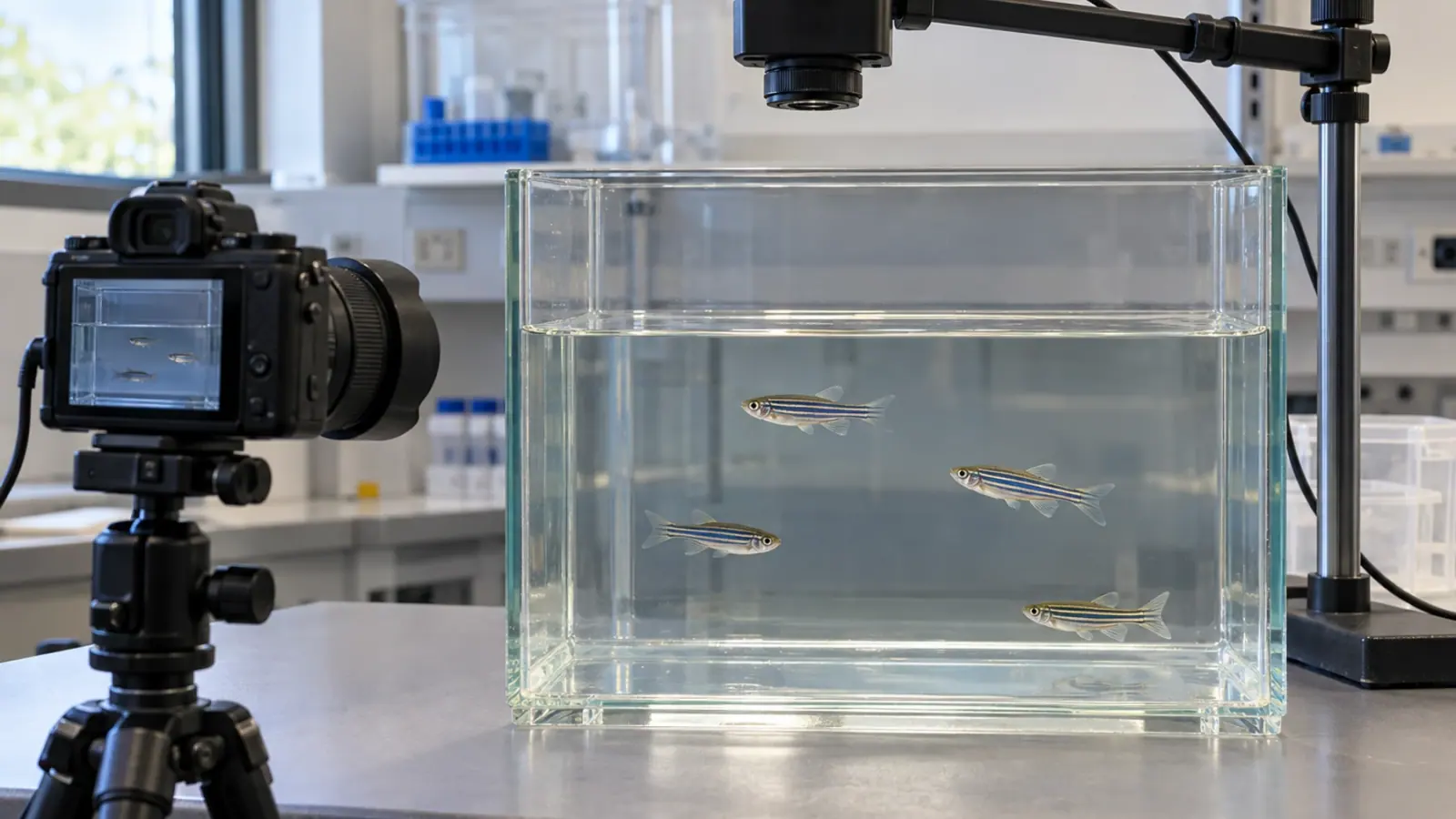
Testing occurred after four and twenty-one days. Groups of four fish were observed for six minutes in water at their housing temperature. Synchronised overhead and frontal cameras allowed the researchers to assess spacing in different dimensions and record where fish were positioned within the observation tank.
These are experimental conditions, not a recommended housing range or an instruction to expose fish to these temperatures for routine welfare assessment. Zebrafish are ectotherms, and thermal history must be interpreted alongside physiology, husbandry and the purpose of the study. A test temperature should never be detached from those conditions when results are reported.
Spacing and shoal organisation were not interchangeable
After twenty-one days at 34 °C, inter-fish distances were smaller than in the 26 °C control across the dimensions assessed. After four days, the corresponding difference was detected in the horizontal plane. Other measures of group structure did not all show the same temperature response.
Shoal volume and several area measurements lacked significant temperature differences. Distance to the group centroid and the homogeneity index likewise showed no significant overall temperature effect in the reported analyses. Describing every measure as evidence of uniformly increased cohesion would erase these negative findings.
After four days at 18 °C, fish occupied the bottom region more than controls. Overall horizontal distribution did not differ significantly between temperatures. What a researcher concludes therefore depends partly on the viewing plane and the measure selected, not only on whether the group appears more tightly assembled.
Behaviour changed within the six-minute observation
The analysis also considered changes during each trial. An average across the entire recording can conceal a transition between entry into the tank and the final minutes. Behaviour immediately after transfer should not automatically be treated as the group’s settled organisation or extrapolated to normal housing.
The same fish were assessed at both exposure periods, but the composition of the four-fish groups changed. At the second assessment, the animals had already experienced the apparatus. The authors consequently analysed the four-day and twenty-one-day conditions separately, without a direct statistical comparison between exposure durations.
A less apparent response at the second assessment does not, by itself, demonstrate thermal adaptation. Familiarity with the tank and group composition may also contribute. In repeated behavioural work, the animal’s previous experience of the test is part of the experimental setting and needs to remain visible in the interpretation.
The behaviour does not establish its mechanism
The authors discuss anxiety-like responses and possible adjustment mechanisms. Cortisol and metabolic measurements were not collected alongside these observations to confirm those explanations. Reduced spacing is therefore neither a diagnosis of stress nor proof that the fish are experiencing a positive state.
Replication also deserves attention. The six shoals observed per temperature came from one housing tank for that temperature. Repeated group tests do not substitute for multiple independent housing tanks receiving the same condition. With this arrangement, a tank effect cannot be fully separated from the temperature assignment. This is a limitation of the comparison, not a reason to discard every observation.
The results concern these adults, small groups and observation procedures. They do not directly describe larvae, all zebrafish lines or larger groups in routine housing. Neurobiological explanations discussed in the paper should not be mistaken for measurements made in each of the fish filmed during this experiment.
Record what the comparison actually needs
An interpretable shoaling record can include measured test-water temperature, recent thermal history and the interval after transfer. Group size, origin, previous exposure to the apparatus and individual composition should accompany the video. These details help later users distinguish a changed behaviour from a changed observation context.
An ethogram or explicit set of measurement definitions can separate vertical position, inter-fish distance and occupied area. The protocol should identify the analytical unit and the role of the housing tank before frames are counted. A recording with many measurements is still a recording of one group, rather than a collection of independent experimental groups.
Read the shoal together with its conditions
This study shows why social measures need their temperature, timing and method attached. A useful account retains measures that did not change, together with the uncertainties of the design. Seeking one sign of welfare would lose information that matters when comparing behavioural experiments.
Vetofish methodological advice can help define observations and the conditions worth tracing. For research facilities, the aim is an interpretable comparison that keeps experimental exposures distinct from husbandry recommendations.


