

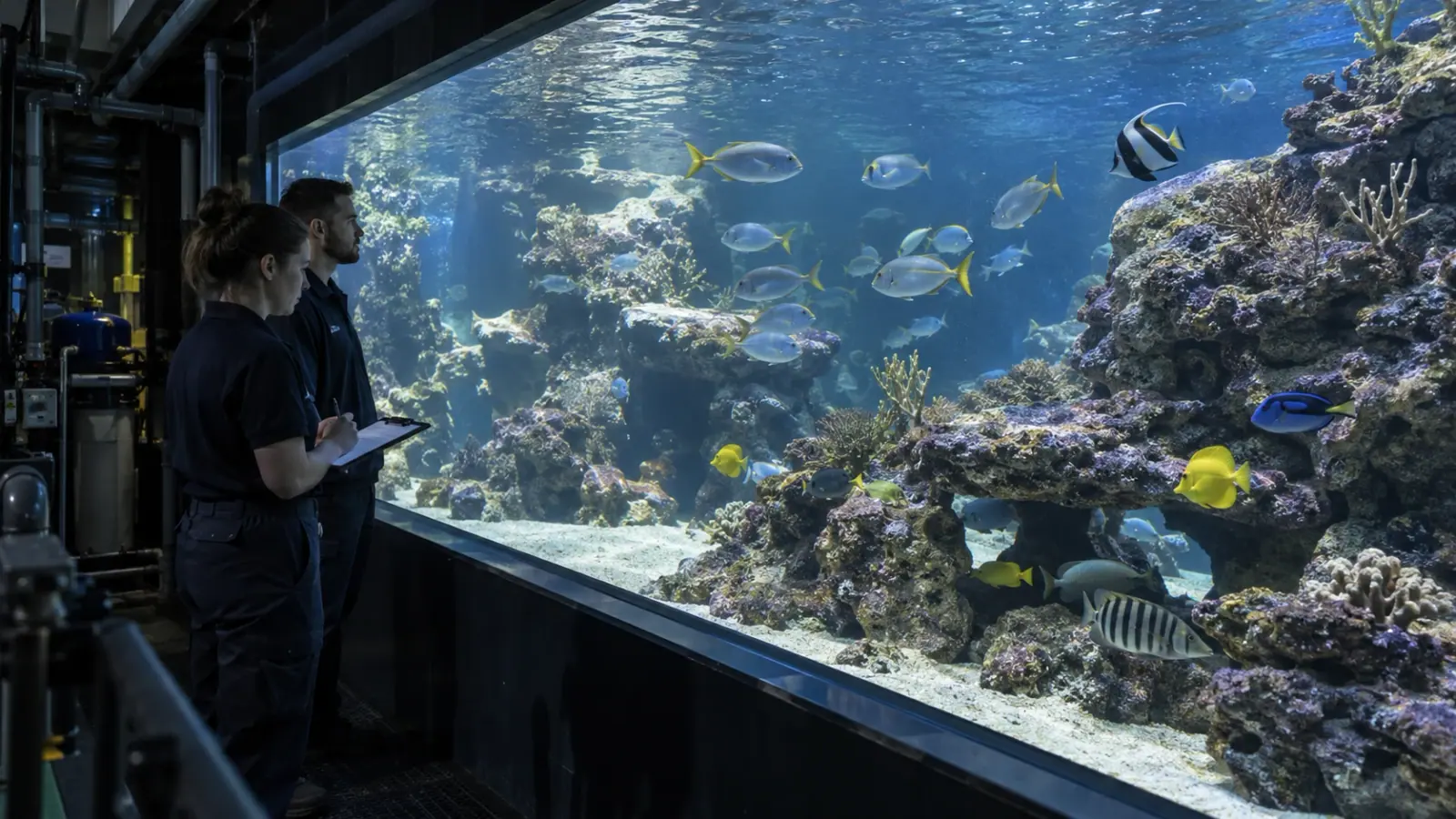
Fish welfare: observe before drawing conclusions
Changes in swimming or appetite may indicate deterioration, but no single measure can describe welfare across a multispecies collection.


- Content type
- Practical guide
- Sector
- Public aquariums
- Animal group
- Fish
- Keywords
- EthogramEnrichmentStress
Seeing a fish swim in a public aquarium is not enough to conclude that it is doing well. A change in appetite, tank position, group cohesion or shelter use may be informative, but it can also reflect time of day, visitors, a recent exhibit change or social interaction. A useful programme therefore combines behaviour, physical condition, biological performance and environment, using reference points appropriate to the species and individual.
Define normal before searching for abnormal
Fish diversity rules out one universal checklist. Remaining still may be concerning in an active daytime species and expected in a nocturnal ambush predator. The first step is to describe the anticipated repertoire: swimming, feeding, resting, social interactions, depth use, shelter seeking and responses to keepers.
A simple ethogram defines each behaviour in observable language. “Stressed” is an interpretation; “remains against the viewing panel for more than five minutes after opening” is an observation. Teams can then compare records, train new observers and distinguish an impression from a repeated change.
Combine three families of indicators
Smith groups indicators into behavioural, functional and physiological categories. Behavioural observations include feeding, aggression, individual or group swimming and unusual activity. Functional measures include body condition, lesions, ventilation, buoyancy, growth and reproduction. Physiological and biological measures may add information, but often require capture and sampling.
In farming, a complementary framework turns this logic into eleven directly observable fish-welfare indicators. They cannot simply be transferred to a public aquarium, but they illustrate how a general principle can become a repeatable monitoring process.
Combining categories reduces misinterpretation. A single refused meal after a diet change does not necessarily mean disease. When it occurs with declining body condition, altered space use and a water-quality excursion, the alert level changes. Conversely, a physiological value without a species-appropriate reference interval may remain difficult to interpret.
Build a system that staff can sustain
The dashboard must fit daily work. A few well-defined variables recorded at comparable times are more valuable than a long list abandoned after two weeks. For each species or group, the protocol identifies frequency, observation unit, scoring scale and the threshold for checking further.
Group observations suit schooling species, but they should not erase individuals. One fish may be consistently excluded from a feeding area while the total ration appears to disappear normally. Individual identification, where practical, improves follow-up of body condition, recurring lesions and responses to care.
Context belongs in the dataset: time, feeding, cleaning, visitor density, technical work, lighting and water measurements. These variables can reveal associations without turning temporal coincidence into causation.
Use feeding as a structured observation
Feeding creates a regular opportunity to record approach, food capture, competition, refusal and leftovers. Interpretation requires the species’ natural feeding strategy. A single concentrated ration may favour dominant animals or leave insufficient time for grazers and cautious individuals.
A public-aquarium study of two freshwater fish species examined food enrichment and visitor presence together. It demonstrates the value of measuring the frequency and duration of behaviours rather than assuming a device is beneficial. Its findings remain specific to the species, exhibit and study conditions; they do not validate the same enrichment across a collection.
Evaluate enrichment rather than merely providing it
Enrichment needs a functional goal: increase foraging, provide choice, reduce an unwanted interaction or enable species-typical behaviour. The team selects an outcome before introducing the device. Too few shelters may increase competition; a novel object may produce avoidance; a complex feeder may benefit only some individuals.
Before-during-after comparison helps identify habituation and unintended effects. A stopping rule is useful when the response is adverse. Visual novelty for visitors is not evidence of positive welfare for fish.
Connect animals, environment and operations
Animal-based measures must be interpreted with the exhibit. Oxygen, temperature, pH, nitrogen compounds, light, noise, flow and refuge access can shift several behaviours at once. Technical changes and incidents should be plotted on the same timeline as animal observations.
Salas and colleagues emphasise that indicator selection should start from natural history and then be validated for the intended use. A generic framework organises thinking but cannot replace species knowledge. Agreement among observers, sensitivity to change and feasibility matter as much as measurement sophistication.
Set proportionate action thresholds
A score matters only if it informs a decision. A mild deviation might trigger a second observation or a sensor check. A persistent combination of reduced appetite, altered ventilation and isolation may justify veterinary examination, sampling or transfer to a suitable treatment area.
Thresholds should be revised as evidence accumulates and must never delay an obvious clinical emergency. Welfare monitoring does not replace diagnosis or keeper judgement. It structures signals so the team can act earlier and evaluate whether an intervention actually helped.
Recognise the limits of comparison
Different species, life stages and social systems should not be collapsed into one league table. A score can track change within a defined population, but a higher numerical value does not automatically mean that one species has better welfare than another. Missing observations should also remain visible rather than being treated as normal values.
Observer expectations can influence scoring. Clear definitions, periodic calibration and occasional blinded review of video improve consistency. Where cameras or automated tracking are used, technical output still needs biological validation; movement quantity alone cannot distinguish exploration, escape attempts and routine swimming.
Vetofish can help develop ethograms, train teams, connect observations with water-quality data and define escalation thresholds. The aim is monitoring simple enough to last and specific enough to guide a real decision.
To move from evidence to action, explore our animal welfare service and our expertise for public aquariums.


