

Public aquariums: record what fish actually eat
Preparing a ration does not prove that every fish ate. Useful monitoring connects preparation, individual access, refusals, body condition and effects on the exhibit.

- Content type
- Practical guide
- Sector
- Public aquariums
- Animal group
- Fish
- Keywords
- EnrichmentStressEthogramOxygen
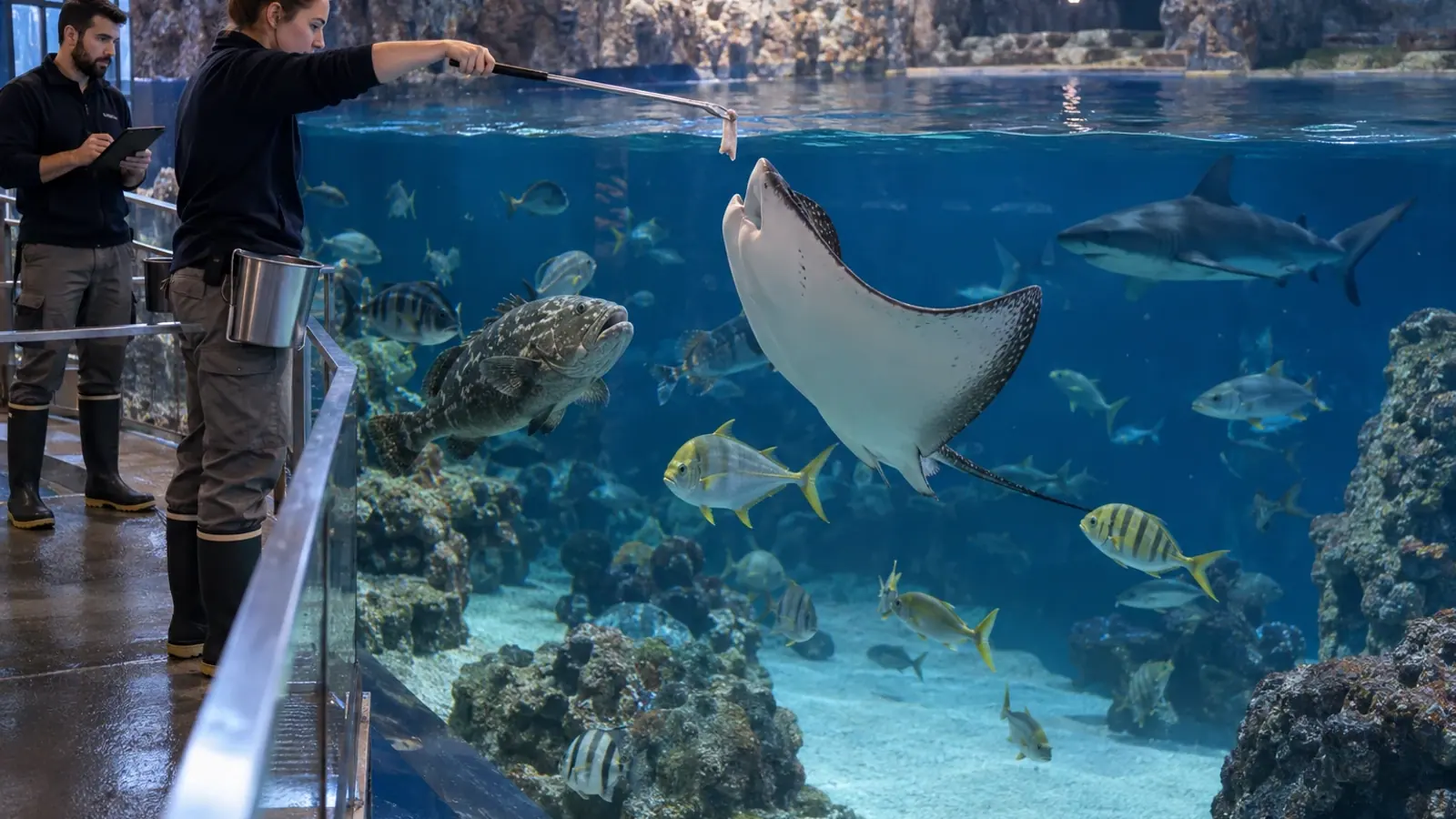
In a mixed-species exhibit, the ration prepared, the ration delivered and the food actually consumed are different quantities. Dominant individuals may capture preferred pieces while shy fish feed outside the usual viewing area. Refusals can disappear into the substrate or filtration. A log that says only “fed” cannot explain weight loss or evaluate a diet change.
Public-aquarium welfare literature also stresses the diversity of nutritional needs. Species differ in diet, feeding rhythm, capture strategy and willingness to recognise a new presentation. Monitoring must therefore remain taxon-, stage- and individual-specific whenever identification is possible.
Describe the ration before judging it
Link every preparation to a date, batch, quantity, thawing or hydration method and supplements. For whole food, record origin, storage and preparation losses. A change in size or water content can alter nutrient delivery even when the distributed weight appears unchanged.
Distinguish planned, offered, recovered and estimated consumed ration. Individual measurement may be impossible in a large school; consistent exhibit-level units, feeding duration and periodic video can still create a comparable time series. The aim is useful consistency, not false precision.
Observe access as well as appetite
Record approach latency, pursuit, avoidance, rejected pieces and spatial distribution. A fish that approaches but does not swallow is not a confirmed consumer. Multiple feeding points, targets and suitable enrichment can reduce competition and support individual monitoring, but each change needs evaluation. Complexity alone does not demonstrate welfare benefit.
A short shared ethogram helps staff use observable categories rather than labels such as “normal” or “stressed”. Notes should identify individuals that repeatedly lose access, change position in the group or alter their feeding technique.
Connect intake with body condition
Repeated capture for weighing may itself compromise welfare. Standardised photographs, species-specific landmarks and a body-condition score can offer a non-invasive trend. Document angle, distance, lighting and limitations; a score developed for a salmonid cannot simply be applied to a ray or a laterally compressed reef fish.
Trajectory matters more than one value. Weight loss, distension, altered musculature or uneven growth should be considered alongside intake, reproduction, age, treatment and social dynamics. Poor condition despite apparent appetite calls for differential diagnosis, not an automatic increase in ration.
Keep food and water data together
Refusals and fragments raise organic load and may affect ammonia, turbidity and dissolved oxygen. Conversely, temperature, oxygen or nitrogenous-waste changes can suppress feeding. Both records need to be reviewed on the same timeline.
During a diet change, retain a documented transition period. This helps separate poor acceptance, increased competition and a simultaneous environmental problem. Responses can include modifying presentation or frequency, redistributing feeding points, temporary observation in a care enclosure, or veterinary examination when the change persists.
Build usable traceability
A practical log uses a small number of fields completed during care: food batch, amount, distribution points, estimated intake, refusals, individuals to watch and unusual events. Overly long forms encourage box-ticking without observation.
Weekly review looks for trends; monthly review connects nutrition, condition, growth, behaviour and exhibit parameters. Decisions and outcomes should remain linked, turning traceability into a care tool rather than an administrative archive.
Vetofish can help aquariums develop species-appropriate scores, standardise observation and connect feeding, clinical and environmental data. The goal is not a universal ration, but early recognition of deviations that require husbandry adjustment or clinical investigation.
Reduced intake is not a diagnosis. It can precede disease, reflect social exclusion, follow handling or accompany an environmental change. First confirm the signal under comparable conditions: same time window, presentation, observer definitions and food batch. Identify affected individuals where feasible instead of applying an exhibit-wide label.
Then reconstruct the timeline. New arrivals, maintenance, lighting changes, cleaning, treatment, temperature and supplier changes may all matter. This prevents formulation from becoming the default explanation. A return to feeding after correction of an environmental parameter should be recorded as carefully as the initial event.
Escalation thresholds need to match natural feeding frequency. Repeated complete refusal, declining condition, persistent exclusion, regurgitation or accompanying clinical signs should prompt keeper and veterinary review. A missed meal may be meaningful in a frequently feeding species but expected in another fed at longer intervals.
Quality assurance includes periodic comparison between observers and review of photographs or video. If staff consistently score access or condition differently, definitions require refinement. Procurement substitutions should also remain visible with composition, size, origin and acceptance; products with similar names are not automatically nutritionally equivalent.
The record should remain connected to veterinary and collection-management decisions. Repeated diet adjustment without investigating oral lesions, parasites, chronic disease or social displacement can delay diagnosis. Conversely, a clinical examination should not erase the husbandry timeline that may explain when and where the change began.
For mixed exhibits, reporting both group and identified-animal observations is useful. Group intake describes operational demand, whereas individual exceptions identify welfare risks hidden by a stable total ration. These two levels should not be collapsed into one average.
To move from evidence to action, explore our advice and support service and our expertise for public aquariums.


