

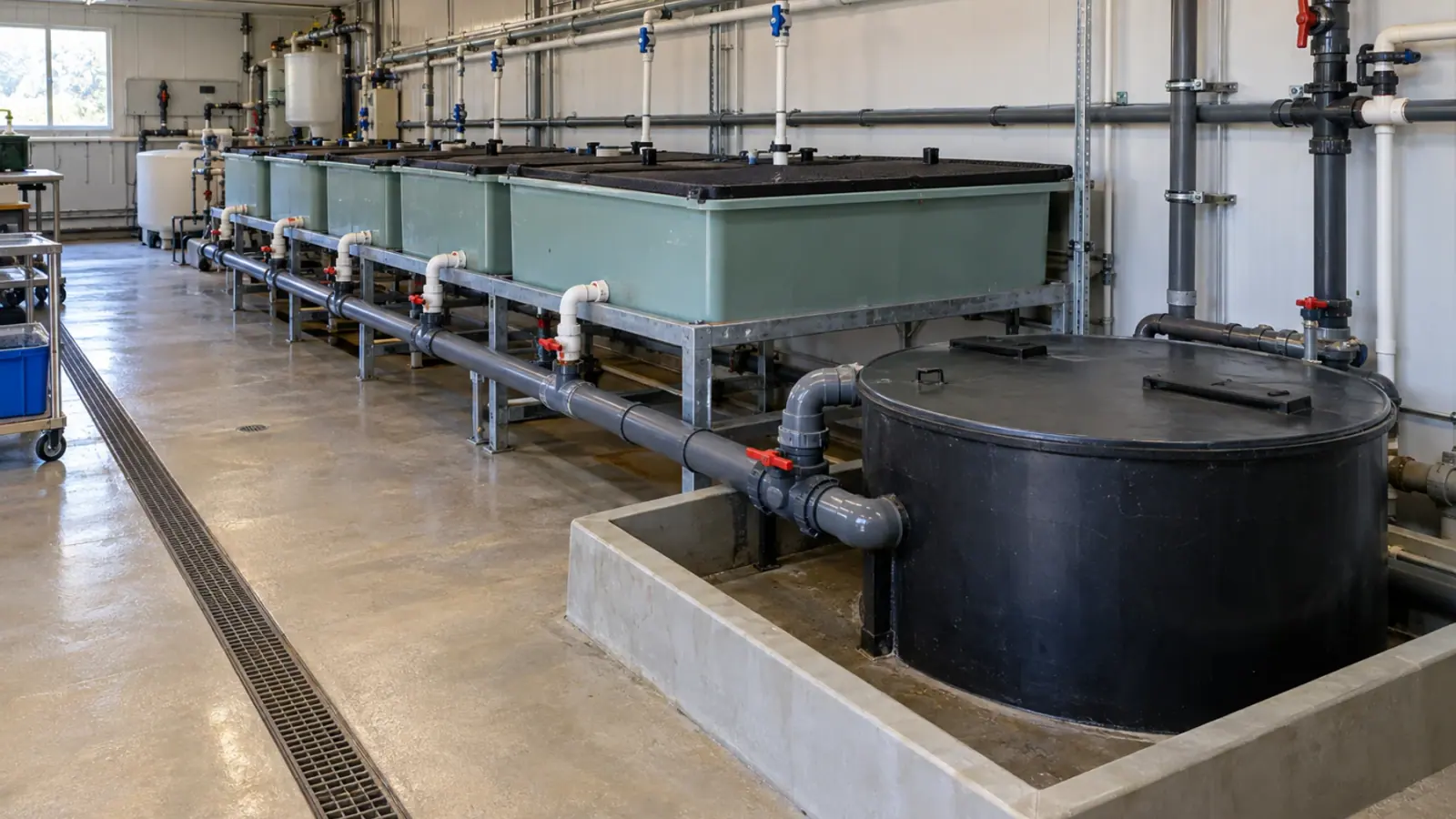
Aquatic containment: follow water to the final discharge
Fish pathogen research requires containment of tanks, drains, sludge and cleaning water. Canadian aquatic standards and US biosafety guidance offer useful risk assessment principles, but their level names and legal scopes cannot be transferred automatically to another country.


- Content type
- Practical guide
- Sector
- Research facilities
- Animal group
- Fish
- Keywords
- BiosecurityDisinfectionUVOzone
Water used in a fish pathogen study does not disappear when it leaves the tank. Siphoning, floor cleaning, sludge removal and accidental overflows can create release pathways that are easy to overlook on a laboratory floor plan. A containment boundary must therefore extend to the final discharge and remain effective during the operations that staff actually perform.
Canadian standards for aquatic animal pathogen facilities and the US Biosafety in Microbiological and Biomedical Laboratories, or BMBL, provide useful ways to examine these risks. Their legal settings and level names remain specific to their jurisdictions. They can inform a technical assessment elsewhere without becoming a foreign facility’s automatic compliance checklist.
Assess the agent together with the proposed work
The BMBL describes risk assessment as a combination of agent hazards and procedure hazards. Susceptible hosts, transmission routes, environmental stability, quantities handled and the consequences of an incident all influence the safeguards needed. The fish species alone cannot determine a suitable containment level for every project using that animal.
The Canadian aquatic standards distinguish work on infectious material from work involving live animals. In live holding systems, water is a vehicle for spread and tanks provide primary containment. Surfaces, building features and drainage arrangements must support that first barrier. Biosecurity consequently includes the network beyond the tank, rather than stopping at a closed room door or a dedicated net.
Canadian AQC, US BSL and ABSL terminology should not be treated as automatically interchangeable. The Canadian AQC 2 framework includes specific provisions for aquatic in vivo work, including effluent collection. Adopting the name does not make a French or other overseas facility compliant with its own requirements. The relevant project needs review with local biosafety specialists, technical staff and competent authorities.
Trace routine water routes and exceptional ones
A hydraulic plan should show incoming water, internal circulation, purges, overflows, cleaning water and the final discharge. Add floor drains, relevant sinks, temporary connections and maintenance activities. An ordinary drain used to empty a cleaning container can bypass a controlled main outlet.
The Canadian standards explicitly consider tank and boot washing, splashes, equipment drainage and pipe maintenance. They also address solid waste and sediments. Wet debris removed from a system remains part of the containment problem when it is placed in a bucket. Its subsequent handling, treatment and disposal need to be included in the assessment.
Following a real work sequence with staff is a practical way to compare the drawing with daily activity. Identify who opens a valve, where the liquid goes, which container moves and how the equipment is cleaned afterwards. This site review is an organisational approach to adapt locally. It is not presented as a regulatory certification procedure contained in either reference.
Validate a treatment under representative conditions
Mechanical filtration can remove some material from the water, but does not by itself demonstrate pathogen inactivation. The Canadian reference calls for suitable decontamination and highlights the influence of organic load, contact time and water characteristics. Heat, chemical disinfection, UV and other methods require an assessment linked to the organism and the process conditions.
Validation asks whether the process performs adequately in conditions representative of its intended use. A lit lamp or a displayed set point is not that demonstration. Water volume, suspended material, mixing and the least favourable conditions permitted by the procedure need consideration. Acceptance criteria and routine monitoring arrangements should be established before normal operation begins.
Treatment can introduce another issue at discharge. The Canadian standards note that chemical residues, including those associated with chlorine or ozone, may need neutralisation, while heated effluent may need cooling. Inactivating an infectious agent and producing an environmentally acceptable discharge are related but separate objectives. Success on one does not establish success on the other.
Decide what happens when the system fails
A power loss, full holding vessel or treatment fault should trigger an agreed response. The Canadian reference describes retention or redundant treatment, alarms and sampling points for verification of decontamination. An alarm only contributes to protection if a responsible person can recognise it, respond promptly and use the necessary equipment.
A planned exercise can examine available retention volume, suspension of work, care of the fish and communication between on-call staff, biosafety personnel and maintenance. Critical equipment should be tested using a prepared procedure. Deliberately improvising a failure could create the very animal welfare or release problem that the exercise is intended to prevent.
Splashes and aerosols need assessment according to the agents and activities involved. Directional airflow or a biological safety cabinet may be appropriate in particular circumstances. Those measures do not remove the need to control liquid releases. Equally, a single ventilation arrangement should not be prescribed for every aquatic research facility without examining its actual hazards.
Keep people and procedures inside the containment plan
The Canadian standards include operating procedures, staff training, spill response and maintenance within the containment system. A technical drawing cannot ensure that staff connect a hose to the intended outlet or retain contaminated cleaning water. Roles and practical instructions need to cover routine work as well as unusual tasks and emergencies.
Maintenance is especially important because opening a pipe or replacing equipment may temporarily change the boundary. Plan who can isolate the relevant section, how retained material is managed and how the system is checked before it returns to service. These decisions should be shared with the staff who perform the work, rather than remaining only in a design specification.
Reassess when the project changes
The BMBL emphasises review when procedures evolve. Adding a tank, changing a flow rate or introducing another agent can alter the assumptions under which a system was assessed. Drawings, training, responsibilities and verification records should change with the work. A past validation cannot automatically cover every later operating condition.
Vetofish can contribute to a review of circuits, working practices and validation needs with research, biosafety and maintenance teams. Our advisory service supports research facilities in connecting biological risk with practical operations. This support does not replace a competent authority’s decision or promise certification.


