

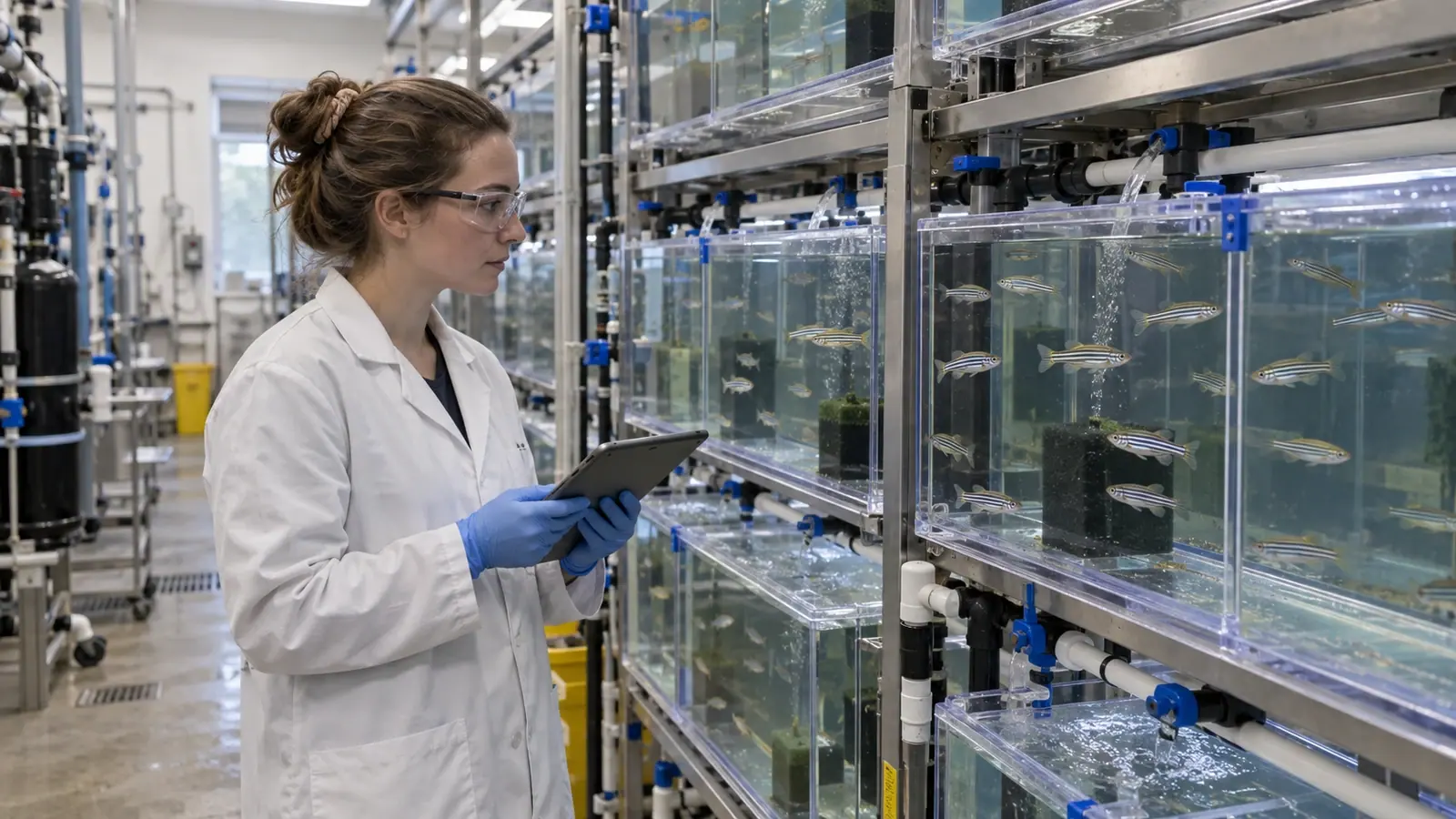
Build a health programme that describes laboratory fish
Testing a few fish on fixed dates does not describe a facility’s health status. FELASA–AALAS recommendations connect daily surveillance, sampling, diagnosis and reporting to actual research risk.
- Content type
- Practical guide
- Sector
- Research facilities
- Animal group
- Fish
Laboratory fish health status affects animal welfare, transfers between institutions and research validity. Subclinical infection can alter immunity, behaviour, histology or reproduction without dramatic mortality. Conversely, detecting an agent’s DNA in system water does not demonstrate disease in the colony. Monitoring must connect observations, sampling and documented interpretation.
Joint FELASA–AALAS recommendations organise this work around six areas: monitor performance, monitor morbidity and mortality, identify diseases of concern, establish routine screening, combine broad and specific diagnostic tools, and report the results. The framework covers research fish generally while providing particular detail for zebrafish (Danio rerio).
Define the population the report describes
An aquatic facility is not always one homogeneous population. Racks, rooms, water loops, stock origins and lines may form separate epidemiological units. A positive finding in one isolated unit does not automatically describe the building; an over-aggregated sample can also conceal restricted circulation.
Map connections through water, animals, equipment and people. Include introductions, quarantine, live feeds where used and effluent routes. This structure defines sampling units and the legitimate scope of each result.
Research objectives affect exclusion priorities. Immunodeficient lines or infection studies have different risk profiles from a toxicology platform. The agent list should reflect prevalence, animal impact, potential research interference, zoonotic relevance and the ability to act on a finding.
Start with performance and health events
Health monitoring begins before laboratory diagnostics. It includes feeding, reproduction, growth, embryo quality, morbidity, mortality and reasons for removal. Data need a denominator, period and unit: ten deaths have very different meaning among one hundred or ten thousand fish.
Daily observations record tank distribution, swimming, ventilation, body condition, skin, fins and visible abnormalities. Their main value lies in departures from each unit’s baseline. Declining spawning performance or increasing losses on one rack may trigger targeted investigation before the next scheduled screen.
Sick, moribund and freshly dead fish are important because they can connect a potential agent with lesions. Routinely discarding them while testing only apparently healthy sentinels may reduce the programme’s clinical sensitivity.
Choose among sentinels, colony fish and environmental samples
Sentinels exposed to system water can integrate some hazards circulating within that system. Their performance depends on route of transmission, exposure duration, species, age and placement. They may miss an agent confined to one tank, transmitted vertically or shed poorly into the water.
Colony fish directly represent the population of interest, but sampling may use valuable animals and remains a snapshot. Retired breeders or animals reaching endpoints can contribute when they are representative and their history is known.
Environmental matrices—water, biofilm or filtration material—provide non-lethal surveillance and may be sensitive. Interpretation is essential: molecular signal can persist, originate from non-viable organisms or fail to identify which fish are infected. A strong programme combines complementary matrices instead of searching for one universal sentinel.
Combine broad and targeted diagnostics
Histopathology examines multiple tissues and may reveal parasites, inflammation, tumours or non-infectious lesions that were not anticipated. Performance depends on animal selection, fixation, section planes and reader experience. It cannot replace targeted testing when low burdens or inconspicuous agents are expected.
PCR can offer high analytical sensitivity for a defined target when primers and matrix are appropriate. A positive result demonstrates nucleic acid, not necessarily viability or causation. A negative result cannot prove facility-wide freedom when sampling is too small or poorly located.
Culture, parasitology, bacteriology, sequencing and direct examination complete the picture according to risk. Predetermine confirmation methods and responses to unexpected, weak or discordant results. Repeating the same assay without revisiting the question may not resolve uncertainty.
Build a risk-based schedule
Fixed intervals aid planning but need event triggers: animal introduction, supplier change, water-system work, performance drift, unusual mortality or a relevant result from a partner institution. High-impact agents with credible entry routes may warrant more frequent attention.
Sample size depends on the prevalence to be detected, confidence level, test sensitivity and population structure. Pooling can reduce cost but may dilute targets and loses individual information. Discuss pool design and validation with the diagnostic laboratory.
Review the programme when species, lines, water loops, research objectives or hazards change. It must remain feasible. A proportionate programme that is completed and interpreted provides more protection than an ambitious schedule that routinely remains unfinished.
Produce a report that can travel
A useful health report states the period, units covered, animals and matrices, methods, agents tested, positive and negative findings, items not tested, clinical events and relevant husbandry conditions. “Not tested” must remain distinct from “negative”.
For transfers, recent history matters as much as the last screen. Recipients need introductions, quarantine arrangements, previous results and actions taken. The report is neither proof of absolute freedom nor a list of PCR outputs. It describes the current level of knowledge and its limitations.
This programme belongs within the broader responsibility for aquatic animal health in research facilities, from unit design to interpretation of experimental results.
Vetofish can help aquatic facilities define epidemiological units, rank hazards, connect daily observation with sampling and build interpretable reports. The goal is to protect fish and research by turning scattered results into traceable health decisions.
To move from evidence to action, explore our health expertise and biosecurity service .


