

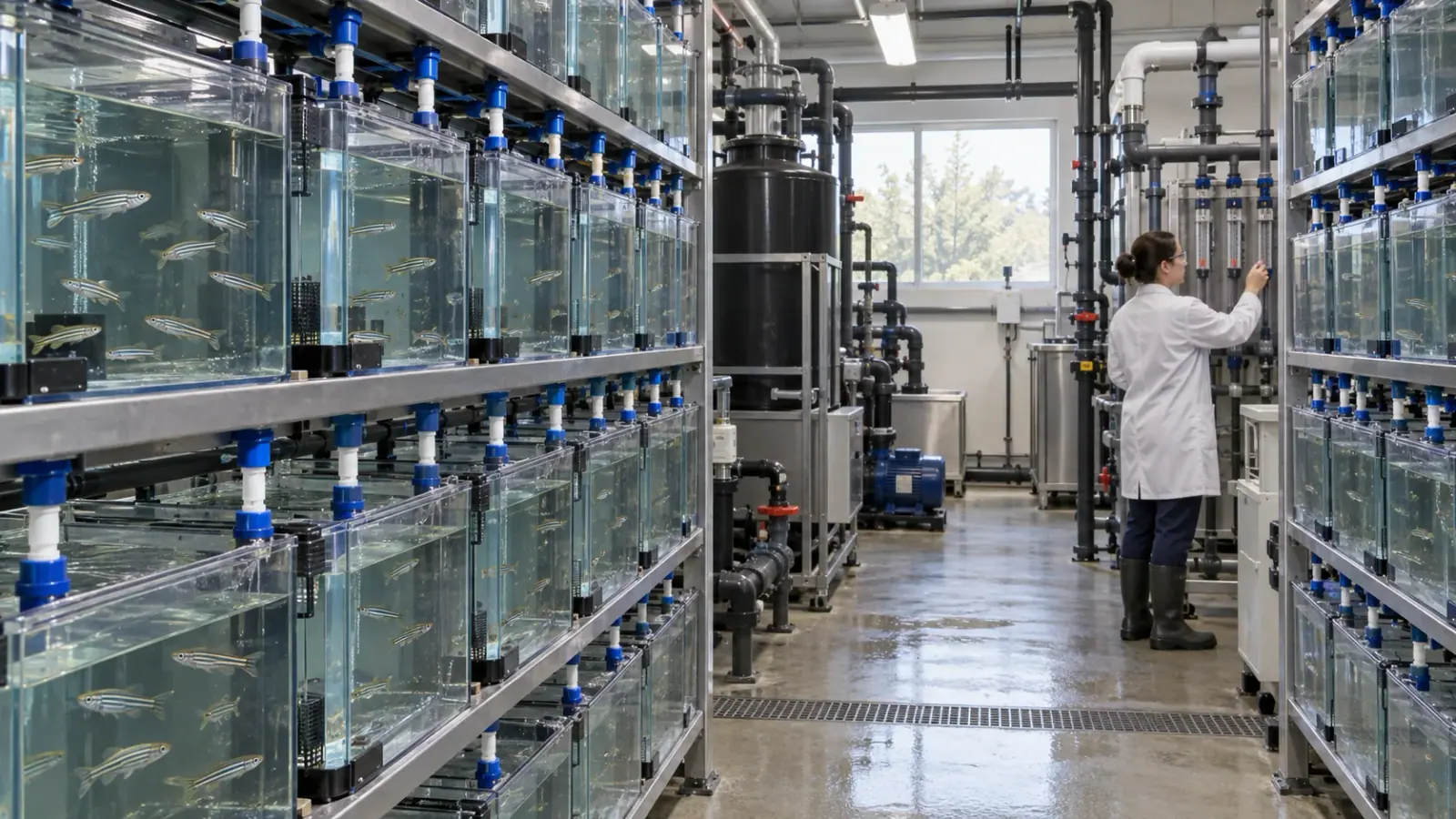
Reducing water, energy and waste in aquatic facilities
A smaller resource footprint starts with measurement and safeguards for water quality and biosecurity. The Institut Pasteur experience provides a way to test changes, not a universal water exchange target.
- Content type
- Practical guide
- Sector
- Research
- Animal group
- Zebrafish
An aquatic research facility continuously uses treated water, electricity, supplies and cleaning equipment. Cutting those flows may be valuable, but a saving that weakens water quality or sanitary separation is not progress. Berard and colleagues describe how animal facility managers at the Institut Pasteur reviewed local practices, suppliers and tradeoffs. Their zebrafish example shows why a measured, monitored change is more useful than a general instruction to lower resource use.
Define the boundary of the calculation
The facility uses more than the water entering fish tanks. Reverse osmosis production, wastewater, pumps, heating, ventilation, washing and the manufacture and transport of consumables all contribute. The balance depends on the site, number of systems, electricity source and effluent treatment. A reduction on one meter may transfer an impact elsewhere. Without a defined accounting boundary, two facilities cannot compare their claims fairly.
The Institut Pasteur paper is an organisational case study built around local initiatives and a workshop with managers. It was not an animal experiment to determine a new physiological limit. It offers examples of feasible questions and organisational obstacles, not multicentre evidence that one equipment configuration will be best everywhere. Any number quoted from the case must stay linked to its particular installation.
Water exchange needs a monitored trial
In the zebrafish facility described, daily water renewal in a recirculating system was lowered from 10% to 7.5% while nitrate concentration was monitored. The authors report no significant change in that concentration in their setting. This does not make 7.5% a target for every facility. Fish biomass, biological filtration, feeding, incoming water, temperature and health history can all alter system performance.
A cautious approach first measures water entering and leaving the system, then specifies what will be checked before and after a change. Alongside nitrate, facilities may need to monitor dissolved oxygen, nitrogen compounds, pH, conductivity and fish behaviour according to their systems. Alert criteria and a return to the previous setting should be agreed in advance. One gradual change observed over a representative period is easier to interpret than several equipment changes made together.
Reverse osmosis is an easily missed part of the water account. Producing a litre of usable water may require several litres of municipal water, depending on equipment and operating conditions. The actual recovery rate should be measured on site. A meter on the fish tank loop alone will otherwise understate upstream consumption.
Measure equipment where it operates
Pumping, heating, cooling and ventilation can be major electricity users, although their relative shares vary. Staff can record power, operating time, flows and temperatures during different workloads. A more efficient pump delivers a benefit only if its performance matches the hydraulic circuit. A flow reduction that compromises oxygen supply or filtration would defeat the purpose.
Berard and colleagues also use illustrative scenarios to compare washing and disinfection options. These calculations show a decision method rather than a universal technology ranking. Washing location, transport, frequency, heat source and sanitary requirements all affect the result. A credible life cycle comparison also needs supplier information that may be difficult to obtain. Missing data should be reported rather than hidden behind an unjustifiably precise carbon figure.
Supplies, cleaning and wastewater
The team considered single use plastics, protective equipment, ordering, waste and chemicals. Replacing a disposable item may reduce one waste stream, but reuse requires washing and disinfection that preserve biosecurity. The appropriate choice depends on sanitary units, monitored agents and institutional rules. Worker protection should never be weakened to improve an isolated environmental metric.
Effluents call for a risk based approach. Routine system water, water from a contaminated unit and water containing an active chemical may require different handling. Clear flows and assigned responsibilities make sorting, treatment and records more reliable. They also reduce the risk that a resource saving shifts an unmanaged burden to the receiving environment.
Design a local test that can be checked
The first project can be modest: measure incoming and outgoing water, energy used by major equipment and a few important consumables for several weeks. Choose one change, state why it is expected to help, link it to health and operating indicators, and specify stop conditions. Animal care staff, veterinarians, maintenance, purchasing and researchers need access to the same observations. The paper identifies cooperation and supplier data as practical levers, while also describing barriers to both.
A useful report gives any saving together with its time period, calculation and associated health observations. It distinguishes lower water consumption, lower energy use and lower emissions; they are not interchangeable outcomes. Other facilities can take the Institut Pasteur process as a prompt and test their own settings. Lasting efficiency must remain compatible with welfare and the reliability of the research model.
For research facilities, our advice and support service can help set up a resource review with sanitary checks before operating practices change.


