

Temperature failure: preparing a zebrafish facility response
Heating or cooling failure requires checks at the tanks, a working escalation route and suitable backup equipment. A facility response plan should connect temperature readings with fish condition and checks after recovery.

- Content type
- Practical guide
- Sector
- Research facilities
- Animal group
- Zebrafish
Check the alarm where the fish are housed
A temperature alarm identifies a departure that needs checking. It does not, by itself, establish that a chiller has stopped, a heater has failed or incoming water has changed the circuit. The University of British Columbia’s temperature-alarm procedure begins by confirming the actual temperature and distinguishing a high alarm from a low one.
In a zebrafish facility, that check needs to connect with the affected tanks. A reading from a technical sump and a reading from a housing tank describe different locations. Recording sensor position, time and units helps avoid comparisons between values whose origins are unclear. A separate check should use equipment appropriate for the facility’s monitoring procedure.
The response also includes observing the fish. Changes in ventilation, swimming or distribution should be recorded before assigning a single explanation. Apparently quiet fish do not remove the need to verify the system. Conversely, unusual behaviour calls for reassessment even when a display appears to have returned to its usual setting.
Assess the connected life-support risks
The Canadian Council on Animal Care links routine water monitoring with contingency arrangements suited to the species housed. Its guidance distinguishes thermal survival from preferred or appropriate housing conditions. A published tolerance limit is therefore not an acceptable operating target during a failure.
Dissolved oxygen deserves attention alongside temperature. The CCAC guidance explains that warmer water holds less oxygen while fish metabolic demand increases. Restricting the response to a temperature display would leave an associated risk outside the assessment. Changes in circulation or aeration can further affect what individual tanks receive.
The response plan should identify observations and measurements to repeat during the incident. It can distinguish affected circuits, groups needing priority checks and equipment that remains available. Monitoring frequency needs to respond to the actual trajectory. A continuing drift requires a different assessment from a value that has stabilised following an intervention.
Agree responsibilities before equipment fails
UBC assigns prompt handling of alarms to facility staff and provides an escalation route to technical support when cooling fails. Its telephone numbers, rooms and connections are specific to that site. The transferable principle is a known response chain supported by reachable staff and identified backup capacity.
A local circuit sheet can identify who confirms the reading, who observes the animals, who deals with equipment and who authorises changes in husbandry. It needs to work outside normal hours and when the usual manager is absent. Naming a responsible person without a functioning contact route does not provide effective cover.
Escalation criteria should be discussed with veterinary and scientific staff. Species, life stage, health status and experimental conditions all matter. An approach written for adult zebrafish should not be transferred automatically to embryos or another species. The plan should make clear which decisions staff can take immediately and which require further advice.
Check that backup equipment can actually work
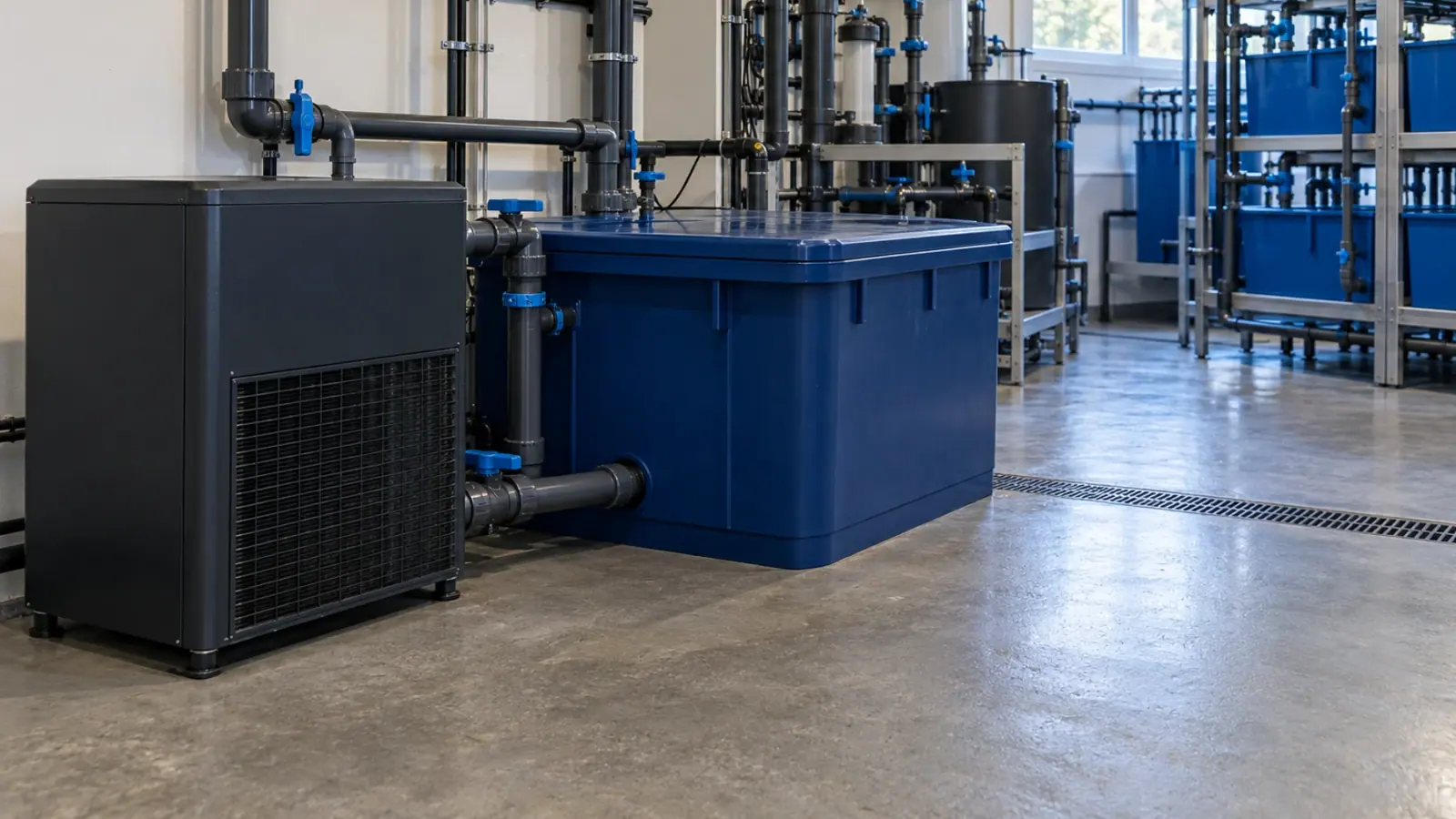
An available chiller is useful as backup only if its capacity, connections and power supply suit the circuit. UBC’s troubleshooting procedure distinguishes equipment that does not start, equipment that repeatedly cuts out and equipment that runs without reaching the required condition. These are reasons for technical assessment, not improvised electrical work beside tanks.
Operating manuals and limits on staff interventions should remain accessible. Work requiring a qualified technician does not become routine husbandry because an alarm is urgent. Backup trials need controlled conditions and checks on the effects of connections or setting changes on circulation and animals.
A possible transfer also raises biosecurity questions. Receiving accommodation must be suitable, available and compatible with the group’s health status. Moving fish into an unfamiliar circuit may relocate the problem or create additional difficulties. Transfer conditions should therefore be defined before relocation becomes the assumed default response.
The plan should also state how the team will know whether the temporary arrangement is working. A connected unit or audible motor is not evidence that conditions at the fish have stabilised. The same measurements and observations used to identify the problem should help assess the response, with any new risks included.
Verify recovery rather than assuming it
Restoration of power or cooling does not close an incident. UBC’s post-outage procedure calls for checks of animals, life-support systems and other equipment. A pump restarting or a display lighting up does not establish that the whole installation is functioning as intended.
Staff should confirm the relevant flows, levels, temperatures and aeration arrangements, then continue observing the fish. Temporary equipment or changed settings may still be in place. Recording what was connected, stopped or adjusted allows the normal arrangement to be restored deliberately rather than reconstructed from memory after the event.
The biological exposure is also more than the highest recorded temperature. Its duration, associated conditions and handling belong in the history passed to veterinary staff and researchers. Possible effects on interpretation of an experiment need consideration without assuming that all data are either unaffected or unusable.
Use the incident to make a specific correction
Once conditions are stable, a review can separate a confirmed cause from remaining hypotheses and identify corrective actions. Testing an alarm, improving sensor placement or repairing the escalation route should address an observed weakness. An assigned action and completion date are more useful than a general instruction to remain vigilant.
For research facilities, our consultancy and support service can help connect animal needs, monitoring arrangements and contingency procedures. The aim is a response that staff can carry out in the actual installation, without a universal temperature threshold or a promise that a failure will have no biological consequences.


