

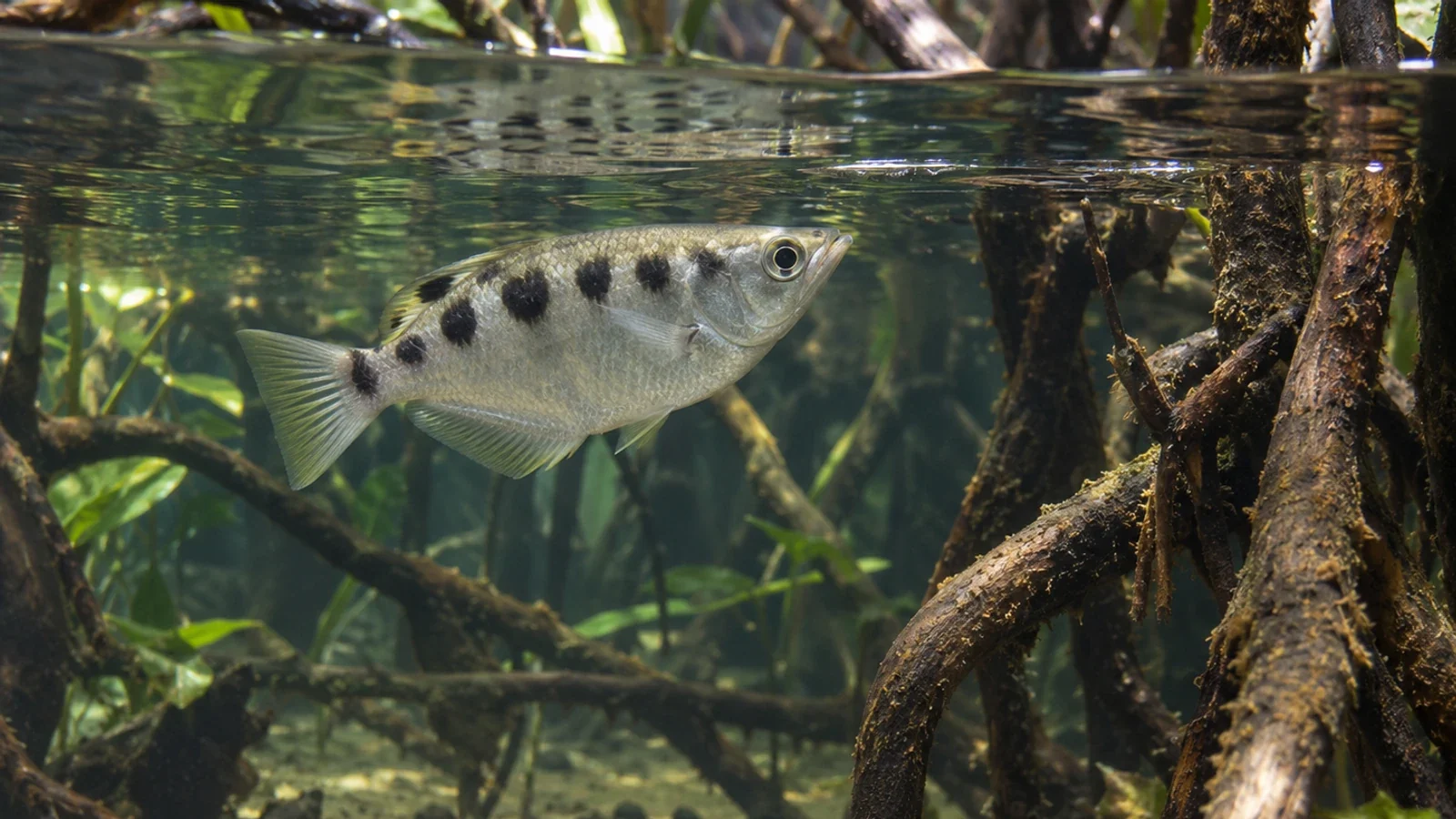
Archerfish: telling faces apart does not establish keeper recognition
Does a fish approaching a keeper recognise the person’s face? A 2016 experiment shows that archerfish can learn to distinguish images of human faces. That is evidence of visual discrimination, while spontaneous recognition of a person in a public aquarium remains a separate question.


- Content type
- Practical guide
- Sector
- Public aquariums
- Animal group
- Fish
- Keywords
- EthogramEnrichmentLighting
A fish approaching a familiar keeper is an engaging observation, but it does not identify the cue the fish used. Clothing, movement, time of day and previous feeding experience may change together. A response to that combination cannot immediately be assigned to recognition of a human face.
An experiment with the archerfish, Toxotes chatareus, separates these questions. Its ability to knock down aerial prey with a jet of water allowed researchers to construct a visual choice task. The study, published in Scientific Reports in 2016, helps distinguish a demonstrated discrimination ability from a broader claim about everyday interactions in an aquarium.
A learned choice in two small groups
The paper reports two experiments, each involving four different fish. The animals had previous experience directing water jets at images on a monitor above the water. They then learned to select one of two human face images to obtain a food reward. Performance was therefore measured after training in a controlled arrangement with a predictable consequence for the choice.
During testing, the fish continued to avoid a learned face when it appeared alongside other faces. The position of the images varied between trials. This is a different task from identifying a person walking into a room: the subjects were choosing between frontal representations under stable experimental conditions.
Both small groups succeeded in the discrimination task. The number of pictures presented must not be confused with the number of animals. Repeated choices from one fish do not create additional independent fish, even when those observations provide convincing evidence about that individual’s performance. This distinction is particularly relevant when using a visually appealing result to make claims about an entire species or about fish more generally.
Controlling the images strengthens a specific conclusion
In the second experiment, the researchers reduced several broad visual cues. The faces were converted to greyscale, their mean brightness was standardised, and an oval mask removed differences in the overall outline of the head. The fish could still distinguish the learned face from the alternatives.
That control supports discrimination based on more detailed visual information. It does not establish precisely which features each animal used, nor whether the fish processed faces in the same way that humans do. Different species, and potentially different individuals, can solve a task using different available information.
Conditioning links a stimulus, a response and its consequences through learning. The reward was part of this experiment. Success therefore does not demonstrate a social preference for a person or an emotional bond with that person. It does show that a fish visual system can solve a demanding discrimination task without the human neocortex. That narrow conclusion is substantial enough without adding claims that the experiment did not test.
A frontal image is not a keeper encounter
The study used faces viewed from a controlled direction. Real encounters vary in distance, lighting, reflections, facial orientation and movement. Equipment, clothing and routine gestures can provide additional information. Demonstrating spontaneous recognition of a keeper would require a design that separates these possibilities, rather than assuming that a response must depend on the face.
The paper cannot establish that every fish recognises every keeper. Nor can a small experimental group describe the capacities of all species held in public collections. Archerfish have a distinctive visual ecology associated with locating and targeting prey above the surface. That ecology is relevant when considering how their abilities may compare with those of other fish.
A choice score is also not a direct measure of health, comfort or the animal’s complete cognitive capacity. Reduced participation in a familiar interaction need not mean that learning has been lost. Motivation, feeding context, opportunities to withdraw and changes in the surroundings deserve consideration. A behavioural change can justify closer observation without providing its own diagnosis.
Record interactions in the context of routine care
An ethogram can define the behaviours an aquarium team intends to record before they are counted. Approaching, orienting towards the surface, waiting, withdrawing and taking food are possible descriptive categories. Shared definitions prevent recognition from becoming a label for several different actions depending on who observes them. Routine encounters can provide observations without adding an experimental challenge.
Useful records include individual identity where known, time, preceding activity and visibility. Occasions when the fish does not approach also matter; recording only memorable interactions creates a selective account. Concurrent changes in lighting or feeding should be retained in the record because they may contribute to an apparent change in response.
A discrimination exercise does not become beneficial enrichment simply because an animal participates. Any proposed benefit needs assessment alongside other welfare indicators, opportunities to withdraw and unintended effects. The 2016 study did not test those benefits in a public aquarium. It does not justify repeated visitor challenges or competition between animals for the purposes of a demonstration. Practical use requires a separate welfare question and evidence suited to that question.
Explain the result without extending it
The finding is that trained archerfish can distinguish human face images, including after several broad visual cues have been controlled. Recognising a real keeper under changing conditions remains an additional hypothesis. Describing that boundary preserves both the demonstrated ability and the limits of the experiment.
For collection management, the practical response is to describe interactions more carefully. Repeatable observations can inform a monitoring question; a striking encounter alone cannot characterise cognition or welfare. Public interpretation can explain this difference while still conveying why the visual performance is interesting.
Vetofish supports public aquariums with animal welfare assessment. Monitoring tailored to the species and the institution’s routines can connect behaviour, housing conditions and clinical information, without assigning a single explanation too early to a fish approaching the viewing panel.


