

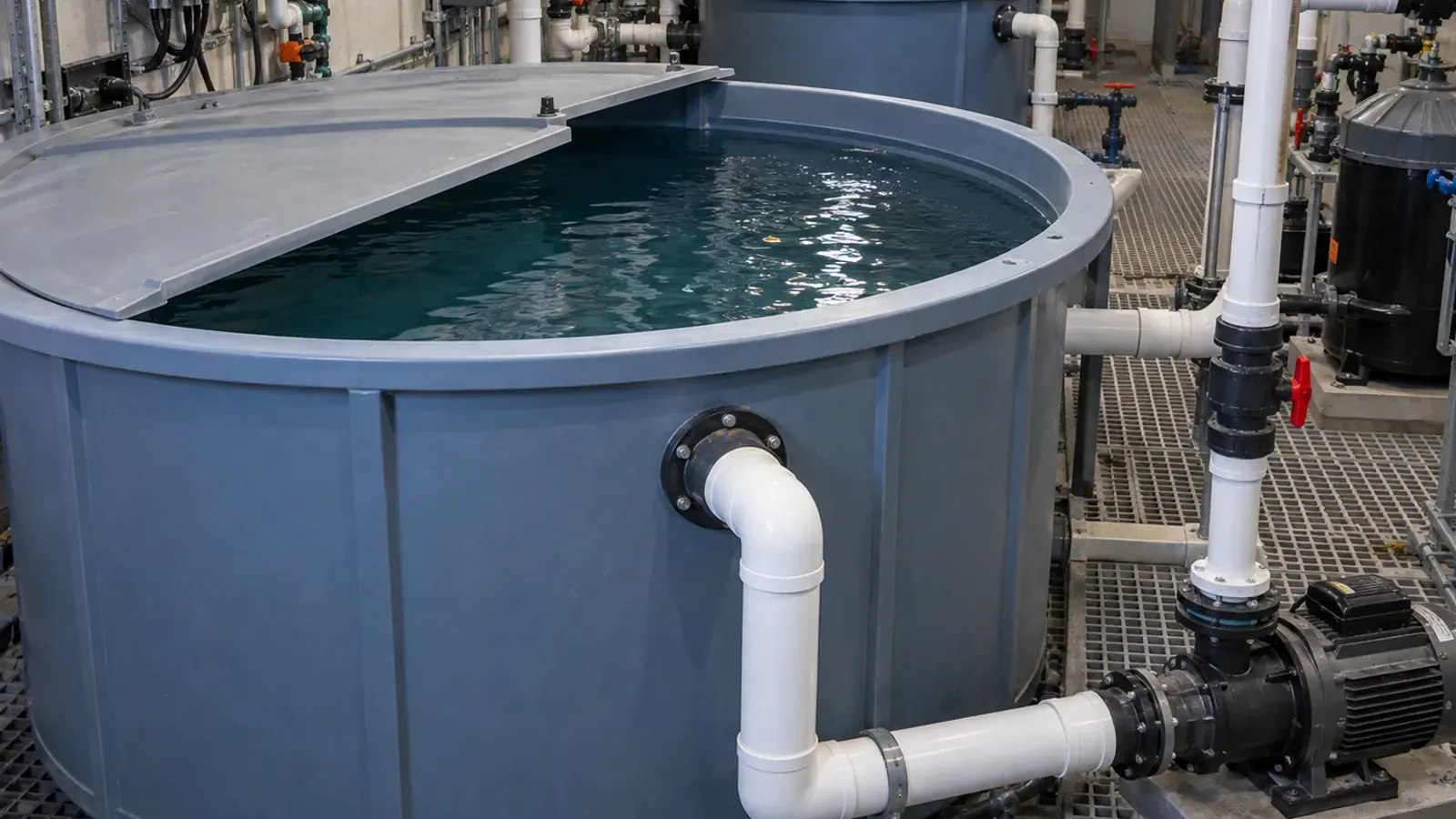
Artificial seawater: a catalogue of aquarium microbial genomes
A 2026 data resource provides genomes reconstructed from water collected while a marine aquarium was being conditioned. It supports research into microbial communities, but does not certify that an exhibit is ready for animals.
- Content type
- Scientific news
- Sector
- Public aquariums
- Animal group
- Fish
- Keywords
- MicrobiomepHSalinity
Commissioning a marine exhibit starts before animals enter it. Mixed seawater, equipment and submerged surfaces become an environment colonised by microorganisms. The practical difficulty is deciding what a result actually measures: water chemistry, genetic sequences or the system’s functional capacity. Each contributes useful information, but none can simply stand in for the others when staff assess readiness for an animal introduction.
In 2026, Mori and colleagues published genomes reconstructed from artificial seawater samples collected while an aquarium system in Nagoya was being conditioned. The paper is a data resource for microbial research. It does not provide a universal commissioning schedule or certify the health status of a future animal collection. That distinction matters when staff apply the findings.
Understanding the genomes in the resource
The water microbiome is the community of microorganisms represented in that sample matrix. The investigators collected 43 filters between December 2017 and April 2018 and sequenced twelve samples. Assembly produced 804 reconstructed genomes: 55 classified as high quality and 749 as medium quality, covering bacterial and archaeal lineages.
These metagenome-assembled genomes, or MAGs, are generated by assembling and grouping sequence fragments. They are not 804 cultured isolates or necessarily 804 newly identified species. Quality categories concern computational estimates of completeness and contamination. In this setting, the term contamination describes the reconstructed genome and should not be mistaken for a clinical assessment of the aquarium water.
Metagenomics investigates community genetic material without requiring each organism to be cultured first. Researchers can examine genes and compare assemblies. A potential function inferred from a sequence is different from activity measured in an exhibit. The catalogue is consequently a resource for developing and testing hypotheses, rather than a direct test of water treatment performance.
A water sample does not describe every surface
The resource concerns water collected using a defined filtration method and timetable. It does not characterise every part of the life support system to the same extent. Biofilms attached to filter media, deposits inside a pipe and organisms suspended in water may require different sampling strategies. Failure to find a sequence in one sample does not establish its absence throughout the installation.
Before commissioning an analysis, specify the sample matrix and the management question. Staff might wish to compare two conditioning periods, investigate an unusual change or examine nitrogen processing. Community profiling cannot automatically replace a targeted diagnostic investigation. A detailed result remains difficult to use if the reason for collecting it was never defined.
Comparisons also need consistent collection conditions: sampling point, volume, equipment preparation, preservation and analytical method. Keep a record of technical changes alongside the sample log. Without it, a difference between profiles may be hard to relate to maintenance work or to the developing system. More sequence data cannot repair missing operational context after the event.
Looking beyond the familiar bacterial groups
A separate study published in 2025 followed recommissioning at Shedd Aquarium for 54 days, including the introduction of live foods and animals. It combined 16S amplicon sequencing with water measurements. Ammonia-oxidising archaea were prominent during startup, and the community changed after biological inputs.
The Shedd investigation and the Nagoya catalogue used different methods in different installations. Their findings cannot be joined into a single experimental timeline. Together, they explain why an account focused exclusively on familiar bacterial groups may overlook part of the marine microbial community. They do not establish that the same organisms or sequence of changes will occur in another exhibit.
Nitrification converts ammoniacal nitrogen through nitrite towards nitrate. Finding organisms associated with that process does not quantify how much additional loading a system can handle. Interpreting performance requires chemistry, actual system conditions and animal observations where livestock is already present. A taxonomic profile alone does not provide a measured treatment capacity.
Decide what the analysis could change
A molecular result is most useful when the question is agreed before sampling. Define the comparison, the additional information needed and the decision that might change. This prevents a rich inventory from becoming a broad verdict on the installation without supporting evidence. It also helps staff explain why a particular method was chosen rather than simply requesting the largest available dataset.
For nitrogen monitoring, record the measured form and units. Ammonium, un-ionised ammonia and total ammonia nitrogen are not interchangeable labels. Nitrite reported as compound mass must not be directly compared with nitrite reported as nitrogen mass. An apparent disagreement between records may arise from units or methods rather than a change in biological processing.
Water pH, temperature and salinity provide context for interpretation. Neither paper establishes a safety limit for every animal species. Relevant criteria need to fit the intended animals, life stages and installation. Monitoring after an introduction should likewise reflect the specific change being made, rather than assuming that a profile obtained during conditioning remains representative indefinitely.
Use the resource without turning it into a certificate
The genome catalogue gives researchers a comparison resource where their methods are compatible. It supports investigation of microbial populations during artificial seawater conditioning. It does not demonstrate that another facility will undergo the same succession or that a diverse profile prevents disease. DNA detection also does not establish the viability of every organism represented by a sequence.
For exhibit managers, the useful distinction is between a genetic inventory, water treatment activity and animal condition. These evidence levels can complement one another without becoming interchangeable. Documenting biological introductions, maintenance changes and sampling conditions makes interpretation more defensible and allows a later result to be considered in its actual operational setting.
Vetofish offers public aquarium teams practical advice and support in connecting a microbiological question to sampling, water measurements and commissioning decisions. The aim is to obtain information that informs management, while retaining the limitations of genetic profiling.


