

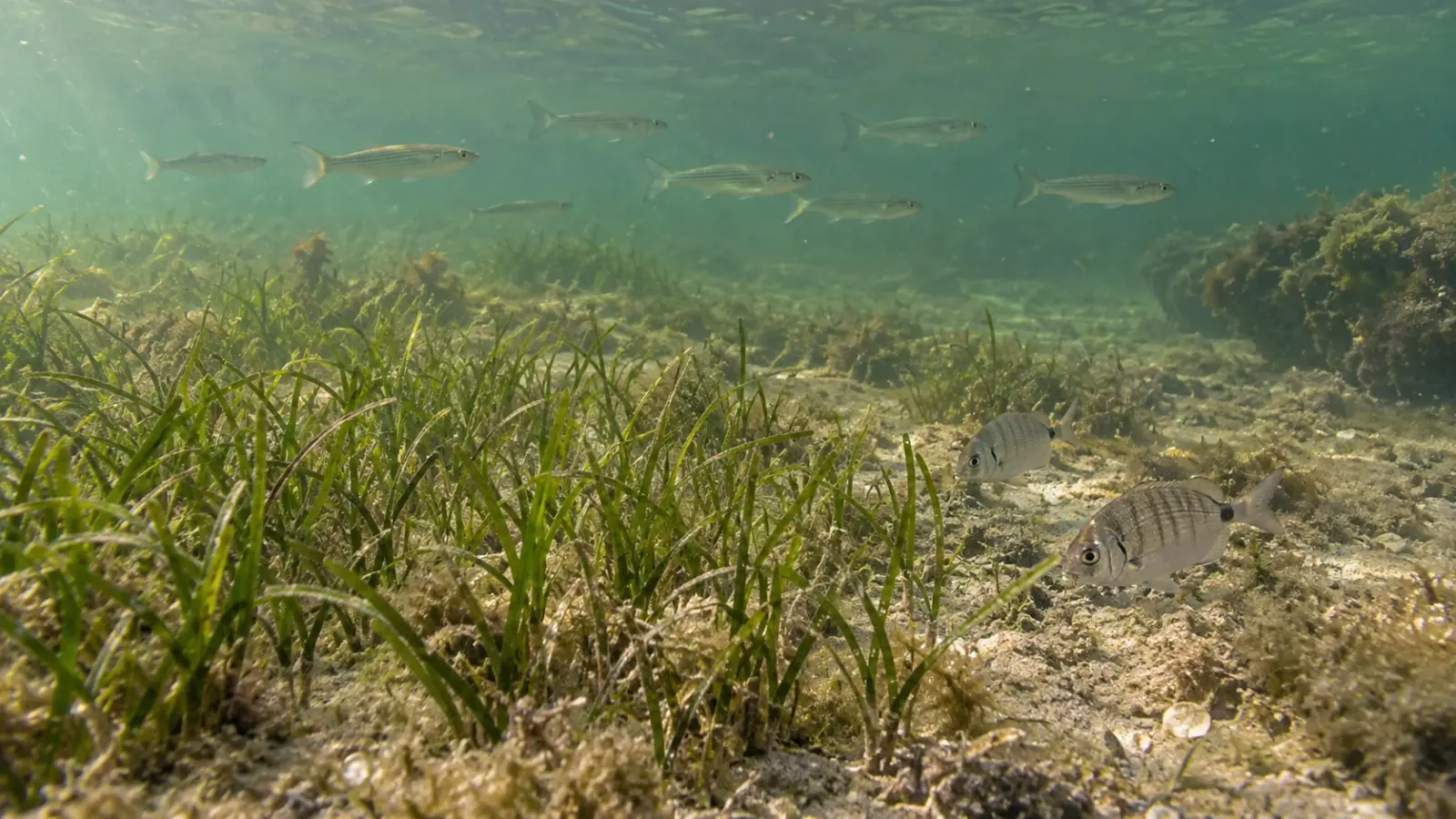
Berre Lagoon: measure fish returning to seagrass
The REHAB project reports juvenile mullets and seabream in transplanted seagrass, but colonisation alone does not demonstrate restored ecosystem function.
- Content type
- Practical guide
- Sector
- Environment
- Animal group
- Fish
- Keywords
- ReproductionOxygenSalinity
In Berre Lagoon, the REHAB project has transplanted seagrass sods since 2024 to accelerate meadow recovery. GIPREB reports more than 80% sod survival at monitored sites in 2025, strong local expansion and rapid colonisation by juvenile fish, particularly mullets and seabream. These observations are encouraging. On their own, however, they do not demonstrate that every function of a natural meadow has returned.
Habitat is more than area
Seagrasses are flowering plants rooted in shallow sediments. Leaves, rhizomes and epiphytes form three-dimensional structure that can provide shelter, food and surfaces for many organisms. For fish, value depends on canopy height and density, continuity, depth, turbidity and connection with neighbouring habitats.
Two plots of equal area may therefore perform differently. A young, sparse planting may attract fish quickly without matching the complexity of a reference meadow. Reporting square metres planted describes an action, not necessarily ecological outcome.
Record colonisation without over-interpreting it
Juvenile mullets or seabream show that fish use the site. Their presence does not yet reveal residence time, resources obtained, survival or growth. Individuals may cross the meadow, seek short-term refuge or use it during one developmental period.
Counts should record size, species, season, time of day and observation method. Repeated surveys at the same sites help distinguish a brief visit from regular use. Natural meadow and unvegetated reference sites are essential.
Follow the assemblage, not one visible species
Restoration targets communities and functions rather than a single conspicuous species. Scapin and colleagues compared restored and reference meadows in the Venice Lagoon. Their analysis suggests that the proportion of seagrass specialists may be more informative than total species number or total biomass alone.
This provides a useful principle for Berre. Lagoon residents, marine migrants, juvenile stages and vegetation-associated fishes need not respond in the same way. More generalist species can accompany colonisation without proving that the intended function has recovered.
Preserve the coastal habitat mosaic
Seagrass matters, but it does not operate alone. Research on the French Mediterranean coast shows that juvenile fishes use a mosaic of shallow habitats, including seagrass, rocky substrate, soft bottom and their interfaces. Importance changes with species, size and season.
Restoring seagrass should not lead teams to overlook meadow edges, bare patches or links to adjacent habitats. A site may be valuable as one stage in a daily or seasonal route. Monitoring benefits from examining movement across the mosaic rather than treating each plot in isolation.
Connect fish observations with environmental conditions
Seagrass and fish share drivers including available light, turbidity, salinity, temperature, oxygen and sediment stability. In a lagoon with rapid variation, monthly averages can hide a critical event. Continuous sensors and field measurements place biological observations in context.
Low abundance does not necessarily indicate failure when sampling misses the recruitment period. Conversely, a dense pulse of juveniles over several days does not demonstrate lasting improvement. Hydrological timing, sea connections and weather events belong beside the biological series.
Define success before comparison
A protocol states what restoration seeks to recover: plant survival and spread, canopy complexity, specialist species, juvenile density, size diversity or seasonal use. It also defines duration, control sites and reproducible methods.
Diver surveys, video and capture gears have different biases. Turbidity changes detection; some fish avoid observers while others hide in foliage. Recording effort, visibility and conditions helps separate ecological change from methodological change.
Protect donor sites and prevent transfer
GIPREB reports that sods are collected from healthy meadows and transplanted with their sediment. This may carry a useful root-associated community, but it also requires limited donor-site impact and attention to associated organisms. Tools, vessels and containers should avoid unintentionally moving species or agents among sites.
Adaptive restoration records failure as well as success. A method that performs in a sheltered cove cannot be assumed to work at a deeper, more turbid or wind-exposed location.
Build evidence over time
Rapid juvenile return is a useful signal and a hypothesis for further testing. Demonstrating nursery function requires repeated series, reference habitats and, where possible, evidence about duration of use, growth or survival. Monitoring should also separate natural recolonisation associated with broader water-quality improvement from the specific contribution of transplantation.
The distinction matters for management. If fish respond mostly to lagoon-wide oxygen, clarity or connectivity, protecting those drivers is as important as planting. If structural complexity within restored plots explains additional use, design and maintenance can be adjusted accordingly.
Vetofish can contribute to monitoring protocols that integrate fish condition, habitat and water quality, and to cautious interpretation of health signals. In Berre Lagoon, the strongest indicator is not the number of sods planted but the system’s renewed ability to support aquatic communities over time.
To move from evidence to action, explore our advice and support service and our expertise in aquatic environmental health.


