

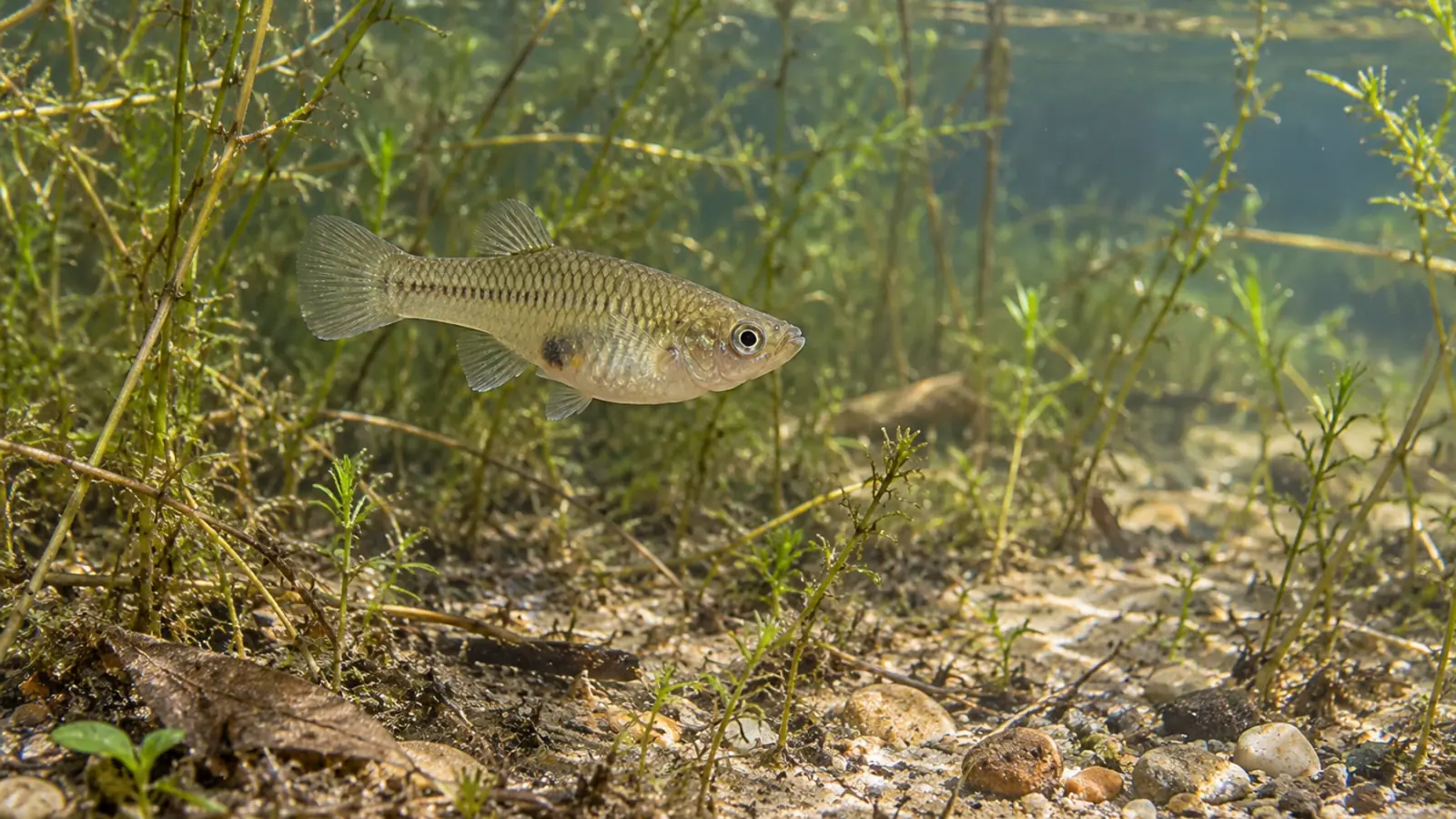
Mosquitofish and clawed frogs: predation depends on life stage and light
A laboratory study published in 2025 shows that predation between two introduced aquatic species can run in both directions. For Gambusia holbrooki and Xenopus laevis, life stage and illumination affect the outcome without establishing population control in natural waters.


- Content type
- Practical guide
- Sector
- Environment
- Animal group
- Fish
- Keywords
- LightingReproductionTemperature
Two introduced species do not have a fixed predator–prey relationship
Eastern mosquitofish, Gambusia holbrooki, and African clawed frogs, Xenopus laevis, have both been introduced beyond their native ranges. Where they meet, a general description of their diets is not enough to predict which will consume the other. Body size, developmental stage and the conditions of activity matter.
Andrey Reshetnikov and colleagues explored these interactions in a study published in NeoBiota in October 2025. Their laboratory experiments document reciprocal predation, with strong differences between life stages and lighting conditions. The work helps explain why an observation needs a precise description before it is used to infer an effect on populations.
An adult escaping a predator says little about the survival of its offspring. Conversely, consumption of a vulnerable stage in an aquarium does not demonstrate that a population will disappear from a pond.
Controlled feeding trials, rather than population monitoring
The mosquitofish originated from a site on the Black Sea coast, while the frogs were captive-bred. Experiments were conducted in the laboratory at 19–21°C. Predators were kept individually so that consumption of offered prey could be recorded.
The researchers presented different frog stages to mosquitofish, then juvenile or adult mosquitofish to adult frogs. Chironomid larvae served as control food to check feeding motivation. Repeated prey presentations formed part of the experimental sequence; they should not be counted as additional independent predators.
This design tests a capacity to consume prey under controlled conditions. It does not reproduce the range of refuges, alternative food, temperatures or encounter rates in a natural ecosystem. No field release intended to control one species with the other was evaluated.
Early frog stages were vulnerable to fish
Mosquitofish consumed frog eggs, hatchlings and tadpoles. Development changes both prey dimensions and the ability to escape. The result cannot be reduced to a statement that a frog either is or is not eaten by a fish, without specifying its stage.
Newly metamorphosed froglets were consumed less frequently. They were not necessarily unharmed: some female mosquitofish inflicted fatal injuries and partly consumed them. Failure to swallow a prey item whole therefore does not establish an absence of impact.
These observations distinguish ingestion, injury and survival. A field method looking only for swallowed prey might miss other interactions. The study nevertheless provides no mortality rate that can be applied to every clawed frog population or every water body where the two species occur.
In the reverse direction, fish age changed vulnerability
Adult frogs attempted to capture adult mosquitofish under bright conditions, but did not succeed during the two- or six-hour trials. The frogs still ate the control food. Additional tests with dead fish showed that failure to catch live adults was not simply a refusal to eat fish.
Juvenile mosquitofish were more vulnerable. A few were consumed in the illuminated trials, whereas live adults escaped. Movement and escape responses can therefore alter the outcome of an encounter beyond the physical possibility of swallowing the prey.
That contrast remains specific to the tested animals and setups. It does not establish that clawed frogs never consume adult fish in nature, or that all juvenile fish face the same risk. A result for this species pair cannot automatically be transferred to another predator and prey.
Low light particularly affected juvenile fish
The researchers also conducted trials below 0.01 lux. Under these conditions, adult frogs captured juvenile mosquitofish much more effectively. Adult fish remained infrequently consumed: none were eaten in the two-hour trial, while only two of the twenty-eight frogs consumed one adult fish each during the six-hour trial.
Low light did not reverse every interaction in the same way. Its clearest effect involved a relationship already dependent on size and life stage. The authors discuss the species’ activity patterns, without experimentally resolving the detailed sensory mechanisms responsible.
Daytime and nocturnal observations can thus describe different parts of the interaction. The experiments do not, however, define a lighting setting for managing an invasion. They do not measure the population-wide effect of urban lighting or its consequences for other organisms in the same habitat.
A feeding event is not evidence of population control
Explaining a change in abundance would also require information on reproduction, stage-specific survival, encounter frequency and other food resources. Predator presence and observed consumption do not establish a sustained decline on their own.
The authors propose hypotheses about situations in which a species already established at a site could suppress the other. Those hypotheses require testing in real habitats. The paper is not an assessment of the benefits and risks of a biological control programme.
Introducing or moving either species to act on the other is therefore not a management measure established by these results. Such an action could create additional impacts on non-target species. The study also does not describe current French distribution or establish the regulatory requirements applicable at a local site.
Record stages and observation conditions
For aquatic environmental investigations, the practical lesson is to record species, size class, developmental stage, time and illumination. Repeated observations help distinguish an occasional encounter from a frequent interaction. Limits to detecting animals or feeding events should remain explicit in the report.
Sampling only one stage or one time of day can give an incomplete account of the relationship. A monitoring question should therefore specify which part of the life cycle it can actually observe, rather than treating all individuals of a species as interchangeable.
Vetofish provides technical support for environmental investigations to connect observations with management questions. This study shows why a trophic interaction is insufficient to identify a control tool: population trajectories and the other components of the habitat must be examined before drawing an operational conclusion.


