

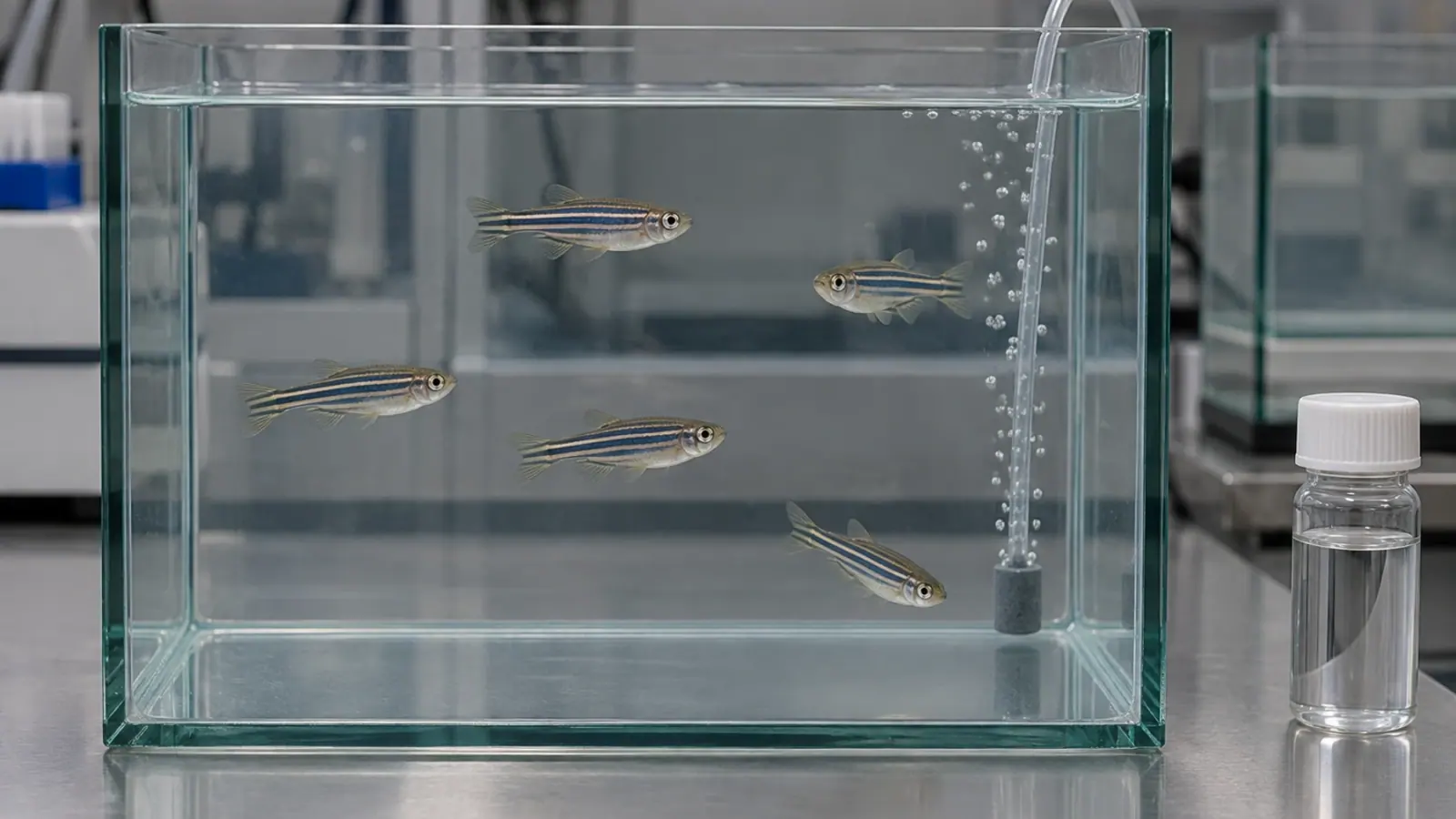
PFOS in fish: separate survival from reproductive effects
A three-generation zebrafish experiment reported different responses for survival, growth and reproduction. Environmental interpretation must retain the chemical, measured concentrations, life stages and endpoints actually tested.
- Content type
- Scientific news
- Sector
- Environment
Finding a chemical and demonstrating biological harm are different tasks. For per- and polyfluoroalkyl substances, or PFAS, comparisons become particularly difficult when chemical identity, exposure duration and fish life stage change between studies. Gust and colleagues’ paper in the 2024 volume of Environmental Toxicology and Chemistry examines these distinctions through controlled PFOS exposure in zebrafish, Danio rerio.
This article examines an experimental study, not a newly reported contamination incident. Its focus is the interpretation of endpoints. Survival, growth and reproduction answer different questions and should not be combined into a single statement that obscures their individual results.
Three generations did not mean three complete adult cycles
The experiment used five nominal PFOS concentrations, 0.1, 0.6, 3.2, 20 and 100 micrograms per litre, together with a control. There were five replicates per treatment. The parental and first descendant generations were followed to 180 days after fertilisation. The second descendant generation was followed to 16 days.
The available observations therefore differ between generations. Early-life outcomes in the final generation cannot be treated as adult reproductive results. The generations were also exposed; this design does not, by itself, demonstrate an inherited effect persisting in descendants kept entirely free of exposure.
Nominal concentrations are the intended preparation levels. Measured concentrations describe what the exposure system actually achieved. The authors documented measured values, which varied between phases. Retaining that distinction is essential when comparing the experiment with water monitoring or another toxicity study.
Survival effects were not identical across generations
At the highest nominal treatment, survival was significantly reduced in the parental and second descendant generations, but not in the first descendant generation. For the mortality observations concerned, measured concentrations associated with the high treatment ranged from 94 to 205 micrograms per litre.
This is evidence of an effect under the tested conditions. It is neither a universal toxicity threshold nor a safe concentration for a river. An experimental effect concentration depends on duration, species, developmental stage and endpoint. It cannot be transferred directly into a protective limit for an aquatic community.
Growth was also affected, most consistently at the highest treatment. Differences at lower concentrations were less frequent and did not always form a regular concentration-response pattern. Describing the findings simply as “no low-dose effects” would remove information from the study.
Reproductive measurements gave a different result
The authors found no statistically significant effect on egg production or egg survival in the parental and first descendant generations. They also found no significant effect on whole-body vitellogenin concentrations in males from those generations.
Vitellogenin is associated with the production of egg reserves. Measurements in male fish are used in some studies to investigate responses linked to oestrogen signalling. The marker does not describe the entire endocrine system and cannot exclude every mechanism of disruption.
Failure to detect a significant difference on these endpoints does not establish that PFOS has no reproductive effects across all species, durations and conditions. It states what this experiment detected. Equally, evidence of reduced survival does not establish that egg production was reduced in the same study.
Keeping the negative findings visible is part of a fair assessment. They should neither be omitted from an account of adverse effects nor expanded into an assurance that the chemical is harmless.
Start a field assessment with chemical identity and matrix
For environmental practitioners, the first check is which substance was measured. PFOS belongs to the PFAS family, but its experimental results cannot stand for every member of that family. The next check is the sample matrix: water, sediment or tissue. A water concentration cannot be compared directly with a concentration measured in fish.
Bioaccumulation describes uptake and retention within an organism. It does not, by itself, demonstrate mortality or impaired reproduction. Conversely, the absence of visible lesions does not exclude exposure or an effect that is not externally apparent.
Ecotoxicological interpretation connects exposure with effects on organisms and ecological systems. A local assessment must retain units, sampling periods, species and analytical uncertainty. This experiment cannot attribute a field mortality event to PFOS without investigation of other possible causes.
For the same reason, an environmental summary should state its question before selecting a result. Is it investigating exposure, explaining a biological observation or assessing possible risks? Each question needs evidence appropriate to the chemical, population and timescale concerned.
Limits that should survive every summary
The experiment concerns one chemical and one laboratory fish model under controlled exposure. It does not reproduce environmental mixtures, the diversity of wild species or changing hydrological conditions. The stages monitored also do not support a claim that harm invariably becomes greater with each generation.
The authors compared their findings with earlier studies that did not always produce the same responses. This is a reason to examine protocols, measured concentrations and endpoints, rather than selecting only the most alarming paper or dismissing concern altogether. A difference between studies needs an explanation grounded in their designs.
The paper does not establish a regulatory standard. The values reported here remain experimental exposure concentrations. They are not water-quality recommendations, discharge permissions or a substitute for an environmental risk assessment.
Laboratory control also changes the question compared with field observation. It supports investigation of a specified exposure, while a natural system may contain multiple chemicals and other stressors. Applying the findings requires an explicit account of those differences.
Conclusion and Vetofish support
The study’s practical value lies in separating endpoints. Effects on survival and growth do not mean that a reproductive effect was demonstrated by the same measurements. A useful account preserves negative findings, the generations actually observed and the limits of extrapolation.
Vetofish can help formulate an investigation and relate exposure data to animal observations through its consultancy and support service, for aquatic environmental work. This can clarify which evidence is available and which additional observations would be needed.


