

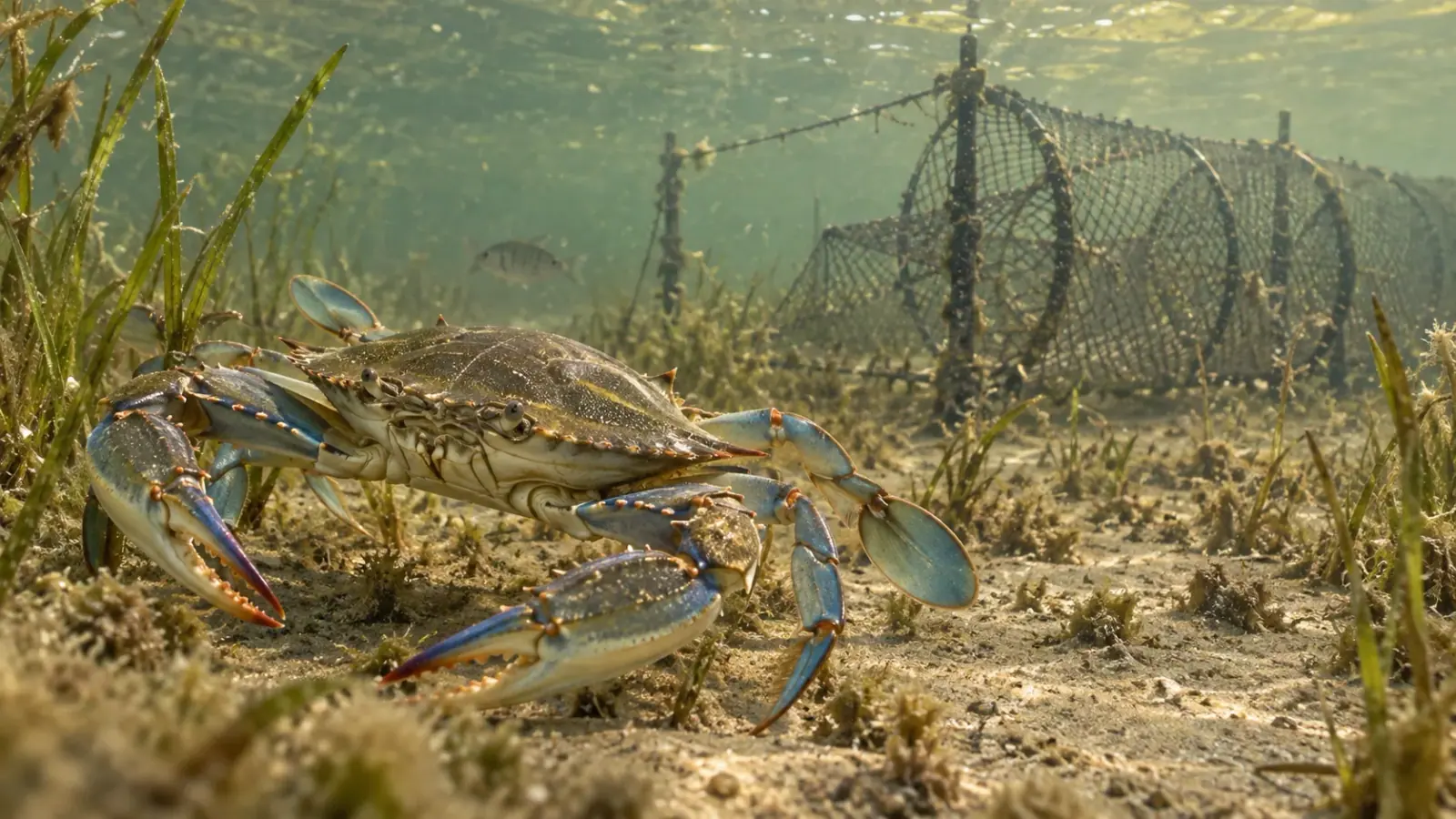
Blue crab in Camargue: measure before attributing
More than 1,500 blue crabs were caught at Ponant in July 2026. Monitoring confirms strong presence, but attributing declines requires comparable time series.


- Content type
- Scientific news
- Sector
- Environment
- Animal group
- Crustaceans
In July 2026, more than 1,500 blue crabs were caught over roughly two weeks in Étang du Ponant, according to the Gard fishing federation. The figure confirms a substantial presence of Callinectes sapidus in this part of Petite Camargue and the value of coordinated monitoring. By itself, however, it does not estimate population size or attribute every fish decline and damaged net to the crab. Moving from a striking signal to robust management requires standardised catches compared with environmental, fishing-effort and community data.
What the Gard monitoring documents
The federation reports the species in several coastal wetlands and lagoons, including Ponant, Médard, Marette and Salonique. Under the “Sentinelles du crabe bleu” project, six fyke-net systems were installed in Ponant and the Vidourle area for about two weeks and checked every two days. The July total is therefore tied to a particular gear, duration, location and season.
Those details are essential. A raw count varies with fishing effort, gear efficiency, season, crab activity and spatial distribution. Trends require comparable indicators: catch per unit effort, size, mass, sex, maturity, egg-bearing females, location, depth and water conditions.
The programme also mentions biometric monitoring in the Camargue delta in 2025 and larval-stage surveillance by the Camargue regional nature park. Combining adult, juvenile and larval observations is more informative than a single campaign. It helps distinguish seasonal passage, local recruitment and a persistently established population.
Why lagoons provide suitable habitat
Blue crabs are mobile, opportunistic and tolerant of broad environmental variation. Their life cycle uses gradients between brackish and marine waters. Shallow, productive areas connected to the sea can provide food, shelter and access to habitats needed at different stages.
A Mediterranean-scale analysis by Gavioli and colleagues related recent occurrence records, including citizen-science data, to environmental and human variables. Nitrate concentration and shallow water were among the most influential factors in their models, while temperature, salinity, shipping density and human population explained less variation. The authors discuss limitations in occurrence data and do not present these associations as sufficient causes.
This prevents an overly simple explanation based on warming alone. Temperature affects crab biology, but Mediterranean establishment also depends on lagoon structure, productivity, connectivity and introduction history. A warm year may change activity without single-handedly explaining local density.
Plausible impacts and causation still to test
Blue crabs consume invertebrates, fish, carrion and other resources. They can damage nets, attack entangled catch and increase sorting time. These mechanisms make ecological and economic costs plausible, but their magnitude varies with habitat, fishery, prey and local abundance.
In a Po Delta lagoon, a 2025 study analysed small-scale fishery landings. The authors found relationships between landed blue-crab biomass and declines in several taxa, including flounder, sand smelt, eel and green crab. They discuss predation and competition as possible mechanisms while stating that those mechanisms require confirmation. A correlation in one Italian lagoon cannot automatically explain a French trend.
Evidence in Petite Camargue requires local time series: catch per effort, fish size classes, salinity, temperature, oxygen, habitat condition, fishing pressure and other invasive species. Targeted experiments or diet analyses can complement those records, provided results are not generalised from one stomach, site or season.
Build indicators that can guide management
An operational dashboard can separate four dimensions. The first describes the crab: catch per effort, size structure, sex ratio and reproduction. The second follows communities: abundance and size of local fish, molluscs and crustaceans. The third documents economic activity: gear damage, handling time, catch loss and commercial use. The fourth records environmental conditions and sampling effort.
Citizen observations expand coverage but should retain photographs, location, date and identification validation. More reports may mean more crabs, better engagement or both. Standardised professional series provide an anchor for interpretation.
Targeted removal can reduce numbers locally and generate data. It should be evaluated just as carefully: effort required, disposal or use of catches, operator safety, bycatch and possible compensatory responses. Commercial use may support continued removal without constituting guaranteed eradication.
Link surveillance, regulation and biosecurity
The federation states that captured animals must not be released and that sale is permitted in France. Applicable instructions should be confirmed with the relevant authorities, especially when animals, bait, gear or water are moved. Cleaning equipment between lagoons also reduces the chance of moving other organisms during control work.
Precise communication supports management. The 1,500-catch figure conveys the scale of one Ponant operation; it is neither a population estimate nor proof of a food-web collapse. Reporting results together with effort and uncertainty builds trust and makes future campaigns comparable.
Vetofish can contribute to monitoring protocols, health assessment of associated fish and crustaceans, and interpretation of mortality or lesions observed in lagoons. For blue crab management, the priority is to connect decisions to repeatable local evidence rather than to a single, premature attribution.
To move from evidence to action, explore our advice and support service and our expertise in aquatic environmental health.


