

River barrier removal: planning for invasion risk
Reopening a river corridor can benefit native species while creating a route for invasive species. A scientific synthesis supports assessing that trade-off before barrier removal and carrying it into long-term monitoring.

- Content type
- Practical guide
- Sector
- Environment
- Animal group
- FishCrustaceans
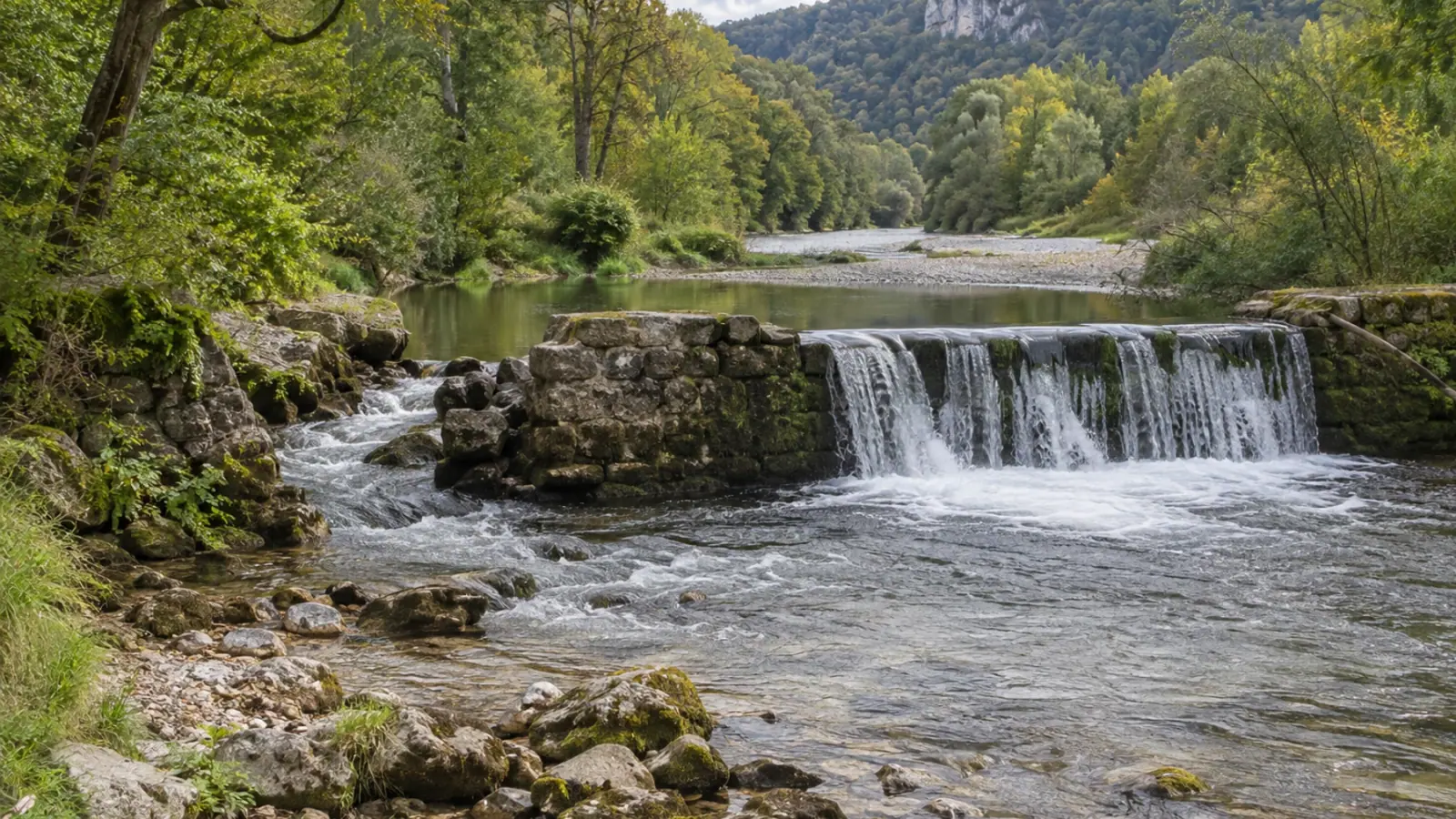
A river barrier can restrict native fish movements while slowing the spread of an introduced species. Removing it changes both situations. Managers therefore need to ask which routes will reopen, which organisms may use them and what habitats lie beyond. Dolan and colleagues’ synthesis offers a framework for discussing that trade-off without assuming that every reconnection causes an invasion or that retaining every obstacle is protective.
Look beyond the structure itself
Hydrological connectivity concerns connections within an aquatic network. A map can show a physical interruption without identifying the populations it separates. Before scheduling removal, combine the network layout with records upstream, downstream and in tributaries that may become accessible. The useful boundary for the assessment follows potential movement routes, rather than the construction footprint alone.
Invasive status depends on location. A species native to one region can be introduced elsewhere. Record the geographical reference, confirmed identifications and uncertain observations in the project dossier. This prevents a newly observed organism from automatically being labelled invasive, while ensuring that known introduced species are not overlooked simply because a recent survey failed to record them.
The catchment provides a useful scale for examining possible pathways. Other structures, seasonal connections and human activities can alter access. A barrier may not block every life stage or every form of movement. Describe its actual role using the available evidence, rather than assuming complete exclusion from the symbol used on a map. Unknown permeability should remain an explicit uncertainty.
A risk framework rather than a universal forecast
The 2025 paper is a conceptual synthesis of relationships between fragmentation, restoration and biological invasions. It discusses possible mechanisms and research priorities. It does not provide a universal probability of invasion following removal, or a height threshold that automatically determines whether a barrier should remain. A local decision requires local information about organisms, habitats and movement.
The authors emphasise uneven knowledge across regions, taxonomic groups and barrier types. Anticipated benefits for migratory fish consequently do not complete the assessment. Crustaceans, molluscs and plants may disperse differently. A documented response in one group cannot be assigned to the others without examining the relevant biology. A whole-project appraisal may need expertise beyond the target fish species.
The baseline should focus on uncertainties that could change the decision. Define species of concern, available records, poorly surveyed areas and the changes to be monitored. Incomplete inventories can still inform planning when their gaps are visible. They become misleading when a lack of detection is presented as evidence that a species is absent. Survey design and detection limits belong beside the species list.
Separate movement, establishment and impact
Dispersal is movement, not proof of lasting establishment. Finding an organism beyond a former barrier after reconnection is a signal to investigate. Evidence for an established population depends on its life cycle and may require further observations. Effects on native populations are another question again. Keeping these stages separate helps a project respond to information without overstating what has occurred.
Plausible competition or predation is not a measured effect at the site. Monitoring can assess presence, abundance, reproduction and habitat change using methods that remain comparable over time. Those observations help test a risk hypothesis. They should not be reported as confirmation of the feared outcome merely because a species has gained access to a previously isolated reach.
Pathogens need a distinct assessment. Reconnection can be considered as a potential movement pathway, but the synthesis does not establish an infectious event in every restoration project. A health suspicion requires an appropriate investigation. It cannot be inferred from a distribution change alone or from a general ecological response. The relevant hosts, agent and exposure route need to be considered together.
Decide how the project will address identified risks
Teams can compare feasible scenarios, including retention, removal, modification or management of passage. Each should state the intended native-species benefit, identified invasion risks and available means of observation. Such a comparison supports site-specific decisions; it is not a general argument for leaving obstacles in place. The alternatives must be real options under the site’s technical and management constraints.
Where selective passage is proposed, examine performance for the organisms and conditions concerned. A measure that slows an invasive species may also restrict a native migrant. Maintenance, feasibility and difficult flow conditions are part of the assessment. Describing a design as selective does not demonstrate that it achieves the intended separation, and the consequences for protected populations must remain visible.
Construction and monitoring activities also need proportionate biosecurity. Moving wet equipment between reaches is a pathway to assess independently of removing the structure. Clear arrangements for equipment and site visits help distinguish possible human-mediated transfers from movement through the reopened corridor. This matters when interpreting later observations and deciding which intervention might address the actual route.
Make monitoring support a practical response
Stations should cover areas requiring protection and predicted routes of spread, not only the former barrier location. Keep season, effort and methods comparable where possible. Environmental DNA can contribute to targeted presence surveys when an appropriate method exists. On its own, a detection does not quantify abundance, demonstrate establishment or measure ecological impact. Those conclusions need additional evidence suited to the question.
Before work begins, specify who receives a new signal, who confirms it and which responses are feasible. Monitoring without that chain can produce data while leaving staff unprepared to act. Responsibility and funding should extend into subsequent years: an immediate observation does not describe every recolonisation trajectory or rule out later change. Review the plan as evidence and site conditions develop.
Conclusion and Vetofish support
Assessing invasion risk helps managers discuss reconnection in terms of its expected benefits and site-specific uncertainties. Our advice and support service can help aquatic environment stakeholders connect animal observations, health risks and surveillance criteria with the hydrological and ecological expertise required for restoration planning.


