

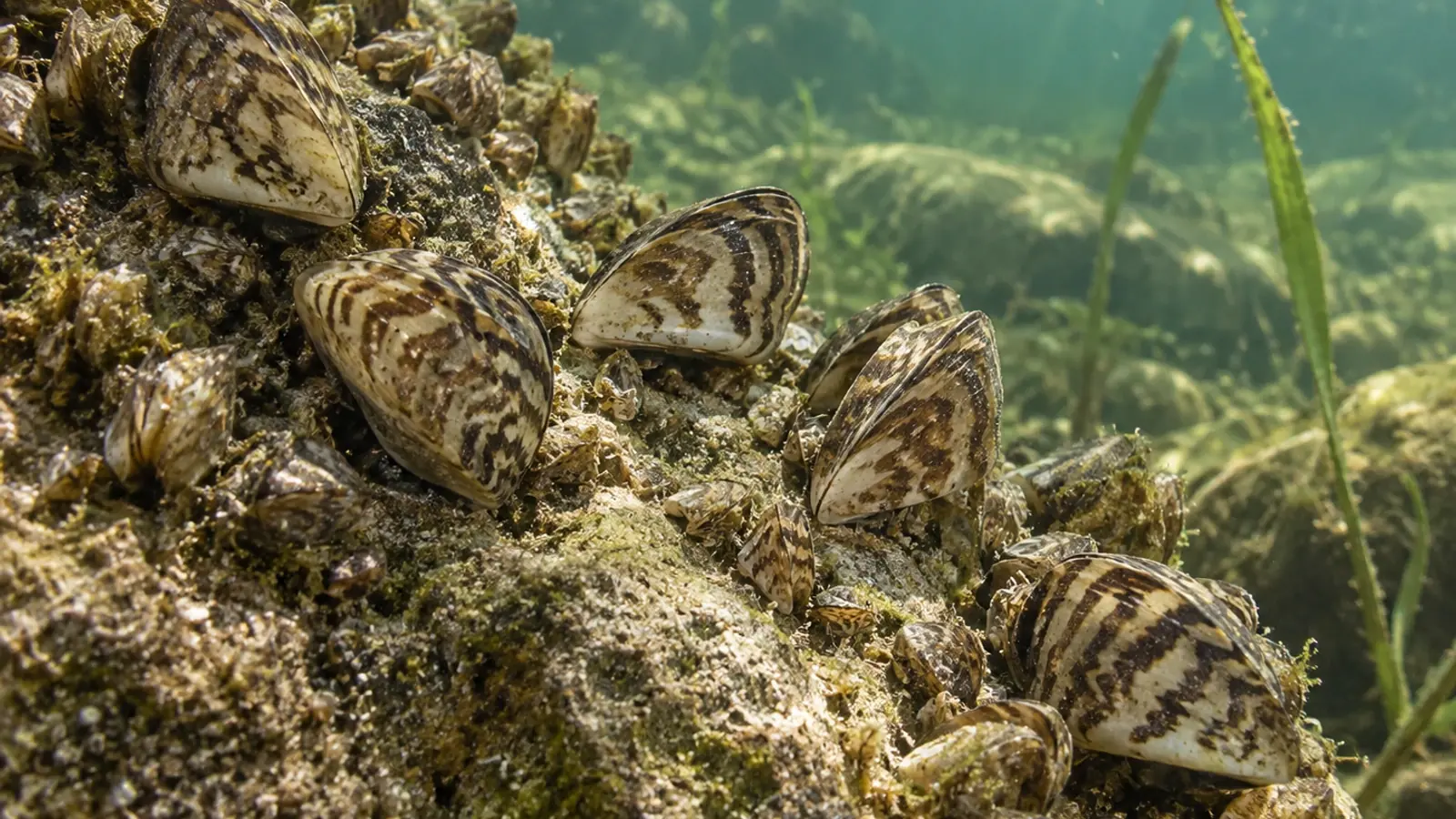
Zebra mussels: interpreting weak effects in Kansas
A 2026 study of 25 Kansas reservoirs found little evidence of lasting zebra mussel effects on the water-quality variables and fish abundances examined. The result sharpens questions for invasion monitoring without establishing that the species is harmless or that prevention has become unnecessary.


- Content type
- Scientific news
- Sector
- Environment
- Animal group
- Corals and invertebratesFish
- Keywords
- TemperatureBiosecurityTransport
Finding zebra mussels in a waterbody warrants monitoring, but their presence alone does not predict how fish populations will respond. A study published on 8 June 2026 by Sliger and colleagues reports a qualified result: across large Kansas reservoirs, the lasting effects detected in several measured variables were small. Managers need to examine how those effects were assessed before using the result in a local decision.
The species examined, Dreissena polymorpha, is a small bivalve attached to submerged surfaces. Minnesota DNR describes its two-valved shell, attachment to equipment and natural substrates, and dispersal through transported equipment and water. Identification still matters: a quagga mussel should not automatically be recorded as a zebra mussel.
What the reservoir comparison examined
The study covered 25 reservoirs of at least 5 km², including 16 with established zebra mussel populations. The authors used records from before and after detection alongside reservoirs without detection. Outcomes included Secchi depth, total nitrogen, total phosphorus, chlorophyll, relative fish abundance and angler use.
Available periods differed between datasets. Water-quality series extended to 2022, while fish records extended to 2024. Not every variable was available for all 25 reservoirs. This was an analysis of monitoring series, rather than an experiment randomly assigning an invasion to otherwise comparable waterbodies.
Little support for large lasting effects
The analyses provided little support for substantial long-term effects on the water-quality variables or fish abundances examined. Reservoir identity contributed more strongly to the water-quality models. Largemouth bass showed a small negative trend in invaded sites, which the authors considered unlikely to be biologically important. Angler use showed no clear response.
Keep that conclusion connected to its measured outcomes and sites. Stable abundance does not demonstrate that every individual is healthy or that food resources and habitats never changed. The records do not measure all lesions, reproductive outcomes or feeding relationships. A weak detectable effect in these series is not evidence that every possible effect is absent.
Mussel density was not available
The authors could not incorporate zebra mussel density. This prevents a direct assessment of whether denser populations produced different responses. First detection also does not necessarily identify the precise time or intensity of establishment.
Filtration acts on particles, including phytoplankton. Minnesota DNR describes how it can alter food available to other animals. However, mussel presence alone does not quantify the amount filtered across an entire reservoir. A plausible food-web mechanism remains different from a demonstrated local change.
Short-lived responses could be missed within a long-term trend. Smaller reservoirs were outside the analysis. The study also did not quantify damage to water intakes or all consequences for other organisms. These limitations prevent the findings being used as a general statement that zebra mussels are harmless.
For a manager, the missing density information is particularly useful when planning a follow-up question. It shows why a presence record cannot substitute for an assessment of establishment or intensity. The next study should be designed around the question it can answer, rather than assuming that more years of the same observations will resolve every uncertainty.
Applying the lesson beyond Kansas
Kansas offers an external comparison for French and other European reservoirs. It does not diagnose them. Hydrological regime, habitat structure, resident species and water use need local examination. The transferable lesson is to define the response of interest before expanding a monitoring programme.
The monitoring plan can distinguish mussel distribution, fish responses and equipment performance. State the sampling stations, seasons, effort and methods. A change in catches has a different interpretation if the gear or surveyed area also changed. Preserve those details so that a future analyst can distinguish ecological change from monitoring change.
Temperature, water-level records and other relevant conditions help place the observations in context. No single indicator should carry every decision. When fish numbers decline, investigate competing pressures such as habitat change, water quality, management operations and site history. Assigning every change to the invasion would weaken the purpose of surveillance.
Before adding new technology to an established programme, check how comparable the earlier records are. Document methods and interruptions. A series with transparent changes may still be useful without being described as homogeneous. A simple account of what was measured, where and when often provides the basis for a more focused next step.
Preventing spread is a separate decision
Transport risks do not disappear because an effect on fish appears weak elsewhere. USGS recommends good boat hygiene and avoiding the transfer of water from live wells or bait buckets between waterbodies. Minnesota DNR describes adults attached to equipment and microscopic larvae in retained water as dispersal routes.
Field teams also need to consider monitoring equipment. Identify items contacting the water, provide a cleaning area and plan movements between sites. Cleaning, draining and drying arrangements should fit the equipment and local requirements. Specific US legal duties or drying periods are not international rules and should not be presented as French obligations.
Document a new observation with photographs, location and context, and notify the appropriate local network or authority. Avoid deliberately moving suspect organisms to another waterbody for demonstration. This article does not propose chemical treatment in open water or imply that an eradication method has been validated for a particular site.
Prevention procedures need responsibilities as well as instructions. The team should know who checks equipment, where remaining water is managed and how a suspected finding changes the itinerary. These are organisational recommendations for a site-specific plan, not outcomes demonstrated by the Kansas study.
Conclusion
The study found little evidence of lasting effects in the measured variables across large Kansas reservoirs. It illustrates why invasions need not produce identical responses everywhere and why monitoring limitations must remain explicit. Preventing dispersal and assessing local effects remain complementary management decisions.
Vetofish support
Vetofish can help define monitoring questions, review fish records and organise field procedures through our advisory service. Our work in aquatic environmental management connects health interpretation with ecological context while retaining the limits on causal conclusions from observational data.


