

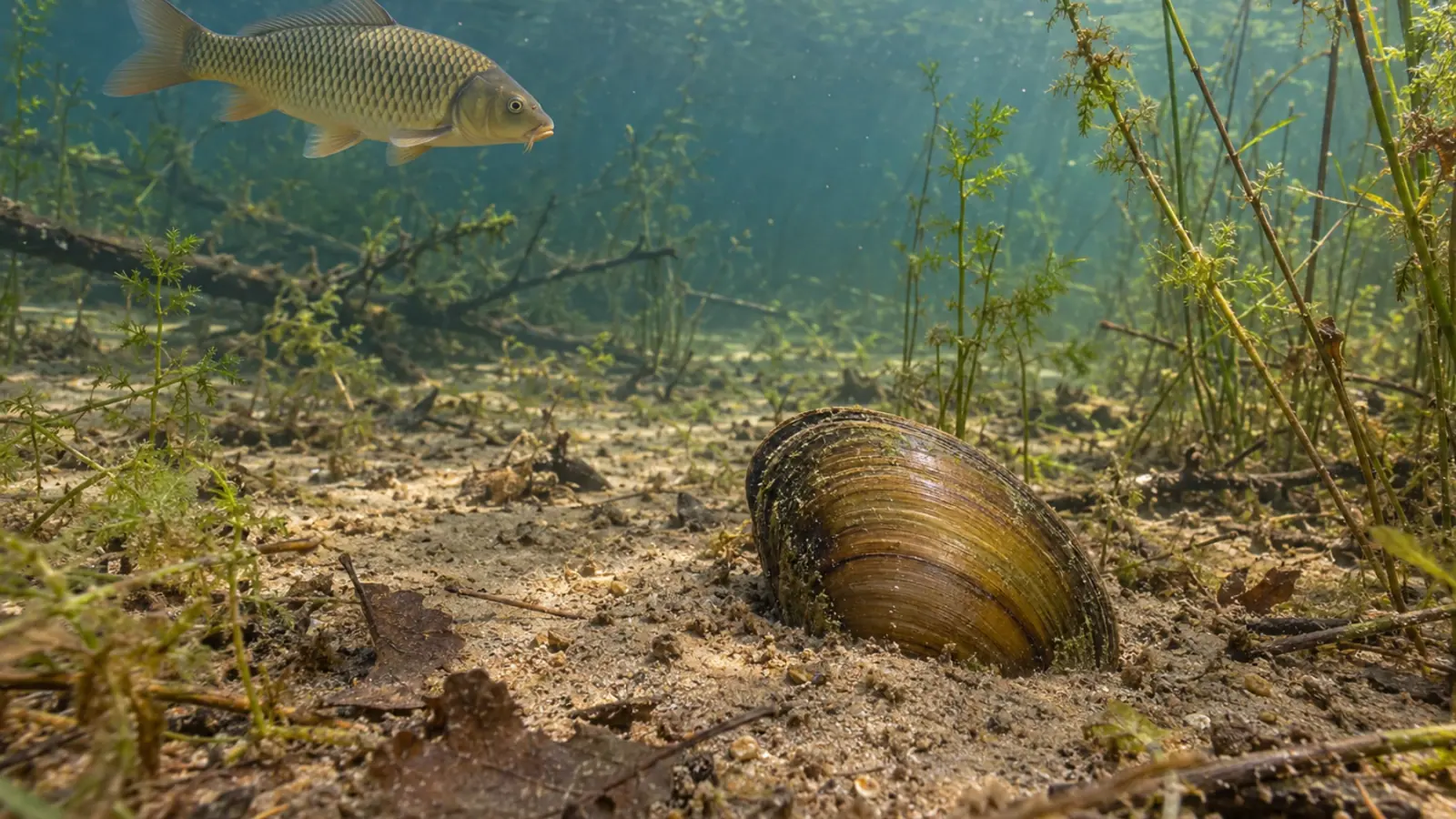
Chinese pond mussels: fish transfers matter too
An adult mussel may move little while its larvae travel with fish. A 2018 genetic study of Chinese pond mussels helps explain their spread across Europe and why mussel surveillance should be linked to records of fish movements.


- Content type
- Practical guide
- Sector
- Environment
- Animal group
- Corals and invertebrates
- Keywords
- TransportReproductionBiosecurity
A bottom-dwelling mussel with a mobile larval stage
The Chinese pond mussel, Sinanodonta woodiana, is a freshwater bivalve introduced to several European regions. Adults live on or within the bottom sediment and may be partly buried. Their limited mobility can be misleading when considering how the species reaches distant water bodies.
Part of the life cycle involves a mobile host. Larvae, known as glochidia, can attach to fish gills or fins before completing development and settling as juvenile mussels. A fish carrying larvae provides a transport route very different from the movement of an adult mussel.
This connects activities that may otherwise be considered separately: recording adult bivalves at a site and tracing fish movements. Normal-looking fish cannot be assumed free from microscopic larvae. Conversely, finding an adult mussel does not immediately reveal the sequence of events that brought its population there.
The practical question is therefore broader than whether adult mussels have been deliberately moved. Connections between sites can involve a life stage that a routine visual inspection of fish would not establish as absent.
What the 2018 genetic study compared
Konečný and colleagues analysed samples collected between 2011 and 2014. Their microsatellite dataset comprised 369 individuals from sixteen European populations and 137 individuals from six Chinese populations. Ten markers were retained after methodological checks.
The study combined nuclear data with a mitochondrial marker. The European sequences examined shared a haplotype also found in the Yangtze region. Nuclear markers added information about diversity and mixing between populations. A single marker therefore does not describe the entire genetic history of an invasion.
France was represented by a site at Arles in the Rhône basin. That historical sample is neither a comprehensive French distribution survey nor a map of occurrence in 2026. Limited representation of a country needs to remain visible when using the study to inform local surveillance.
The sampling dates also matter. The paper can help explain historical patterns and relevant pathways. It cannot establish which particular sites are occupied now without contemporary observations.
Modelling routes is not tracking a shipment
The authors compared alternative introduction and spread scenarios. Their findings support a role for European source areas, including southern France and the Danube region, in subsequent dispersal. The observed genetic structure did not simply show exchanges declining with geographical distance.
These patterns are consistent with human-assisted movement, including fish transfers. They are not direct tracking records for a consignment. A population model cannot by itself identify a shipment date, operator or exact number of transfers responsible for introducing mussels to each location.
The scenarios also depend on the populations available for analysis. An intermediate step through an unsampled region cannot simply be ruled out. The findings guide questions for movement records; they do not establish an operator’s responsibility from the presence of a mussel alone.
This distinction determines how the genetic findings can guide surveillance. It provides a reason to investigate connections between sites without claiming that every route has already been reconstructed.
Connect observations with documented movements
At a freshwater site, adult mussel records can be compared with fish introduction dates, origins and exchanges between facilities. Movements of bivalves themselves, water or equipment may also need recording where they are relevant. Recognising the larval route should not remove other possible transport pathways from the investigation.
The useful task is to establish which movements connect environments, then determine what evidence confirms the species’ presence. Visual inspection of fish is not a test for freedom from glochidia. Equally, failing to see an adult mussel during a visit does not mean that the entire bottom has been examined with a known detection sensitivity.
Photographs, location, date and circumstances make an observation easier to assess. Identification based only on a shell outline remains uncertain because shell forms can vary. Taxonomic expertise, followed by suitable confirmation where needed, helps distinguish a suspicion from an established identification.
This information is also needed before comparing observations between years. Differences in search area, water visibility or identification confidence should not automatically be read as changes in abundance or spread.
What the study does not prescribe for management
The paper investigates invasion history. It does not validate a universal fish decontamination procedure, a quarantine period guaranteed to remove all larvae or a treatment suitable for every environment. Practical arrangements need to be designed around the site, species and surveillance question.
The authors also discuss whether cold tolerance may have evolved during establishment in Europe. This is not experimental evidence for classifying cold water as protective or warm water as necessarily colonised. An ecological hypothesis cannot become a management threshold without further data.
This guide does not announce a new legal classification. A 2018 population-genetic study is insufficient to establish an operator’s current legal duties. Its value here is biological: it identifies a pathway that belongs in a considered health and environmental assessment.
Nor can a genetic scenario establish the effectiveness of a proposed control measure. Evidence about spread and evidence about successful intervention address different questions. Site decisions require that distinction to remain explicit.
Watch the bottom and the links between sites
The study illustrates how a relatively sedentary adult can depend on a fish-borne stage to travel long distances. Surveillance is more informative when it combines bivalve observations, reliable identification and movement history, rather than relying only on the distance between water bodies.
For environmental teams, this approach helps prioritise investigations without claiming to infer a population’s origin from a single sighting. Biosecurity begins with traceable movements and observations that can be interpreted.
Vetofish provides aquatic health expertise to connect observed species, documented transfers and diagnostic options. The aim is to build surveillance appropriate to the site and identify what still needs checking before a management decision.


