

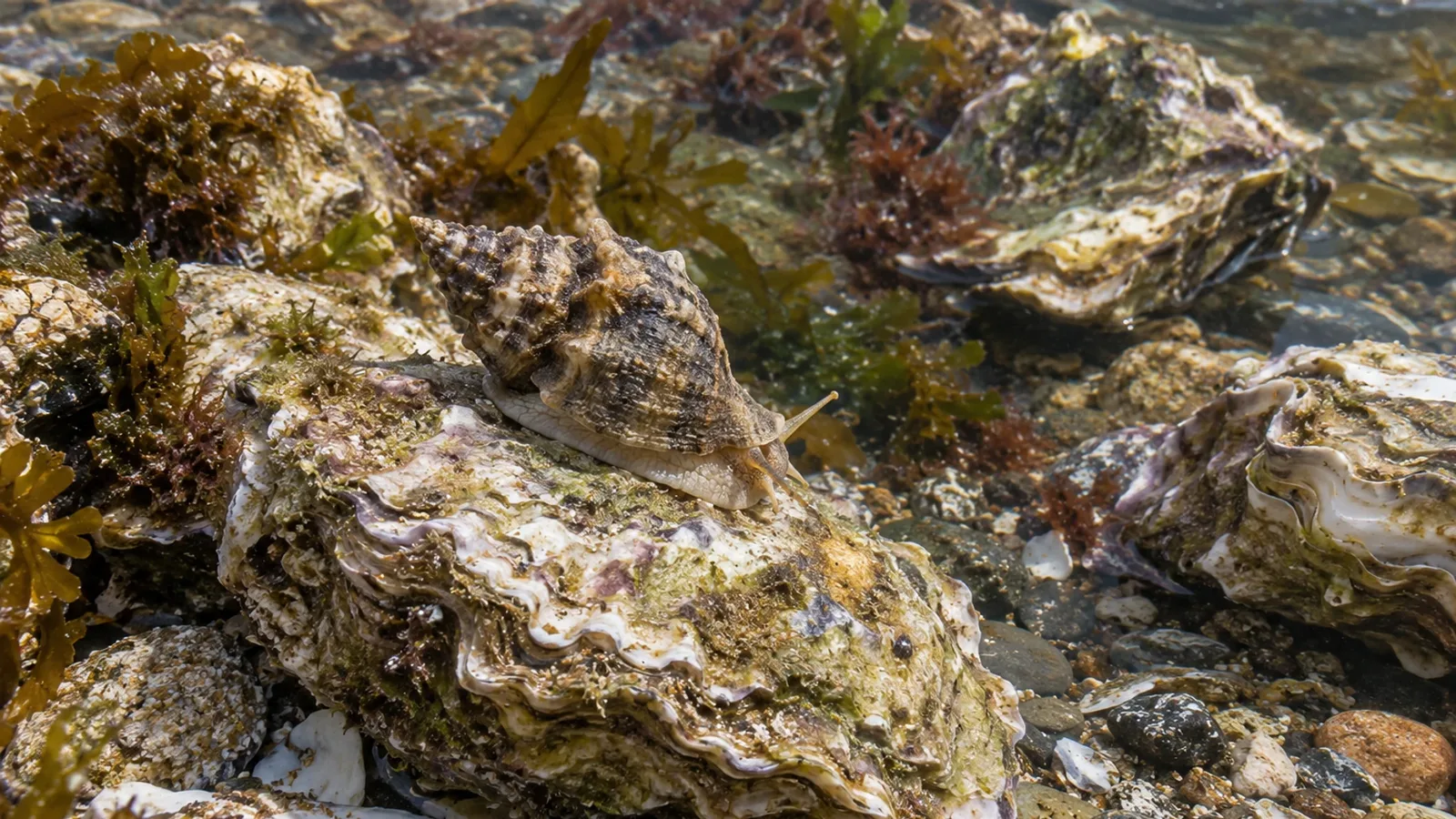
Japanese oyster drills: keep track of shellfish transfers
A snail without a swimming larval stage can still spread along a coast. A 2004 genetic study of Ocinebrellus inornatus highlights the likely role of oyster transfers and the limits of monitoring based only on geographical proximity.
- Content type
- Practical guide
- Sector
- Environment
- Animal group
- Corals and invertebrates
- Keywords
- TransportReproductionBiosecurity
Coastal distance is only part of a dispersal map
The Japanese oyster drill, Ocinebrellus inornatus, is a marine gastropod that preys on bivalves. Its life cycle lacks a free-swimming larval stage, which might suggest predominantly local spread. Shellfish movements can nevertheless connect distant sites and change that expectation. Monitoring therefore benefits from a map of exchanges as well as a map of geographical distances.
Martel and colleagues investigated this question in a study published in 2004. It examined expansion along the French Atlantic coast following detection in Marennes-Oléron Bay in 1995. Its genetic comparisons help investigate possible dispersal pathways. It is neither an inventory of the species’ distribution in 2026 nor a current assessment of financial losses to oyster farming.
Compare populations rather than isolated sightings
The researchers analysed 580 adults from 17 populations: nine in France, three in the United States and five in South Korea, within the native range. The French sample comprised 347 individuals. French collection dates documented in the paper span 2000 to 2002, with sampling conducted in shellfish-growing areas.
Seven enzyme markers were used to compare genetic diversity and differences between populations. They describe inherited variation rather than track individual snails travelling with a consignment. Comparing allele frequencies between sites allows researchers to examine whether the observed pattern resembles gradual spread or is compatible with exchanges linking locations further apart. These approaches address population history, with the resolution available from the chosen markers.
The French genetic pattern did not follow distance
Genetic differentiation among French populations was low but detectable. It did not simply increase with distance along the coastline. Some populations separated by several hundred kilometres remained genetically close for the markers studied, while differences were also present between locations much nearer one another. The geography alone did not account for the pattern.
The authors interpreted this as consistent with oyster-farming movements compensating for the species’ limited natural dispersal. This is an inference from genetic structure and transfer practices, rather than an experiment tracing each introduction to an identified oyster batch. The available markers and sampled populations restrict how precisely an expansion history can be reconstructed.
Direct development does not block human transport
Direct development here means that the life cycle lacks a free-swimming larval phase distributing animals through the water column. That biological feature does not prevent a snail from travelling with oysters, bags or associated supports. The study describes a plausible relationship between shellfish exchanges and the genetic distribution observed along the French coast.
Reproduction and local establishment are still required for an arrival to produce a persistent population. An empty shell, a live individual and an established population therefore represent different findings. Keeping those categories separate helps managers avoid both treating every discovery as proven expansion and dismissing an arrival because it seems unexpectedly far from a previously known site.
Monitor connections between locations
Surveillance restricted to the immediate neighbourhood of a known population can miss a location receiving shellfish from further away. The reasoning developed in the study supports bringing together field observations and transfer histories. This practical application does not imply that every transfer carries oyster drills or that the same process operates identically on every stretch of coast.
A useful record can identify a batch’s origin, destination, date, transferred supports and observations on arrival. When a suspect gastropod is found, a scaled photograph and precise location help a specialist assess the finding. Species identification needs to remain separate from an approximate description such as “oyster drill”, because different gastropods can occur in the same area.
Presence alone does not quantify oyster losses
Finding a bivalve predator warrants investigation, but it does not independently measure its impact. Mortality monitoring needs to distinguish shell observations, evidence compatible with predation and other possible causes. The 2004 genetics study was not an experiment capable of calculating what share of losses is caused by the drill in an oyster bed today.
Nor did it compare control or eradication treatments. A local response should be developed with the relevant specialists from the identification, observed extent and connections between affected sites. Moving organisms to test a field hypothesis could create another link between locations. Control options cannot be inferred from a superficial resemblance between shells or from a genetic result alone.
Keep the historical limits visible
Nine French populations do not cover every habitat or transfer route. A location missing from the sample cannot be treated as a demonstrated absence. Comparisons with the American and South Korean populations add context to the analysis, but do not turn the work into a complete map of the invasion.
More than twenty years after those collections, useful contemporary records require recent dates and confirmed identifications. Older findings remain relevant to dispersal reasoning, while being unsuitable as a substitute for a current distribution survey. The paper also does not establish today’s legal status. Any decision involving legal restrictions requires a separate check of the applicable jurisdiction and current official texts.
Conclusion and Vetofish support
The operational lesson is that limited natural dispersal can be overcome by human exchanges. For O. inornatus, batch traceability and confirmed observations therefore complement monitoring based on proximity. The genetic evidence supports asking better questions about connections between sites, without proving an individual transport event.
Vetofish can help organise traceability, information collection and communication between those involved through its advisory and support service for environmental work. The aim is to frame a question that can be checked before drawing conclusions about the origin or extent of a reported occurrence.


