

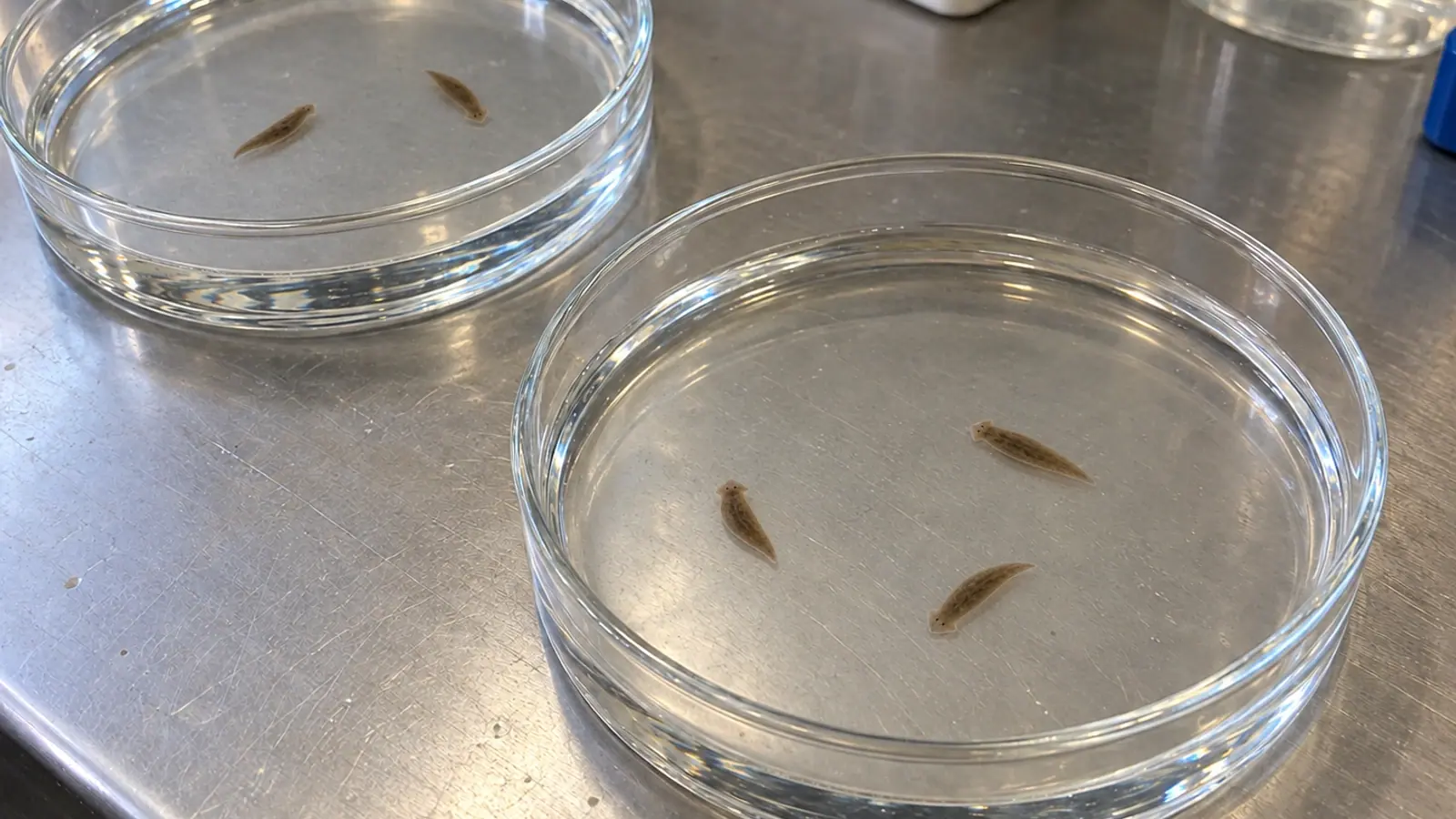
Clonal planarians: two substrains behind the same name
A clonal strain name does not guarantee genetic uniformity among all descendants. An open 2025 study identifies two substrains within CIW 4 Schmidtea mediterranea planarians. Differences in reproduction and somatic diversity make lineage history relevant to how laboratory results are described and compared.
- Content type
- Scientific news
- Sector
- Research facilities
- Animal group
- Corals and invertebrates
- Keywords
- ReproductionTemperatureStress
CIW4 does not fully describe an experimental population
The planarian Schmidtea mediterranea can produce descendants without sexual reproduction. Its asexual CIW4 strain is widely used in research, including studies of regeneration. A shared clonal origin is easily mistaken for permanent genetic identity among all descendants. Simon Kershenbaum and colleagues question that assumption in their 2025 iScience study.
The researchers followed four founder-derived lineages, named P, H, F and S, over two and a half years. They combined reproductive and survival observations with genomic analysis. Two groups emerged: P and H on one side, F and S on the other. They describe PH and FS substrains within material previously regarded as homogeneous.
This is a different finding from general advice on maintaining planarian cultures. The CIW4 label can cover distinct genetic histories and reproductive patterns. The result does not mean every laboratory colony can immediately be assigned to one of two known categories. It first raises a question about how fully the population used in an experiment has been described.
Genetic and observable differences occur together
Under the conditions studied, PH lineages divided more frequently, produced more offspring and had lower mortality than FS lineages. These phenotypic differences were followed over a long period, but they arose from a limited set of founding lineages. Many descendants do not become many independent founders or many laboratories independently reproducing the result.
Genomic profiles also distinguished the groups. The authors describe differences in runs of homozygosity, regions where both genetic copies carry the same detected variants. Heterozygosity instead describes different variants at a location in a diploid genome. Understanding these terms helps explain the comparison without attributing every feature of a substrain to one presumed causal mutation.
An association between genetic profiles and reproductive performance does not establish a single individual cause. Lineage history and other biological differences may contribute. PH should not be read as a health certificate, and FS is not a disease diagnosis. The categories describe research groups in this study, rather than a recommendation to replace a colony.
Variation also occurs within an individual
The paper separates differences between animals from somatic diversity within an organism. A planarian’s cells need not all carry exactly the same variants. The authors detected greater somatic diversity in the FS group. External observations of a worm’s size or colour cannot substitute for this level of analysis.
Planarians have stem cells called neoblasts, which support tissue renewal and regeneration. In an animal that reproduces by dividing, the partitioning of different cell lineages can contribute to the genetic history of its offspring. The researchers propose that division can act as a bottleneck by distributing some of that diversity between descendants.
This remains a mechanistic explanation discussed in the paper, rather than a universally demonstrated rule. The authors consider alternatives and limitations in detecting variants. A newly detected variant did not necessarily arise when it became measurable: it may have existed earlier at a low frequency. The study therefore does not provide a simple clock for dating every mutation in a lineage.
Make lineage history and sampling units explicit
For a laboratory, the first implication is traceability. Colony origin, separation into lineages, observation periods and husbandry conditions help describe the population behind a strain name. Temperature, feeding history and events that may cause stress remain useful context. They cannot replace genetic characterisation or prove which substrain an animal belongs to.
The unit of comparison also needs to be clear. Descendants from the same founder share a history; treating them as independent origins can overstate replication. Reports should distinguish founders, lineages, analysed animals and repeated observations. This makes the reach of a conclusion easier to judge when results are compared with another colony.
Important limitations remain. Genomic sampling did not follow every unchanged individual through all generations. The authors discuss how sequencing depth and somatic diversity affect detection. Their comparisons with other published datasets suggest that different substrains circulate in research, but do not provide a comprehensive inventory of laboratories or suppliers.
The practical record also needs to show what has not been established. A colony with an undocumented history cannot be assigned a genotype from its reproductive rate alone. A change in that rate may have several explanations, including conditions that need checking independently. Recording uncertainty is more informative than adding a confident substrain label without supporting analysis.
Add a lineage history to the strain name
Keep the lineage history alongside the CIW4 name so the experimental population can be identified more precisely. The study does not diminish the model’s value; it identifies a source of variation worth reporting. It does not justify modifying colonies in pursuit of assumed uniformity or explaining every unexpected result by genetics before other causes have been assessed.
Vetofish can help connect husbandry records, biological observations and experimental questions through its advisory and support service. Our work with research facilities supports usable descriptions of aquatic populations and study conditions. This can prepare discussions with genetics specialists while keeping responsibility for genetic analysis with the relevant experts.


